
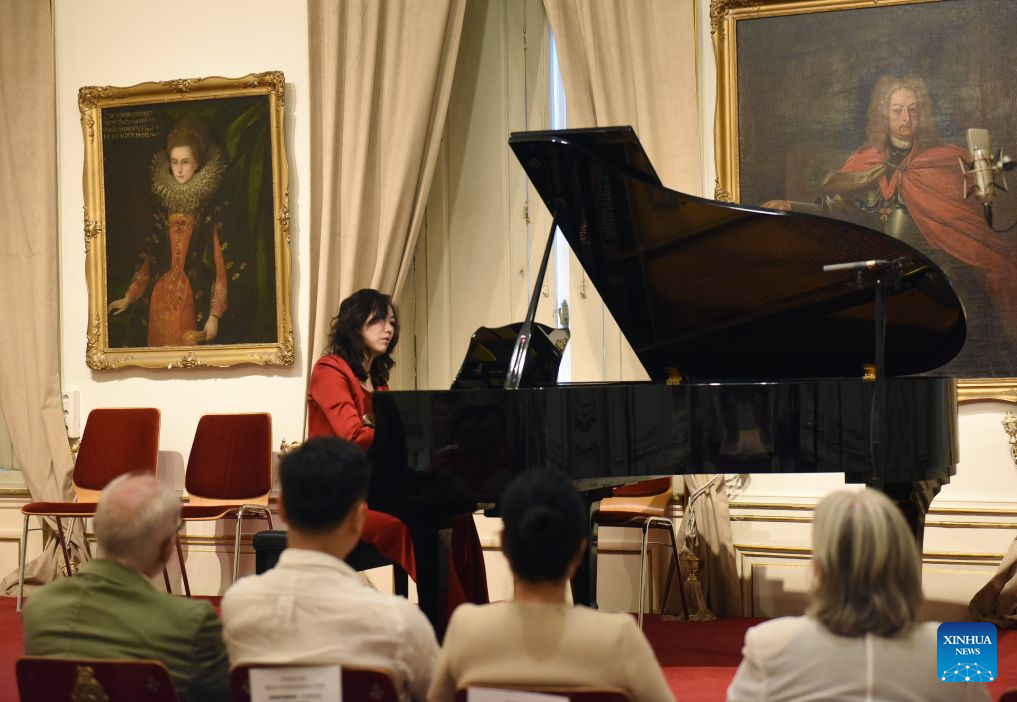
Chinese pianist Xie Jingxian, an associate professor at the Shanghai Conservatory of Music, performs during a Chinese piano recital in Vienna, Austria, July 23, 2026. (Xinhua/He Canling)
VIENNA, July 24 (Xinhua) -- "Beethoven's Moonlight Sonata unfolds a tranquil, brooding atmosphere through rich harmonies, while the Chinese classic Colorful Clouds Chasing the Moon paints an elegant Eastern landscape with flowing pentatonic melodies. Both pieces depict moonlight, yet they speak entirely different musical languages."
With these opening remarks by the host, the audience at the classical music hall in Vienna's historic Palais Palffy embarked on a musical journey into the world of Chinese piano music.
The recital, held on Wednesday evening as part of the Vienna Golden July Music Festival, offered something rarely seen on Vienna's classical music stage -- an entire concert dedicated to Chinese piano works.
While Chinese compositions have occasionally appeared as individual pieces at local music festivals, full-length programs devoted exclusively to Chinese repertoire remain uncommon, drawing many local music lovers eager for a fresh listening experience.
Half an hour before the performance began, the concert hall was already filled with audience members. A bilingual digital program introduced each composition with detailed notes on its historical background and cultural origins, prompting many attendees to pause, discuss and photograph the program before taking their seats.
Structured around four thematic chapters -- Clouds, Moon and Landscapes, Folk Songs from North and South, the Spirit of Chinese Literati, and Contemporary Voices -- the concert unfolded as both a musical performance and a cultural dialogue.
Chinese pianist Xie Jingxian, an associate professor at the Shanghai Conservatory of Music, combined live performance with English-language commentary, guiding audiences through the aesthetics and cultural philosophy embedded in Chinese piano music.
"Instead of building emotional intensity through dense harmonies, Chinese music places greater emphasis on lyrical melodies," Xie explained during the recital. "It resembles the flowing brushstrokes of traditional Chinese ink paintings -- seemingly understated, yet carrying remarkable expressive power."
From the lyrical Colorful Clouds Chasing the Moon and the folk-inspired Liuyang River to Poet Li Bai and contemporary compositions, each piece was accompanied by accessible explanations that helped listeners appreciate the expressive beauty of China's pentatonic musical tradition.
Throughout the 90-minute concert, the audience listened attentively, immersed in melodies unfamiliar yet captivating.
The evening reached its climax when Chinese and international musicians joined hands to perform Ode to the Red Flag. Latin Grammy nominee and pianist Adonis Gonzalez infused the well-known Chinese composition with jazz harmonies, bringing a fresh interpretation to the classic melody.
"Chinese music has a lot of colors and much more imagination. I think it's freer," Gonzalez told Xinhua after the concert, adding that he believes Chinese music deserves a much stronger presence on the international stage.
For many audience members, the recital offered their first comprehensive encounter with Chinese piano music.
"I had only heard one or two short Chinese pieces before," said Marx, a student at the Music and Arts University of the City of Vienna. "Tonight I finally learned the stories behind the music. The melodies are incredibly beautiful and unlike anything I had experienced before."
After the performance, many attendees gathered around the stage to speak with the musicians, expressing hopes that more Chinese piano recitals will be presented in Vienna.
Among them was Daniela Egg, director of the Franz Schubert Conservatory, who said Vienna's concert stages have long been dominated by the Western classical canon, and European audiences' understanding of Chinese music remains rather fragmented. "I think for Europe, people must go to more of this kind of concerts. This is another hearing for us and another feeling."
Speaking with Xinhua after the performance, Xie said that China has produced a wealth of outstanding piano works over the past century that deserve wider international recognition.
"The combination of performance and commentary helps bridge cultural differences," she said. "Performing alongside musicians from different countries has convinced me once again that music transcends national boundaries. Artists from diverse cultural backgrounds can always find resonance through the same melody."
In recent years, cultural exchanges between China and Austria have continued to deepen through exhibitions, academic cooperation and music education, creating new platforms for dialogue between the two sides. ■