
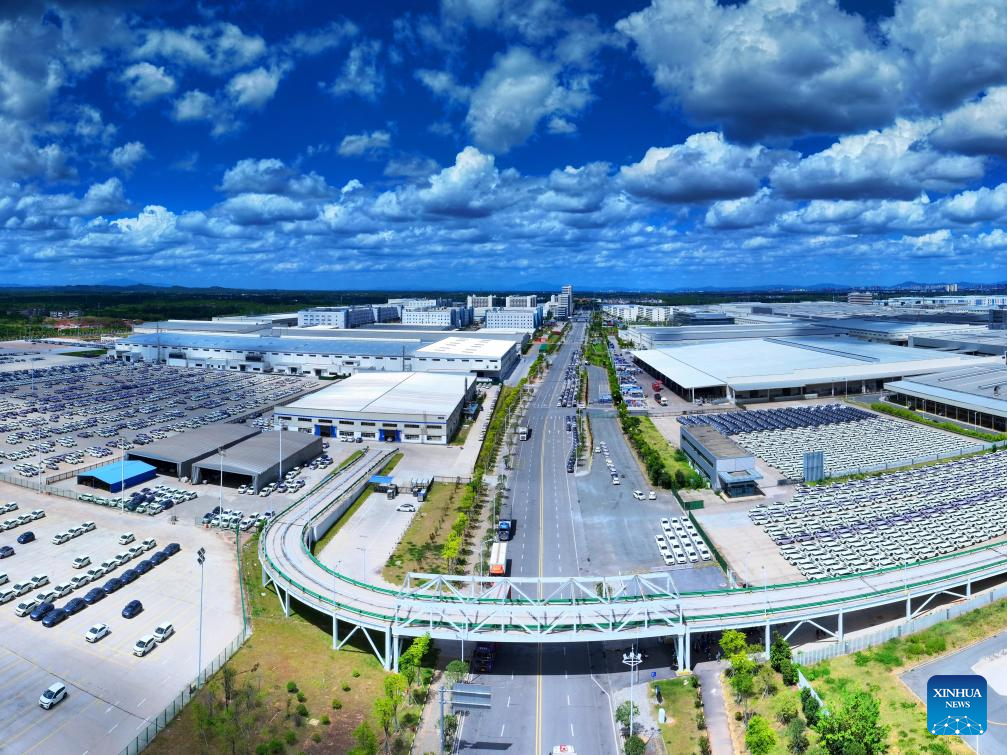
This photo taken on Jan. 14, 2026 shows a view of the new energy vehicle industrial park in Fuzhou, east China's Jiangxi Province.(Photo by Chen Qiang/Xinhua)
LONDON/NANCHANG, April 27 (Xinhua) -- A BYD Dolphin rolled slowly through Stratford-upon-Avon, the hometown of William Shakespeare, passing the Peony Pavilion, a Chinese-style garden structure in the town center with red pillars and upturned eaves glowing in the afternoon sun.
More than 400 years ago, Chinese playwright Tang Xianzu's The Peony Pavilion and Shakespeare's Romeo and Juliet appeared in roughly the same era. Today, the Chinese electric vehicle (EV) made in Tang's hometown of Fuzhou in east China's Jiangxi province has arrived in Shakespeare's town.
The scene brought together two places linked first by culture and now increasingly by industry. A broader story has been unfolded on cultural exchange extended into modern manufacturing and low-carbon cooperation between China and Britain.
The Dolphin in Stratford-upon-Avon rolled off a BYD production line in Fuzhou where theater has become one of the bridges to the outside world.
The seventh Tang Xianzu International Theatre Exchange Month which was held recently in Fuzhou drew more than 1,000 scholars, theatre professionals and enthusiasts from China and abroad.
Productions including English-language Peony Pavilion, A Midsummer Night's Dream in Nanke, and Tang and Shakespeare explored new possibilities for dialogue between Eastern and Western dramatic traditions.
Michael Dobson, director of the Shakespeare Institute at the University of Birmingham, brought an English-language version of The Peony Pavilion from Stratford-upon-Avon to Fuzhou. He said the production, with Chinese actors playing Du Liniang and Irish actors playing Liu Mengmei, was meant to help Tang's drama reach a wider audience. "We are presenting this Chinese play in the way we perform Shakespeare," he said.
As cultural ties deepen, industrial links have followed. In BYD's vehicle plant in Fuzhou, robotic arms move in steady rhythm as new energy vehicles come off the production line. As one of China's leading makers of new energy vehicles, BYD sold more than 4.6 million such vehicles worldwide in 2025, including more than 2.25 million battery electric vehicles, both topping global rankings.
For inland Fuzhou, a new logistics channel has been opened. The Fuzhou International Land Port officially started operation in late January this year, activating a corridor linking inland production with rail lines, seaports and overseas markets.
Britain, for its part, has taken up measures for energy transition, which has provided a broad prospect for the new energy vehicles.
George Cowcher, deputy leader of Stratford-on-Avon District Council, said, "Stratford-on-Avon has always been a tourist destination, really, for the last 150 years." He added that the town had long attracted overseas visitors and, in more recent years, had also seen significant numbers of tourists from China.
For Cowcher, the town's challenge is to remain both historic and alive. He said, "This town has a population of 30,000 people itself, and it has to operate as a town."
The balance between heritage and daily life also helps explain why new forms of cooperation can take root here. Britain's green transition is opening fresh space for electric vehicles and related industries.
At the University of Warwick, a multi-million-pound charging network project has been completed, with 142 charging points installed across the campus. Near Coventry, not far from Shakespeare's home county, a 2.5-billion-pound investment plan is under way at the former Coventry Airport site, which is expected to become one of Britain's largest battery manufacturing bases.
The BYD Dolphin's owner, Luke Collins, chose the Chinese-made new energy vehicle in late 2024. He said it met his needs for daily commuting and short-distance travel, and he was satisfied with both the charging cost and the driving experience.
"Now you can also see electric buses in London," he said. "I hope British and Chinese companies can continue to deepen cooperation in green technology."
In Fuzhou, BYD is also looking ahead. Deng Peng, who manages BYD's business in Jiangxi, said the company plans to turn its local production base into a zero-carbon industrial park through technological innovation and better energy management. ■
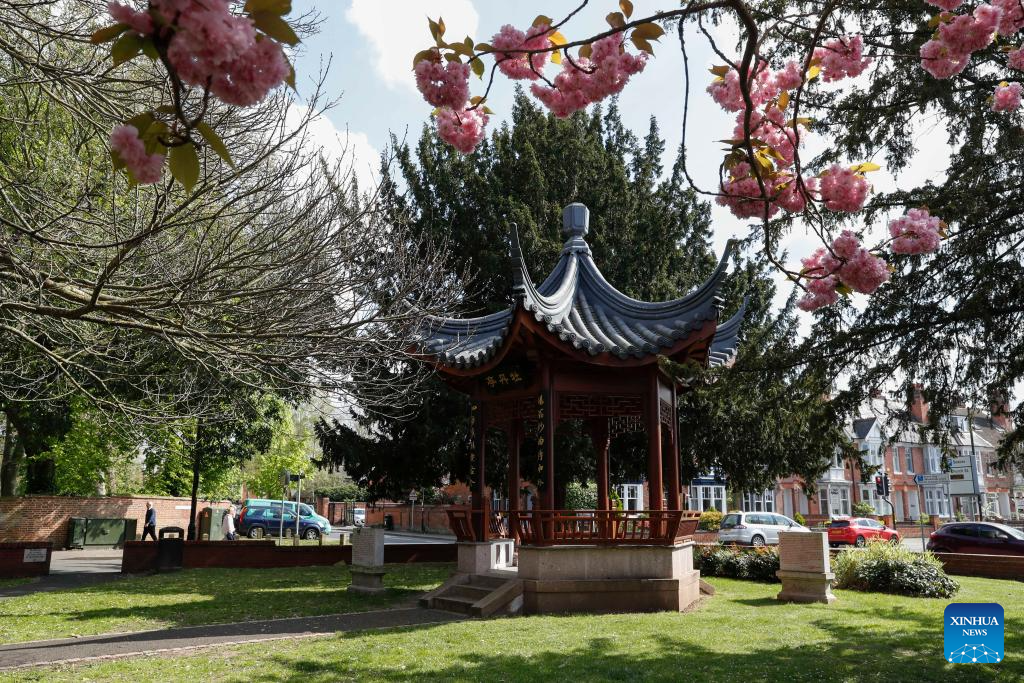
This file photo taken on April 20, 2022 shows the Peony Pavilion in Stratford-upon-Avon, Britain.(Xinhua/Han Yan)