
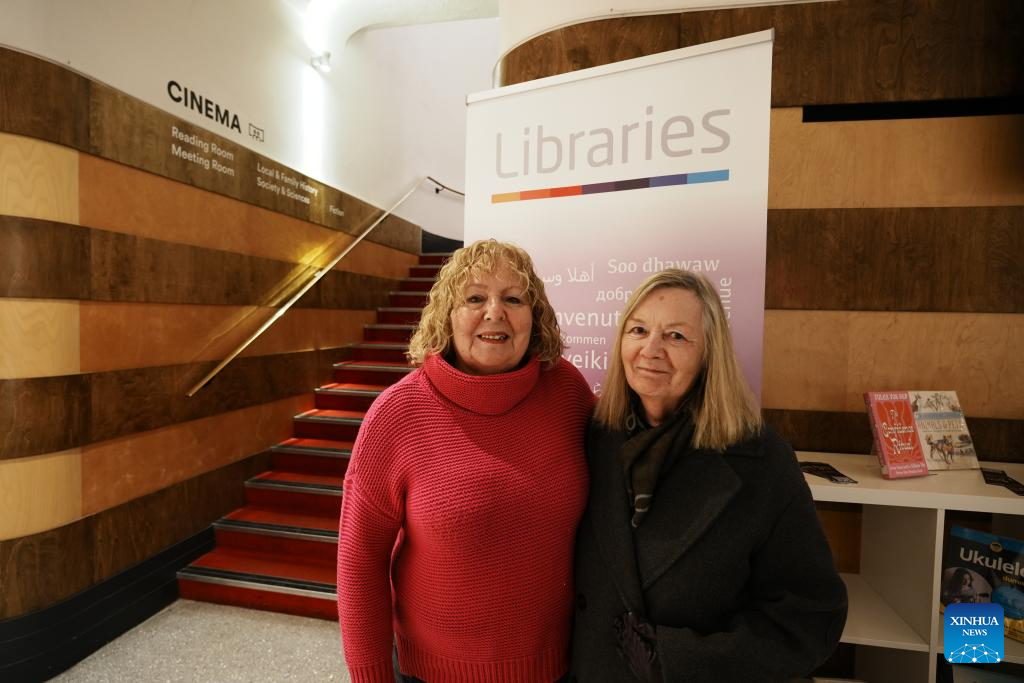
Susan Barsky Reid (L) and her friend pose for a photo after a "Death Cafe" event in Chester, Britain, on Jan. 5, 2026. (Xinhua/Zhao Jiasong)
by Xinhua writer Zhao Jiasong
CHESTER, Britain, April 6 (Xinhua) -- As dusk fell over Chester in northwestern England, fewer than 10 people gathered around a table, sharing slices of cake baked by the host herself and talking, with unexpected ease, about life and death.
"We're here to remember that life is short. That's why we have cake, and nice drinks and these conversations," Susan Barsky Reid, the host of the event called "Death Cafe," said in a soft, unhurried voice.
INSIDE DEATH CAFE
The idea behind Death Cafe can be traced back to Swiss sociologist Bernard Crettaz, whose "Cafe Mortel" gatherings inspired Reid's son, Jon Underwood, to develop the Death Cafe model in Britain in 2011 and launch the Death Cafe website.
The social initiative in which people, often strangers, gather over tea and cake to discuss death in an open, group-directed conversation aimed at raising awareness of mortality and helping people make the most of their finite lives.
Reid told Xinhua that Death Cafe offers practical guidance on its website for those who want to host their own events. Through a free affiliate program, organizers who agree to its principles can use the Death Cafe name, post their events on the official website.
The guidance covers the practical basics of hosting a Death Cafe, including venue, refreshments, publicity and safety. It says the events should be non-profit, respectful and confidential, and should remain open discussions rather than counseling sessions.
Since Underwood died in 2017 from acute promyelocytic leukemia, his family and close collaborators have kept Death Cafe going.
According to the website, since its launch in 2011, Death Cafe has spread rapidly across Europe, North America, Australia and Asia, reaching 97 countries, with more than 23,000 events held worldwide.
Many of these gatherings are independently organized by local hosts who draw on the model, principles, and guidance established by the Death Cafe platform founded by Underwood and his collaborators.
A CONVERSATION SPREADING WORLDWIDE
Gail Rubin, a certified thanatologist and death educator based in Albuquerque, New Mexico, first connected with Underwood in early 2012, when the idea was only beginning to travel beyond Britain. Inspired by the format and ground rules he had shared, Rubin went on to host one of the earliest Death Cafes in the United States in September 2012.
Rubin said she was drawn to the fact that Death Cafe was neither a lecture nor a counseling session, but an open, respectful conversation. Rather than splitting people into small groups, she chose to seat participants in one large circle so that everyone could engage in the same discussion.
"I think there is a need for people to talk about death and dying," she told Xinhua in a video interview. "In most cultures, it is frowned upon, so the opportunity to do it is really exciting for people."
Over time, Rubin turned the gathering into a monthly discussion in Albuquerque. In recent years, Rubin has expanded those conversations through "Mortality Movie Nights," where films are screened and discussed for their themes of death, grief and remembrance. Rubin said these events have helped bring in new audiences, including more men, as some feel more comfortable coming first for a film and then staying for the discussion.
Rubin said she has tried to help people engage earlier with questions of dying and bereavement, rather than waiting until a crisis leaves families little time to prepare. That effort has taken different forms, from Death Cafe gatherings and film-based discussions to a forthcoming book, "98.6 Mortality Movies to See Before You Die."
For her, all of it grows out of the same belief behind Death Cafe. "The work is about helping people face mortality before loss forces the conversation upon them," she said.
As the idea spreads, Death Cafe has quietly taken root in many countries.
In China, Shi Hui, founder of Shanghai-based funeral service company Baiduren -- which means "ferryman" in Chinese -- and manager of the city's first Death Cafe, said the venue opened in late 2024 in Shanghai's Jing'an District. Initially conceived as a space for grief healing for families Baiduren had served, it drew far wider attention after media coverage sent it to the top of local trending searches on social media.
Shi said the attention soon spread beyond Shanghai, bringing visitors from other cities who came to tell their own stories. While no formal headcount has been kept, she said the number of participants has already reached into the hundreds.
Shi said most death-cafe-style events in China currently take the form of one-off salons or discussions without a permanent venue. In addition to offering a relatively fixed and comfortable space for regular gatherings, Baiduren's cafe draws on real-life experience and uses original tools such as a "Restart Life" card deck designed to help people reflect on life in a lighter, more accessible way.
For Shi, the larger goal is public education. "The purpose is not to make death feel frightening, but to help people accept that life has an end while still learning to value and enjoy it," she added.
Liu Yining is among a younger generation in China that is trying to make conversations about death more public and practical. After graduating in 2024 with a master's degree in psychology from Goldsmiths, University of London, she returned to Beijing and began volunteering in the palliative care ward of a hospital. There, she took part in hospital-based activities such as a Death Cafe for death doulas and volunteers and a "Life Milk Tea Shop," the latter focusing more on life planning and reflection.
She said the training she received at the hospital, together with her volunteer work there, reshaped her understanding of end-of-life care and of what such conversations can offer.
Liu said many people in modern society have little or no prior understanding of palliative care or death education, and often do not know where to seek such information. That, she said, has convinced her that conversations about death should not remain confined to hospital wards. "There also needs to be a safe space in society where people can talk about these issues and have their voices heard."
She now organizes and facilitates Death Cafe gatherings at a non-profit venue in Beijing, reaching participants through Chinese social media platforms such as Rednote. Using her academic background in psychology, she said she tries to make each session more reflective and emotionally supportive, so that it offers not just conversation, but also healing.
THE LEGACY LIVES ON
In an effort to carry on her son's legacy, Reid decided late last year to begin hosting a Death Cafe once a month in Chester, the city where she lives. The gatherings are now held on the first Monday of each month at Storyhouse, a cultural venue in the city.
"It makes me feel closer to Jon," Reid said. "If people who are grieving, or frightened of death, realize there is something like this near them and find comfort in it, then that is hugely valuable."
Reid said people come to Death Cafe for different reasons. "Unless we talk about death, we don't know how to support one another when it comes," she said.
"After my mum died, and she had a horrible death, it really raised my awareness of end-of-life care and what happens at the end of life," said Jane, a participant in a recent event who gave only her first name. She said she came in search of conversation, reflection and a space to speak more openly about death.
Reid said gatherings like these can not erase grief, but they might help ease it. "That raw grief you're feeling now probably does ease with time ... It may get less sharp, and I don't think you ever get over it. I think you learn to live with it," she said, suggesting that what Death Cafe makes possible is not closure, but a shared way of living with loss.
Following Underwood's death, the Death Cafe website received numerous tributes, one of which described him as "a warm, gentle and great man" whose vision inspired many people to engage more openly with death as part of life.
At the end of each Death Cafe event, Reid would always play some of her son's favorite pieces of music for the participants.
Asked what she would most want to say to her son, Reid replied without hesitation.
"I miss you." ■