
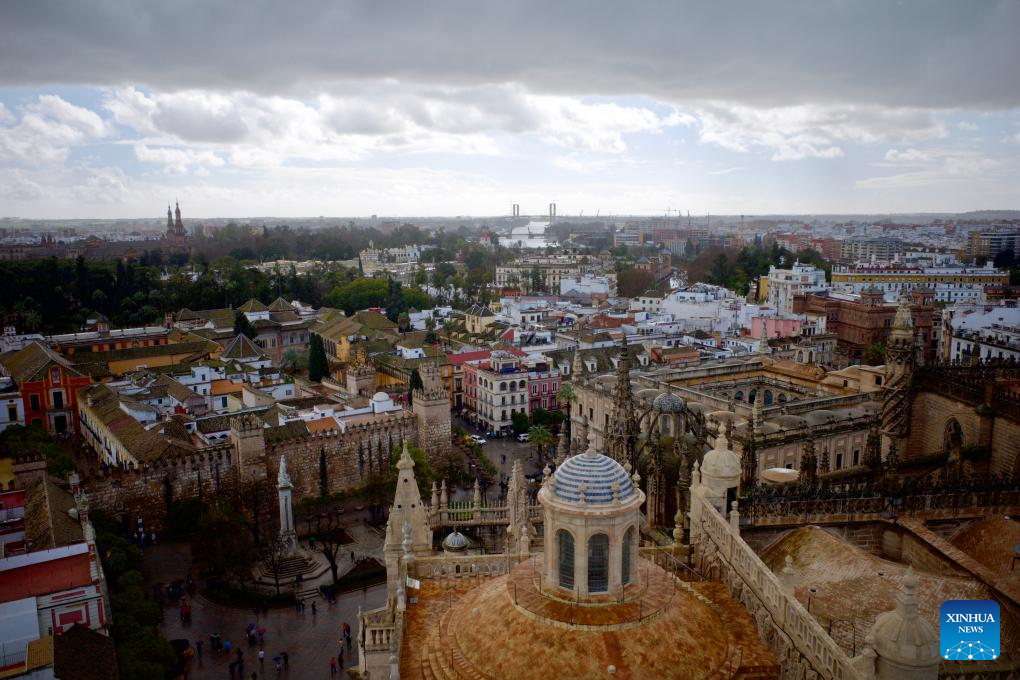
This photo taken on Feb. 6, 2026 shows clouds above Seville, Spain. A wave of extreme weather has swept across Europe in recent weeks, as powerful Atlantic storms battered southern countries with flooding, while Arctic cold gripped parts of central and northern Europe, leaving dozens dead, thousands displaced and causing widespread disruption. In Spain, torrential rains brought by storm Leonardo have forced the evacuation of 3,000-5,000 people across the southern part of the country. (Xinhua/Liu Mengqi)
BRUSSELS, Feb. 9 (Xinhua) -- A wave of extreme weather has swept across Europe in recent weeks, as powerful Atlantic storms battered southern countries with flooding, while Arctic cold gripped parts of central and northern Europe, leaving dozens dead, thousands displaced and causing widespread disruption.
A series of powerful Atlantic storm systems has raged across Portugal in recent weeks, leaving at least 14 people dead and hundreds more injured or displaced, and causing widespread damage to infrastructure.
The storms, dubbed Kristin and Leonardo by meteorological services, triggered flooding, landslides, power outages, and transport disruptions across large parts of the country, particularly in central Portugal.
In response, the government announced a support package worth up to 2.5 billion euros (2.95 billion U.S. dollars) for affected households, companies and local authorities.
In Spain, torrential rains brought by storm Leonardo have forced the evacuation of 3,000-5,000 people across the southern part of the country.
The storm has caused rivers to overflow across parts of Andalusia and Extremadura, leading to school closures, widespread transport disruption and the suspension of most rail services.
According to the Portuguese Institute for Sea and Atmosphere (IPMA), the extreme weather was caused by a rapid succession of Atlantic low-pressure systems combined with an unusually weak and displaced Azores High, the semi-permanent anticyclone that often shields Portugal from winter storms.
Angela Lourenco, a meteorologist at IPMA, said that such events can produce "episodes of extreme wind, often brief but highly destructive."
Climate scientist Pedro Matos Soares, a professor at the University of Lisbon, said that sequences of storms like those seen this winter are relatively rare but not unprecedented in Portugal's transitional climate between subtropical and mid-latitude zones.
While Southern Europe has seen consecutive rounds of heavy rainfall and stormy weather, many parts of central and northern Europe have been plunged into severe cold, heavy snowfall and freezing rain.
In Germany, extreme winter weather caused numerous traffic accidents across the northeastern part of the country.
Police have reported multiple accidents on icy roads, including several on motorways around Berlin, where sections were temporarily closed. Dozens of people were injured, and an elderly woman was killed in a collision in the state of Brandenburg.
Icy conditions also led to wider disruptions. Public transport services were suspended in some cities, schools were closed in parts of northwest Germany, and rail services between Berlin and Hanover were affected.
In Romania, red warnings have been issued for cold waves, snowfall and freezing rain, with a temperature of minus 15 degrees Celsius and a snow cover of 15 cm.
Along the Baltic coast, Estonia and Latvia have experienced one of the coldest winters in years. In Estonia, some islands are facing the worst ice conditions in a decade, halting ferries and forcing residents to rely on hovercraft or all-terrain vehicles for deliveries of essentials.
Latvia was hit with the severest cold spell in 12 years this weekend, as a weather station in Latvia's southeastern city of Daugavpils recorded a temperature of -32 degrees Celsius.
According to the World Meteorological Organization, a major sudden stratospheric warming event over the Arctic caused significant weakening of the polar vortex, setting the scene for Arctic air intrusion into northern Europe and North America.
The polar vortex is a large, persistent area of low-pressure, cold, swirling air located in the stratosphere near the Earth's poles. During winter, it strengthens, acting as a barrier that keeps cold Arctic air contained.
However, when weakened or disrupted by factors like sudden stratospheric warming, the vortex can become unstable, allowing the frigid air to spill into mid-latitude regions, such as Europe, the United States and Asia. ■