

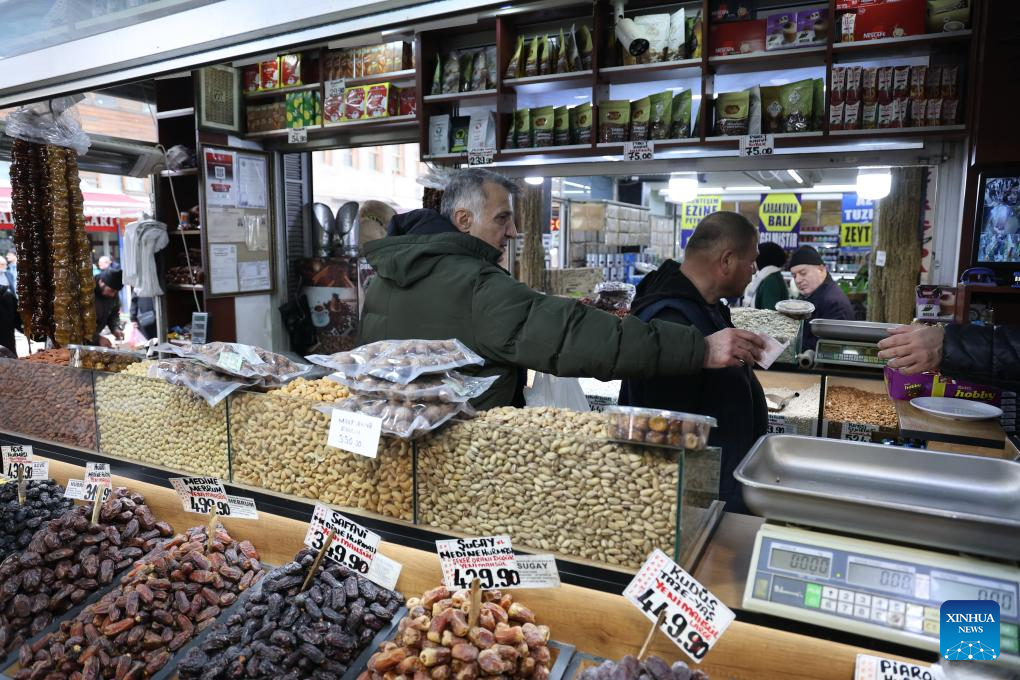
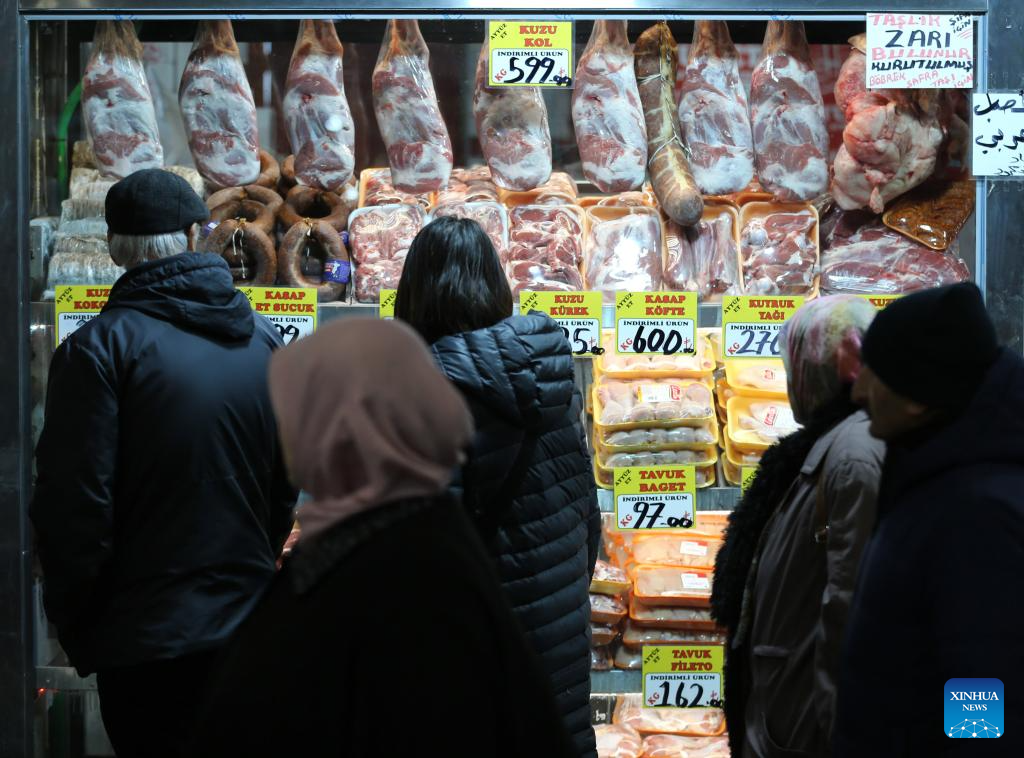
People shop at a local market in Ankara, Türkiye, Feb. 3, 2026. Türkiye's inflation trajectory took an upward turn in January, with consumer prices rising faster than expected, fueling concerns that the cost-of-living squeeze remains persistent despite a gradual easing in annual inflation.
Data released on Tuesday by the Turkish Statistical Institute showed consumer prices increased 4.84 percent month-on-month in January, exceeding market expectations. The increase was mainly driven by higher food and non-alcoholic beverage prices, which climbed 6.59 percent over the month. (Mustafa Kaya/Handout via Xinhua)
ANKARA, Feb. 3 (Xinhua) -- Türkiye's inflation trajectory took an upward turn in January, with consumer prices rising faster than expected, fueling concerns that the cost-of-living squeeze remains persistent despite a gradual easing in annual inflation.
Data released on Tuesday by the Turkish Statistical Institute showed consumer prices increased 4.84 percent month-on-month in January, exceeding market expectations. The increase was mainly driven by higher food and non-alcoholic beverage prices, which climbed 6.59 percent over the month.
On an annual basis, inflation eased slightly to 30.65 percent, down from 30.89 percent in December, a modest decline as households continued to grapple with high prices.
Economists said January's inflation reflected a familiar pattern, with the annual minimum wage hike and price adjustments introduced at the start of the year feeding into costs across food, services and utilities.
"I buy less meat now and compare prices at several shops. Even then, my credit card bill keeps growing," said Lutfiye Sanli, a 42-year-old office worker.
For many households, the strain stems not only from current price increases but from the cumulative impact of past inflation, which has significantly driven up the cost of everyday goods.
That pressure is reflected in the Financial Well-Being Monitor 2025, published in January by Istanbul-based research firm OWL Intelligence.
The nationwide survey, conducted in the final quarter of 2025, found that more than 50 percent of households in Türkiye carried some form of debt, relying on borrowing to manage ongoing cost pressures, including informal loans from relatives and friends.
For pensioners, income increases have failed to keep pace with rising living costs.
"My pension increased at the start of the year, but electricity, rent and food rose faster," said Mehmet Kaya, a 63-year-old retiree. "At the end of the month, I still need help from my children to cover the essentials."
"Disinflation does not mean prices are falling; it means they are rising more slowly," said Senol Babuscu, a finance professor at Baskent University in Ankara, noting that households are still facing a much higher price level than two or three years ago.
While tight monetary policy has helped curb inflation over time, he added, high interest rates designed to anchor expectations have increased borrowing costs and pushed many households to depend on credit cards to smooth consumption.
"Relying on minimum payments risks locking households into a debt spiral," he warned, adding that even if annual inflation continues to slow, the legacy of high prices and accumulated debt will take time to unwind.
Looking ahead, analysts caution that maintaining disinflation will be crucial to rebuilding consumer trust, which has been shaken by several years of cost-of-living pressures. ■
People shop at a local market in Ankara, Türkiye, Feb. 3, 2026. Türkiye's inflation trajectory took an upward turn in January, with consumer prices rising faster than expected, fueling concerns that the cost-of-living squeeze remains persistent despite a gradual easing in annual inflation.
Data released on Tuesday by the Turkish Statistical Institute showed consumer prices increased 4.84 percent month-on-month in January, exceeding market expectations. The increase was mainly driven by higher food and non-alcoholic beverage prices, which climbed 6.59 percent over the month. (Mustafa Kaya/Handout via Xinhua)
People shop at a local market in Ankara, Türkiye, Feb. 3, 2026. Türkiye's inflation trajectory took an upward turn in January, with consumer prices rising faster than expected, fueling concerns that the cost-of-living squeeze remains persistent despite a gradual easing in annual inflation.
Data released on Tuesday by the Turkish Statistical Institute showed consumer prices increased 4.84 percent month-on-month in January, exceeding market expectations. The increase was mainly driven by higher food and non-alcoholic beverage prices, which climbed 6.59 percent over the month. (Mustafa Kaya/Handout via Xinhua)