
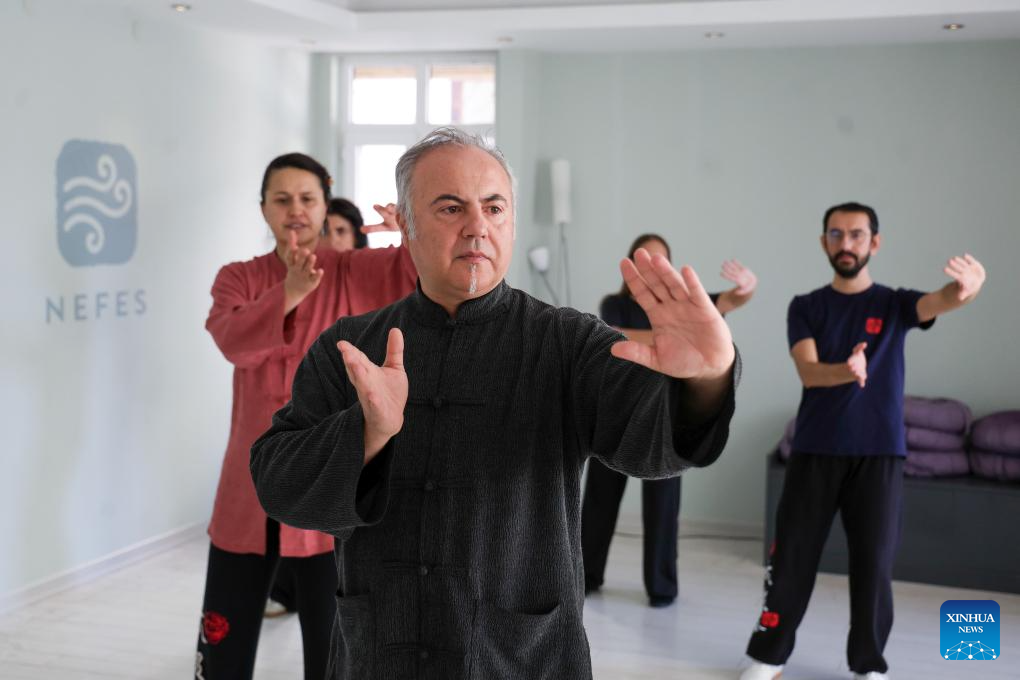
Numan Pekgoz (front), a Turkish Tai Chi master, demonstrates Tai Chi to students at a studio in Ankara, Türkiye, Jan. 17, 2026. (Photo by Mustafa Kaya/Xinhua)
by Burak Akinci
ANKARA, Jan. 21 (Xinhua) -- A growing number of urban Turks are taking up Tai Chi, with practitioners and instructors citing stress relief and rising interest in Chinese culture as key drivers in Türkiye's major cities.
Once a little-known discipline in the country, the ancient Chinese martial art is increasingly attracting office workers, professionals and young urbanites seeking physical balance, mental calm and a deeper cultural connection, according to a Turkish Tai Chi master with three decades of experience.
"People who already feel close to Chinese culture are naturally more interested and more enthusiastic," said Numan Pekgoz, a Tai Chi master in an interview with Xinhua at his studio in Ankara, where students practice slow, flowing movements in silence.
"Likewise, people who have no prior knowledge of Tai Chi gradually come to know the beauty and elements of Chinese culture more closely over time," he pointed out.
As students continue their practice, Pekgoz said their curiosity often expands beyond physical exercise.
"They start watching films related to China, reading books, and becoming more engaged with Chinese elements," he noted.
Interest in Tai Chi has risen noticeably in Türkiye, particularly in large cities such as Ankara and Istanbul, Pekgoz said.
"There has been a visible increase in Türkiye, especially over the last 10 years, and particularly over the last five years," he noted. "It is possible to link this partly to social media. We can clearly say that there is a visible interest."
Social media platforms have made Chinese philosophy, wellness practices and traditional arts more accessible, helping Tai Chi reach audiences who may never have encountered it before.
Pekgoz said the growing interest is not limited to physical well-being but also reflects cultural exchange between the two countries.
Tai Chi can definitely serve as a cultural bridge between China and Türkiye, he said.
"In the near future, the need has arisen for us to organize a visit to China with our students, and we have plans in that direction," the master said.
Pekgoz said the appeal of Tai Chi in Türkiye is also rooted in historical and philosophical connections between the two civilizations.
"There are very strong ties between China and Türkiye," he said. "The philosophical interaction between ancient cultures is very significant. Some of the most important roots of our own culture actually originate from Central Asia," Pekgoz emphasized.
For Pekgoz, China is a large country, and its different philosophical traditions can be seen across various regions.
"It is also possible to observe the impact of those currents within our own culture," he pointed out.
In a fast-paced urban environment where instant results are often expected, Pekgoz said Tai Chi appeals to people who value patience and long-term commitment.
"At a time when we are accustomed to obtaining everything very easily, there are people who have begun to enjoy the act of making an effort to achieve something," according to Pekgoz.
Beyond its cultural and philosophical dimensions, Tai Chi is increasingly viewed as a response to the psychological challenges of modern urban life.
As cities grow larger and social structures become more fragmented, Pekgoz said many individuals experience new forms of stress and isolation.
"In city life, our lives are becoming increasingly individualized, and as this happens, problems that did not exist before can begin to emerge," he said, insisting on the need to restore the harmony between humanity and nature.
"Tai Chi is not just an exercise art. It should also be seen as a practice that mentally relaxes the body," thus improving human health with scientifically proven benefits and fostering cross-cultural understanding, Pekgoz added. ■
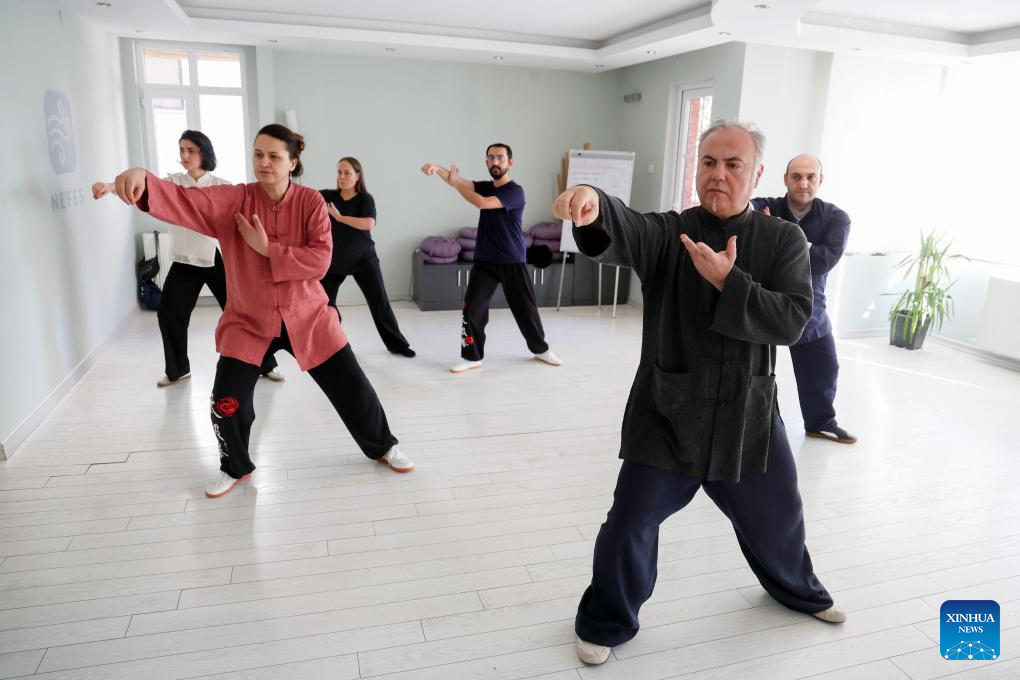
Tai Chi masters and enthusiasts practise at a studio in Ankara, Türkiye, Jan. 17, 2026. (Photo by Mustafa Kaya/Xinhua)
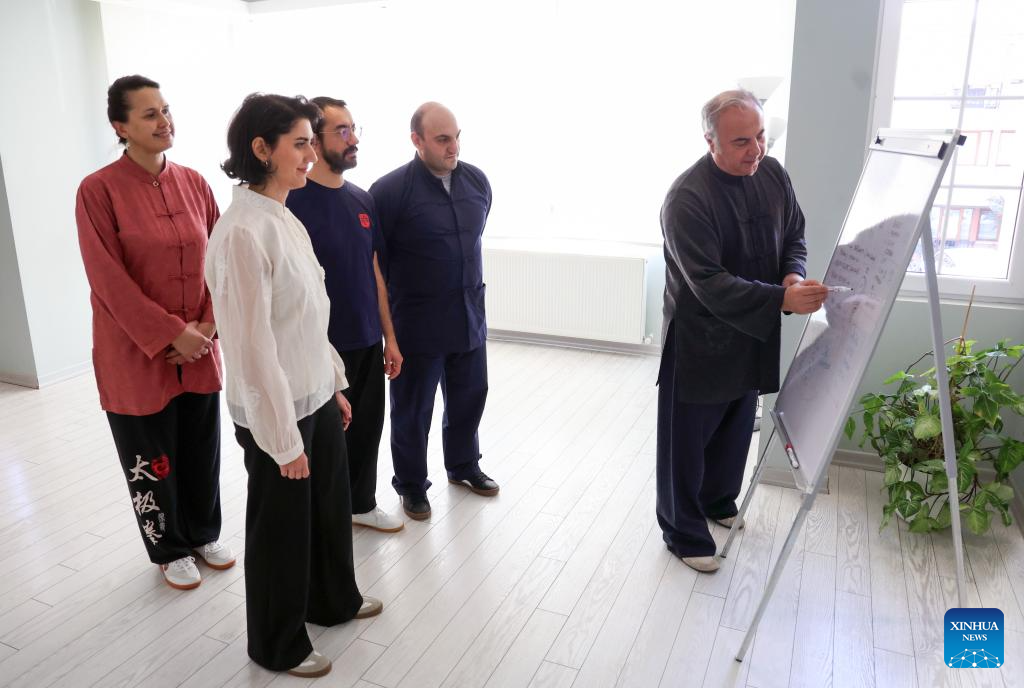
Numan Pekgoz (1st R), a Turkish Tai Chi master, instructs students at a studio in Ankara, Türkiye, Jan. 17, 2026. (Photo by Mustafa Kaya/Xinhua)