
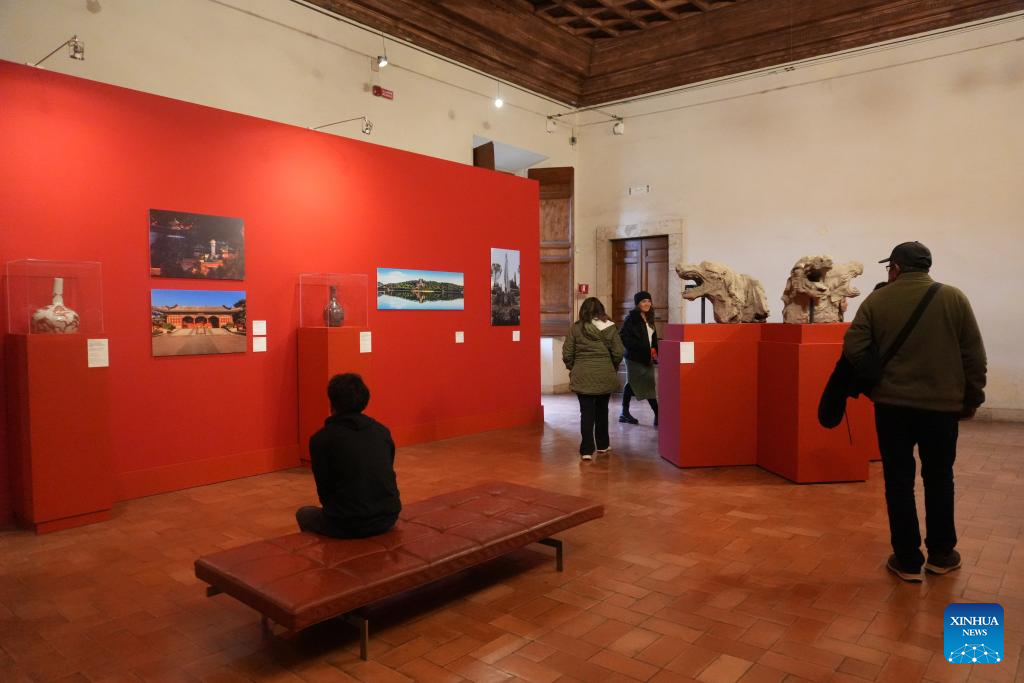
People visit the exhibition "Harmony Between Humanity and Nature: The Summer Palace at Villa d'Este" at Villa d'Este in Tivoli, Italy, on Dec. 16, 2025. The joint exhibition opened on Dec. 3 at Villa d'Este near Rome and will run until April 5, 2026. It marks the first collaborative exhibition since the Summer Palace and Villa d'Este signed a China-Italy World Heritage Site partnership agreement in November 2024. (Xinhua/Zhang Xinwen)
By Xinhua writers Zhang Xinwen, Zhang Huan
ROME, Dec. 21 (Xinhua) -- Partnerships between Chinese and Italian UNESCO World Heritage sites help deepen mutual understanding and hold great potential beyond co-hosting exhibitions, including sharing conservation experience and expanding academic exchanges, said Elisabetta Scungio, director of Italy's Villa d'Este, in a recent exclusive interview with Xinhua.
The joint exhibition "Harmony Between Humanity and Nature: The Summer Palace at Villa d'Este" opened on Dec. 3 at Villa d'Este near Rome and will run until April 5, 2026. It marks the first collaborative exhibition since the Summer Palace and Villa d'Este signed a China-Italy World Heritage Site partnership agreement in November 2024.
Scungio said at the opening ceremony that the exhibition was organized to celebrate the long-standing cooperation between the two countries' cultural heritage sites. Marking the 55th anniversary of the establishment of diplomatic relations between Italy and China, the exhibition also signals a new phase in cooperation between their world cultural heritage sites.
According to Scungio, during the curatorial process, both sides engaged in in-depth discussions and found that "water" plays a distinctive role in both gardens. At Villa d'Este, water is expressed through a rich array of fountains in diverse forms, while at the Summer Palace, Kunming Lake serves as the central feature of the landscape.
She said the exhibition therefore adopted the theme "Harmony Between Humanity and Nature," drawn from ancient Chinese philosophy, to highlight the shared ideal of harmonious coexistence between people and nature embodied by the two world-renowned gardens.
The exhibition features a large number of photographs provided by the Summer Palace, displayed in the Renaissance-style rooms of Villa d'Este. Selected related artifacts, on loan from another Italian museum, are presented alongside the photographs and correspond to themed sections such as nature, architecture, and the seasons.
Villa d'Este is one of the cultural and artistic achievements of the Renaissance and a classic example of an Italian terraced garden, with its main buildings set along a high ridge and gardens cascading down a steep hillside behind. It was inscribed on the UNESCO World Heritage List in 2001, while the Summer Palace was added to the list in 1998.
"The aim of the partnership is to share views on the management, preservation, and promotion of these two monuments," Scungio said.
"It is also valuable for broader relations between the two countries, because occasions like this help us understand each other on common ground. By working together, we learned so much about each other. Making comparisons is useful in understanding differences and finding meeting points," she added.
Since the exhibition opened, audience feedback has been enthusiastic, Scungio noted. She said the exhibition allows Italian visitors to enjoy a kind of "travel abroad" without leaving home, enhancing their understanding of Chinese history and culture.
Scungio also expressed expectations for future cooperation, noting that Chinese and Italian cultural heritage sites face many shared challenges, including managing overtourism, protecting gardens and water features, promoting sites while expanding their educational functions, and strengthening exchanges and training among staff. All of these areas, she said, can be further advanced within the framework of the partnership agreement. ■