
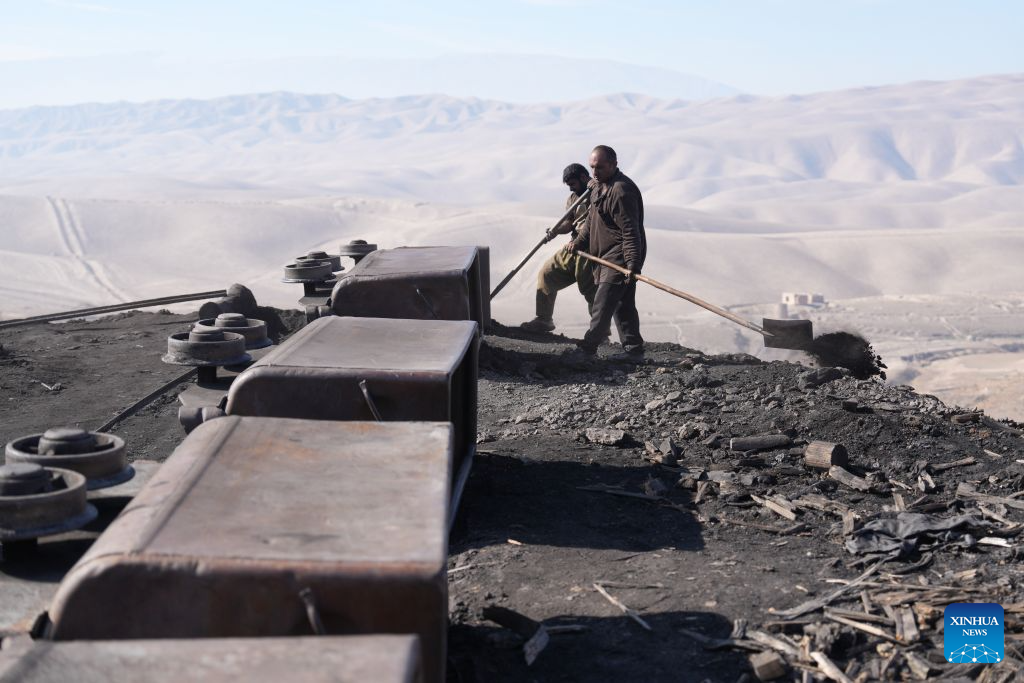
Miners work at a coal mine in Baghlan province, Afghanistan, Nov. 15, 2026. Deep beneath the rugged terrain of northern Afghanistan, where miners spend hours extracting coal from narrow underground tunnels, improved safety measures and modern equipment are gradually transforming working conditions, reducing occupational hazards and paving the way for increased production. (Photo by Saifurahman Safi/Xinhua)
KABUL, Nov. 22 (Xinhua) -- Deep beneath the rugged terrain of northern Afghanistan, where miners spend hours extracting coal from narrow underground tunnels, improved safety measures and modern equipment are gradually transforming working conditions, reducing occupational hazards and paving the way for increased production.
At the historic Karkar coal mine in northern Baghlan province, standardized operations are not only safeguarding miners' lives but also driving higher production and generating vital revenue for local communities and the national economy.
Ahmad Saber, a miner who has spent more than five years extracting coal at Karkar, supports a family of seven on his wages. Speaking 450 meters underground, he described the transformation in working conditions with quiet satisfaction.
"Working conditions are good, and all the necessary facilities are provided for us," Saber told Xinhua inside a coal mine tunnel.
He and his team work daily from 8 a.m. to 1 p.m., extracting coal in tunnels now reinforced against collapse. "I am happy that 10 people are working alongside me. This is a very good job. Supervisors and officials check on us every day to monitor our work and ensure that everything is in order."
Located on the outskirts of Baghlan provincial city, Pul-e-Khumri, roughly 170 km north of the Afghan capital, Kabul, the Karkar mine employs around 250 workers and is renowned for high-quality coal.
For Gula Jan, a mine safety officer with more than 25 years of experience, the changes represent a decisive break from the past. Previously, operations lacked proper standards and essential equipment. Now, gas detectors capable of identifying methane, oxygen, carbon dioxide, and sulfur oxides are in regular use, and tunnels are systematically reinforced.
"In the past, we did not have the equipment needed to detect gases," Gula Jan said. "The authorities have now provided us with gas detectors...The state-owned enterprises directorate provides us with all the necessary facilities and equipment."
He remains underground from early morning until dusk, working alongside three shifts of miners.
Officials confirm that the shift toward standardization is deliberate and expanding. Farid Ahmad Hamnawa, general director of mines in Pul-e-Khumri, said that the state-owned North Coal Company has supplied standard technical equipment to enable safer and more efficient extraction.
Mining at Karkar is now fully standardized, while other mines in the province have reached 70 to 80 percent compliance.
"We have been able to carry out mining operations 100 percent according to standards at this mine," Hamnawa said, adding that the goal is to both prevent fatal incidents and increase overall output.
Abdul Latif Wahabzai, engineering director of the North Coal Company, said the authorities had made extensive efforts to equip all nine coal-mining zones across northern Afghanistan with improved technical facilities and machinery.
He said the initiative was gradually replacing traditional extraction practices with more systematic, technically supported operations that comply with established mining standards.
"Previously, there were no proper support structures in place; tunnels were simply dug without adequate reinforcement. Now, mines are being secured in accordance with technical standards through the installation of metal and wooden support structures," Wahabzai told Xinhua at the Karkar coal mine.
"Technical work is now underway across all our mining areas," he added.
According to Wahabzai, more than 1,500 people are currently employed in coal extraction at state-owned mines, producing approximately 1,500 tons of coal daily.
"In the northern region, we have two types of production. State-owned mines alone produce approximately 1,200 to 1,500 tons of coal per day," he said. ■
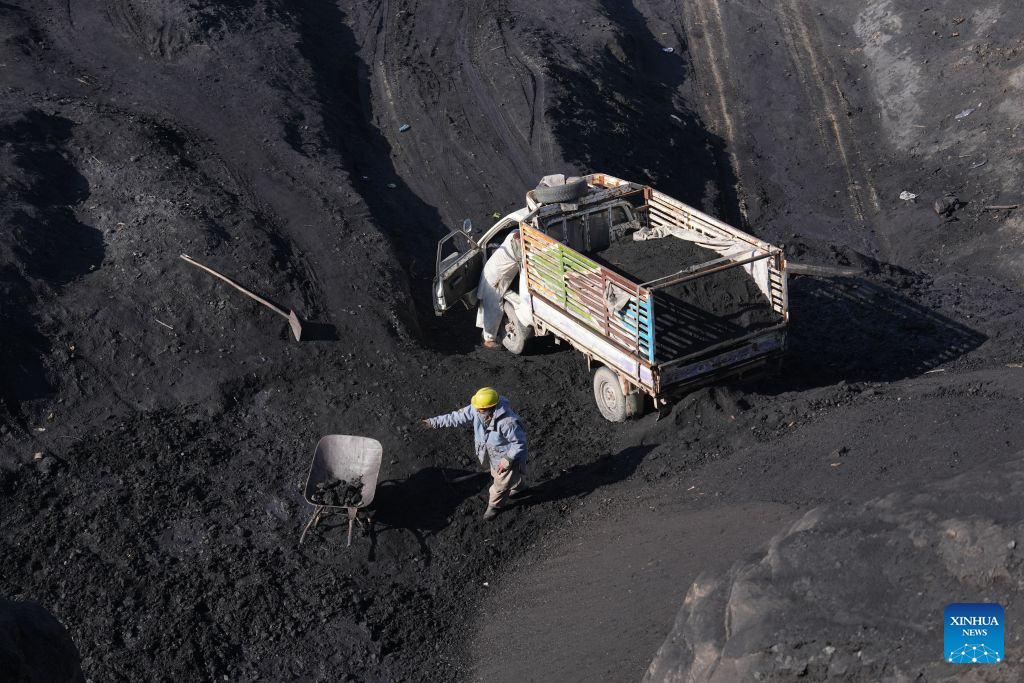
Miners work at a coal mine in Baghlan province, Afghanistan, Nov. 15, 2026. Deep beneath the rugged terrain of northern Afghanistan, where miners spend hours extracting coal from narrow underground tunnels, improved safety measures and modern equipment are gradually transforming working conditions, reducing occupational hazards and paving the way for increased production. (Photo by Saifurahman Safi/Xinhua)
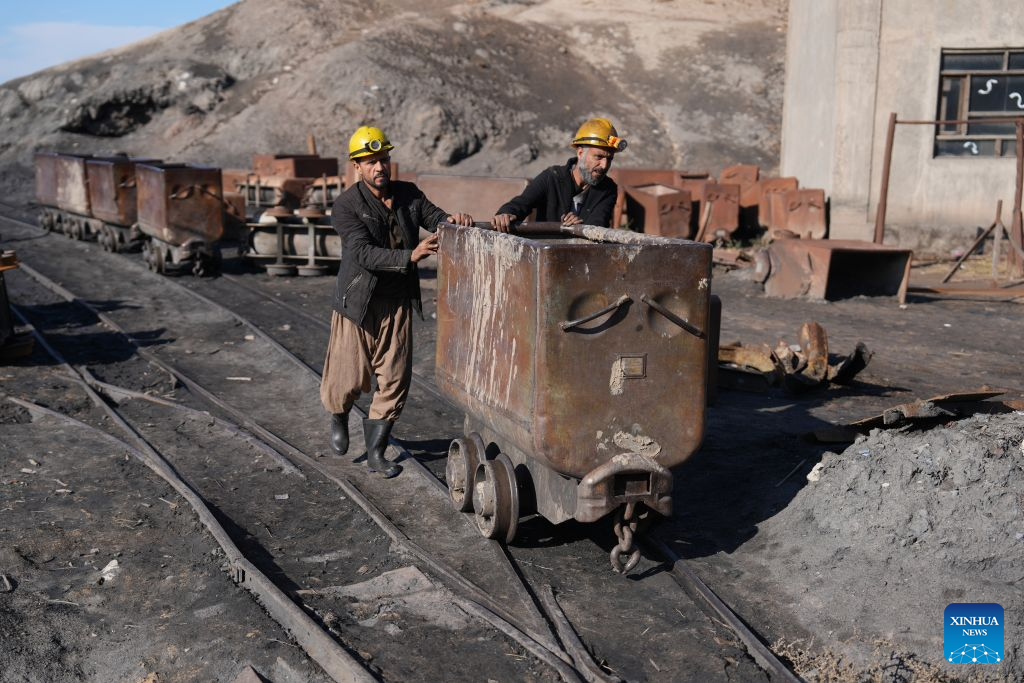
Miners work at a coal mine in Baghlan province, Afghanistan, Nov. 15, 2026. Deep beneath the rugged terrain of northern Afghanistan, where miners spend hours extracting coal from narrow underground tunnels, improved safety measures and modern equipment are gradually transforming working conditions, reducing occupational hazards and paving the way for increased production. (Photo by Saifurahman Safi/Xinhua)