
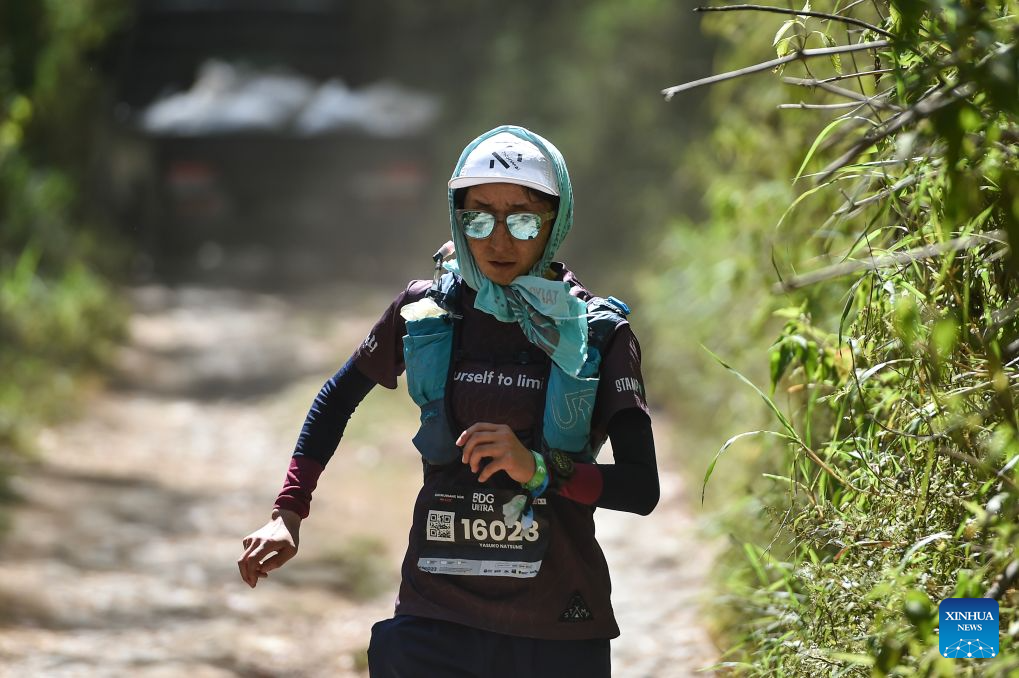
A runner competes at the Bandung Ultra 100 in Bandung, West Java Province, Indonesia, Aug. 29, 2026. (Xinhua/Veri Sanovri)
by Hayati Nupus, Veri Sanovri
JAKARTA, Sept. 15 (Xinhua) -- Trail running in Indonesia is expanding beyond highways to dirt tracks, forests, and mountains as runners look for new challenges and an environment apart from the rhythms of city life.
Because each path offers unique physical obstacles and scenery, Fitri Utami finds that trail running offers an experience that road running does not.
"I'm more comfortable on the trails. We can enjoy the scenery and even greet and converse with other runners because we are not overly concerned about pace," she told Xinhua on Monday.
The 45-year-old Jakarta-based worker began jogging in 2018 after prioritizing strength training. Later, she tried trail running since she loved trekking, mountain climbing, and camping.
Since competing in her first trail race in 2023, she has raced in Yogyakarta, Bali, Bromo, and the Dieng Mountains. She most recently finished a 100-kilometer race in Bandung.
The 2024 Coast to Coast Nite Trail Ultra in Yogyakarta, when she ran 80 km from 4 p.m. to 10 a.m. and completed barely five minutes ahead of schedule, was one of her favorite experiences.
She passed through a beach, gardens, a cemetery road, then back to the beach before encountering thick, slick mud after it had rained.
Because the terrain varies from rocks and roots to slick ground, water, and sand, as well as because runners must deal with heat, rain, wind, and cold weather, Fitri said that trail running is more physically taxing than road running.
According to the Indonesia Marathon website, hundreds of trail running competitions have been staged in Indonesia in recent years as the trend continues to spread, with at least 51 planned for 2026.
Indonesia offers a wide range of terrain that is drawing more and more local and international runners, with distances ranging from 15 kilometers to ultra-trail races and routes spanning mountains, forests, valleys, rivers, plantations, and coastal areas.
Trail competitions currently pass through Mount Rinjani in West Nusa Tenggara and the Merbabu and Lawu mountains in Central Java, in addition to Bromo, Dieng, Bali, Bandung, and Yogyakarta.
"I enjoy how the terrain is always shifting. In contrast to road running, which typically takes place on flat ground with views dominated by asphalt and buildings, we can run on dirt, rocks, and sand, through forests, and up mountains, so it never seems repetitive," said Hazet, 43.
Hazet, who previously loved mountain climbing, began running after the COVID-19 pandemic closed gyms. In 2023, he participated in his first trail race.
One of his most memorable experiences was competing in the Bromo Tengger Semeru 100 Ultra in the mountainous region of Bromo Tengger Semeru National Park in East Java, where he spent two nights on the trail and only got ten to fifteen minutes of deep sleep to replenish his energy. He typically trains in the hilly regions of Sentul and Mount Gede, both in West Java.
Purwaji Santoso, 38, started trail running in 2025 after taking up road running, badminton, and climbing. The tough terrain has become a means for him to decompress from work-related stress.
"My body and mind feel different, fresher after finishing a trail race," Purwaji said, adding that trail running helps him explore his physical potential and alleviate stress.
"To know how far our bodies can go, we need to experience fatigue and push that limit beyond," he continued.
Purwaji also recalled his grandmother's counsel to engage in activities that uplift the mind, as, according to him, a contented mind improves life and the body. ■
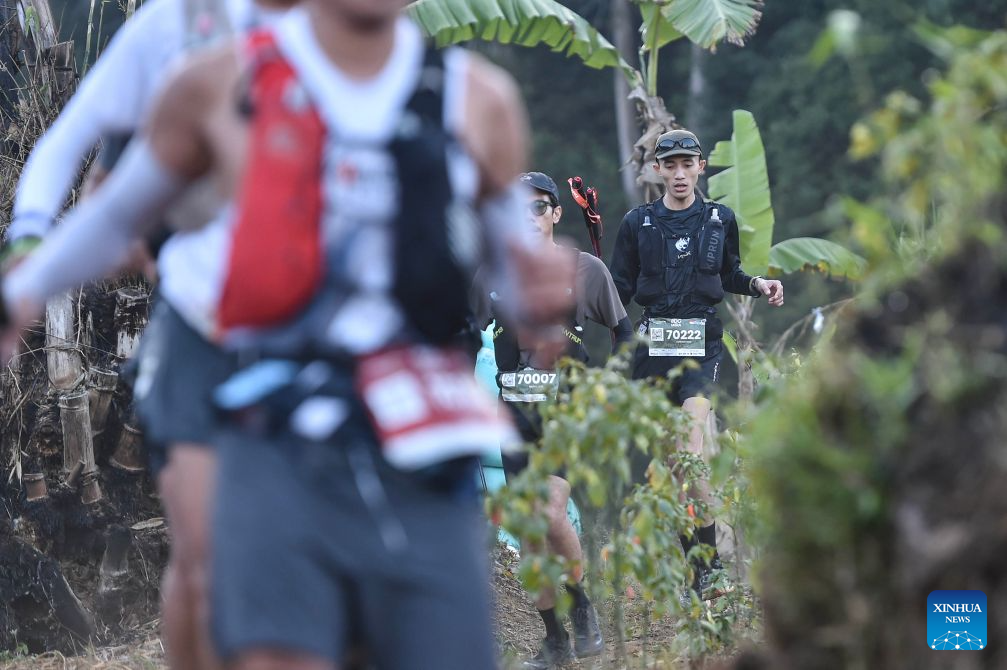
Runners compete at the Bandung Ultra 100 in Bandung, West Java Province, Indonesia, Aug. 29, 2026. (Xinhua/Veri Sanovri)