
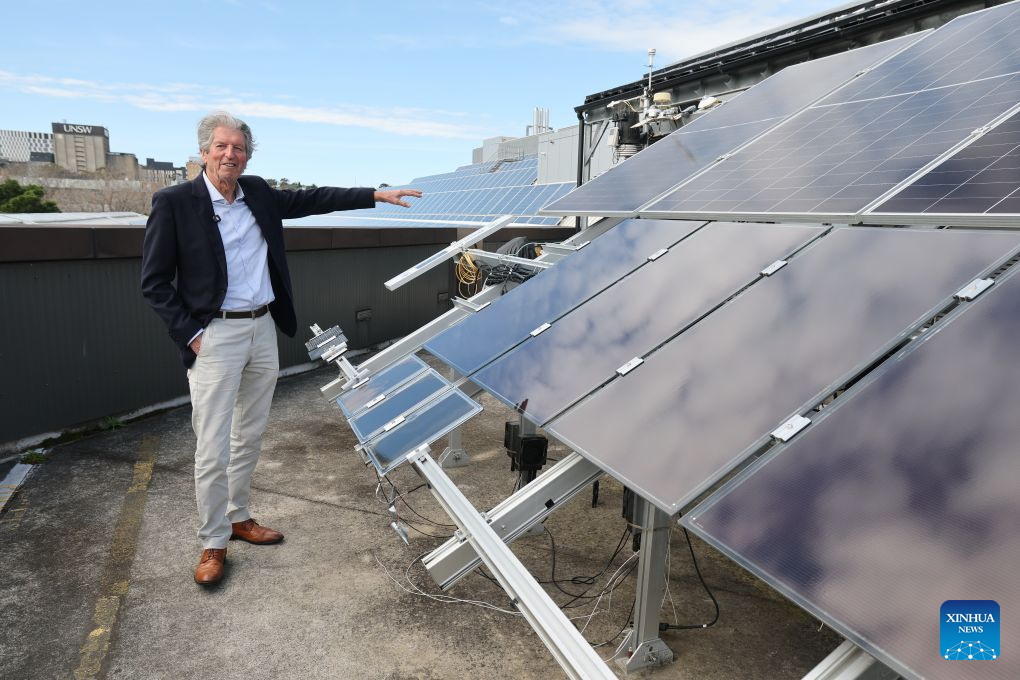
Scientia Professor Martin Green of the University of New South Wales introduces solar modules in Sydney, Australia, Aug. 20, 2026. (Xinhua/Gong Bing)
SYDNEY, Sept. 5 (Xinhua) -- The winter sun shined bright outside the window of Scientia Professor Martin Green's office at the University of New South Wales (UNSW), Sydney, a quiet reminder of the very element he has spent a lifetime converting into energy.
The energetic 78-year-old engineer from UNSW's School of Photovoltaic and Renewable Energy Engineering is a leading pioneer in modern photovoltaics thanks to his decades of relentless innovation that changed the way the world harnesses solar power.
Green and his team have made pioneering contributions to the advancement of photovoltaic (PV) technology, particularly in improving the performance of silicon solar cells. The two technological pathways they pioneered have both become fundamental to modern silicon solar cell design.
Yet "an even more important achievement" and "the most exciting stuff" is "helping to get the PV industry established in China through the researchers and engineers that we had trained, who did so well in setting up a very competitive industry in China," Green told Xinhua just weeks after returning from Beijing, where he received the China International Science and Technology Cooperation Award for the year 2025.
The contact with China all started in 1981. Green's lab welcomed its first Chinese visiting researcher, and batches of them were trained here over the following decades. Some of them founded China's earliest PV companies.
In 1984, Green published a paper on the fundamental efficiency limit of silicon solar cells -- around 30 percent. That same year, he visited China for the first time, invited to lecture at Huazhong University of Science and Technology. He sensed the country's unmistakable potential as it was just beginning to modernize.
In Green's view, mainly with solar and batteries, China's green development has made a massive contribution to the world's green transition. It was the combination of China's massive manufacturing scale and Australia's continuous technological advancement that drove photovoltaics to become one of the world's cheapest sources of electricity.
"Without China's involvement, we definitely wouldn't have solar cells as cheap as now. It could be 10 times the price that they are now. Solar would still be an interesting technology for the future rather than the best option for now."
According to a report Green released in 2016, the flow-on economic benefits to Australia from decades of local photovoltaic research were worth well over 8 billion Australian dollars (about 5.74 billion U.S. dollars), heavily underpinned by the solar manufacturing industry in China.
"If I did the calculation again now, it would be hundreds of billions that it saved Australia by providing a cheap way of generating electricity and avoiding the imputed costs of all the carbon dioxide that we would have been emitting," he told Xinhua,
A frequent visitor to China's PV research institutes and manufacturers, Green observed that they are evolving rapidly. "All the companies are continually building new production lines to accommodate the improved equipment that's going to be available as well as the improved cell technology."
Today, silicon solar cells are approaching the fundamental efficiency limit of around 30 percent. To go further, Green said, the industry must stack new materials on top of silicon. The next chapter of solar power will be defined not by efficiency records, but by whether new cell technologies can stand the test of time in the real world. That is where his latest collaboration with China comes in.
"China dominates the industry, so that makes the collaboration sort of unique," Green said. "Working with China, we feel we're in a position to improve the solar performance more quickly."
"We've just started a big project using AI to find other candidates for stacking onto silicon," Green said. "With AI, it might provide a more systematic way of finding such new materials."
China, he noted, has been pushing hard on AI development, and that makes it an even more attractive partner for this next phase of discovery. "The more China improves AI, the more options we'll have using different AI to explore the available space and see if they can come up with ideas for new compounds," he said. ■
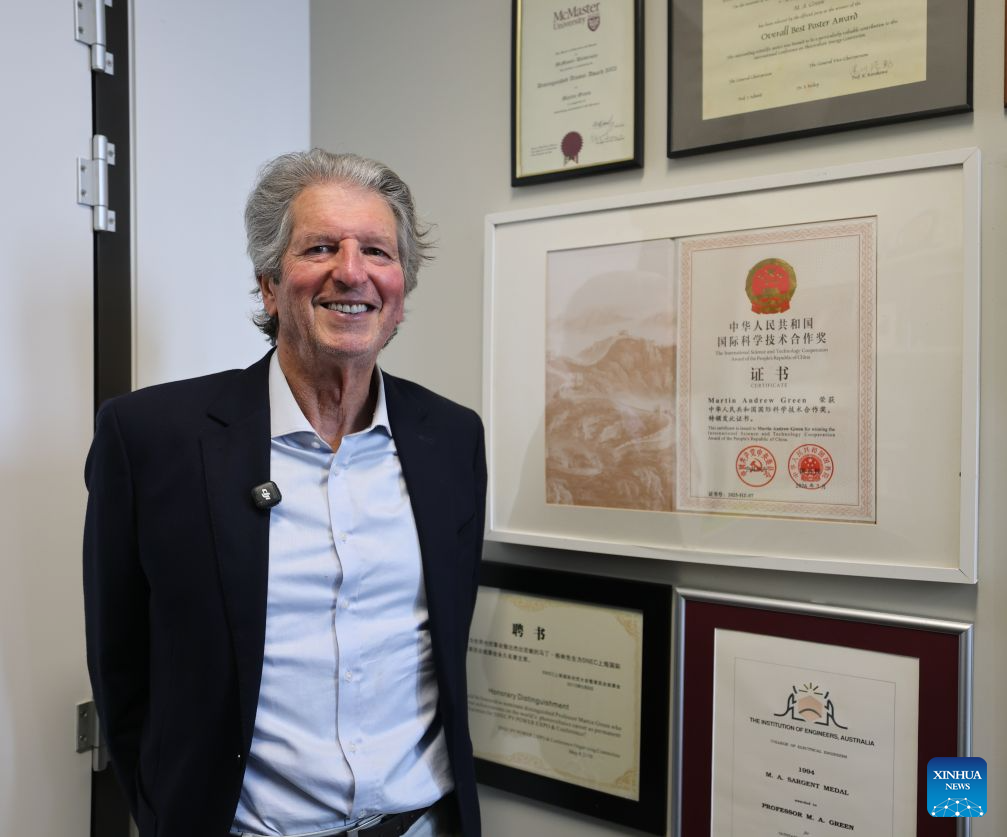
Scientia Professor Martin Green of the University of New South Wales poses for a photo with his certificate of the China International Science and Technology Cooperation Award for the year 2025 in Sydney, Australia, Aug. 20, 2026. (Xinhua/Gong Bing)
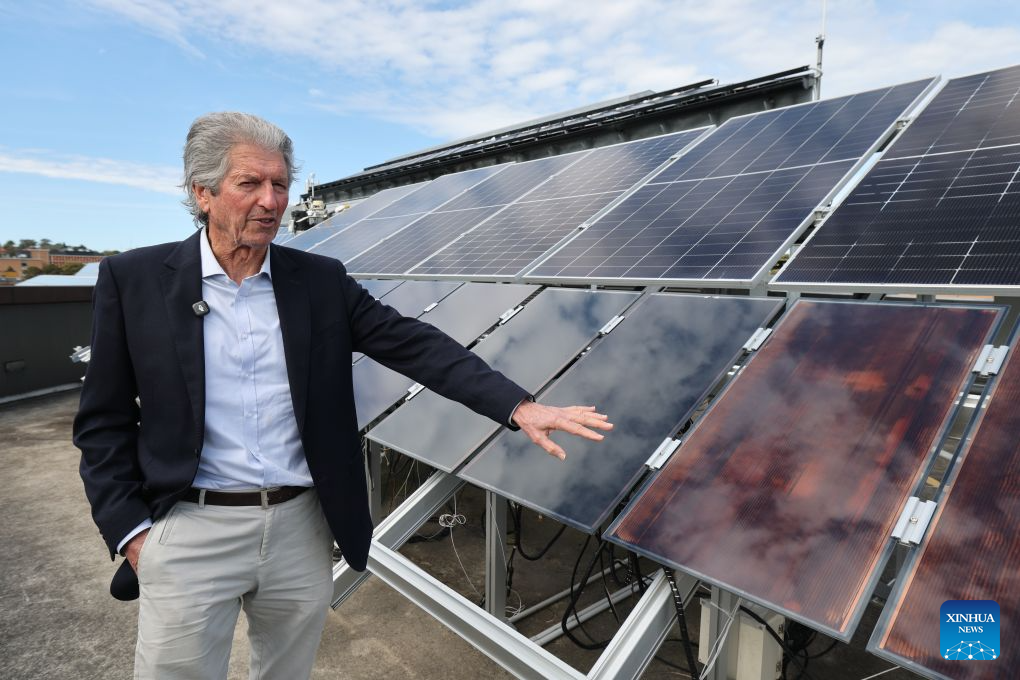
Scientia Professor Martin Green of the University of New South Wales introduces solar modules in Sydney, Australia, Aug. 20, 2026. (Xinhua/Gong Bing)
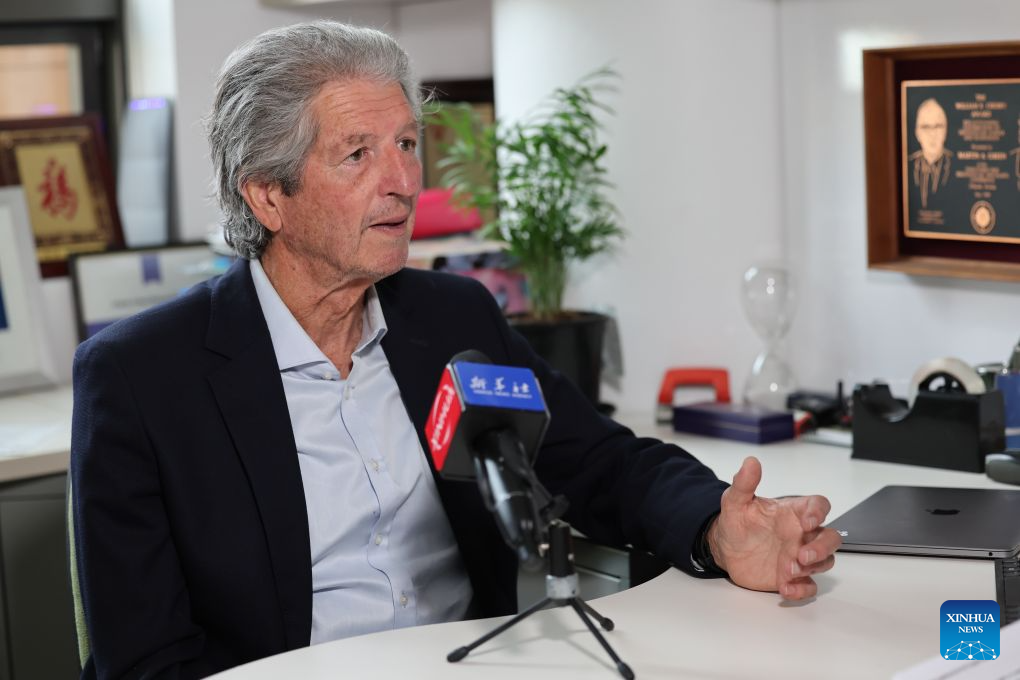
Scientia Professor Martin Green of the University of New South Wales receives an interview with Xinhua in Sydney, Australia, Aug. 20, 2026. (Xinhua/Gong Bing)
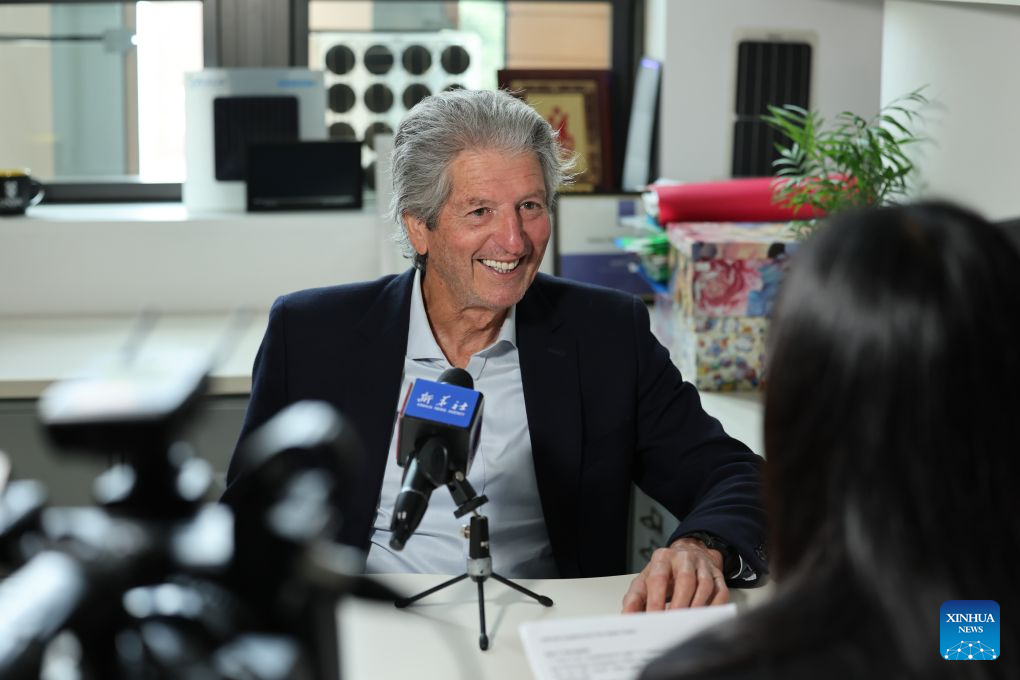
Scientia Professor Martin Green of the University of New South Wales receives an interview with Xinhua in Sydney, Australia, Aug. 20, 2026. (Xinhua/Gong Bing)