
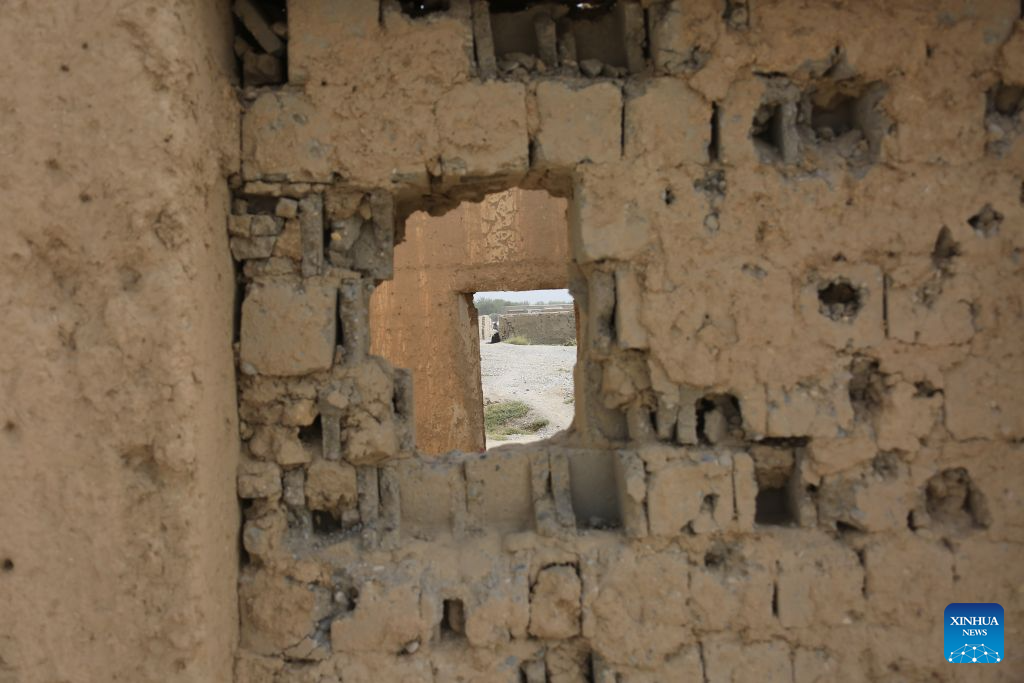
This photo taken on Aug. 23, 2022 shows an area devastated by U.S. bombing in Helmand, Afghanistan. (Photo by Saifurahman Safi/Xinhua)
KABUL, Aug. 28 (Xinhua) -- An infant, still hungry and unaware that his mother had been killed, reached for her breast after a U.S. overnight bombardment in Bala Buluk district of Afghanistan's western Farah province in 2009.
The haunting scene is described in the newly released English edition of a book by Muhajer Farahi, Afghanistan's deputy minister for publications at the Ministry of Information and Culture, as Afghanistan approaches Aug. 31 -- five years since the last U.S. troops left the country, bringing America's longest war to an end.
The English edition, titled Memories of Jihad: Twenty Years in Occupation, looks back at the two decades of U.S.-led military presence through the eyes of Farahi, chronicling what he describes as years of bombardment, civilian casualties, displacement, destruction, detention and torture.
Five years after the withdrawal, for many Afghans, the scars of war remain.
Farahi said he wrote the book to document what he describes as the realities of the U.S. military presence and its far-reaching consequences for Afghan society.
"The Americans committed widespread acts of violence and atrocities over the past 20 years, from 2001 to 2021. They bombed villages, wedding ceremonies, funerals, religious schools and educational institutions," Farahi told Xinhua.
"They left behind enormous devastation, mostly in remote areas and rural communities. Hundreds of thousands of our compatriots were killed, imprisoned and tortured," he said. "Civilians suffered extensive losses and hardship, and people were displaced from their homes."
Farahi also challenges portrayals of the two-decade U.S. presence that emphasize development assistance and reconstruction projects undertaken during those years while overlooking what he sees as Afghanistan's continued dependence on external support.
"Instead of teaching our people how to catch fish, they preferred to keep providing them with ready-caught fish under their own control," Farahi said.
For many Afghan families, however, memories of those two decades are rooted not in debates over the legacy of the war, but in the loss of loved ones.
Haji Sharif Khan, a resident of Hesarak district in eastern Nangarhar province, still remembers the night in 2019 when his brother, Dr. Nazar Gul, and 12 others from two related households were killed in a U.S. bombing.
Khan said the attack came from multiple directions and continued for hours.
"About six planes came for bombardment from three sides, which continued for over three hours. M4 ammunition, helicopters, jets and even B-52 aircraft were included in this attack," Khan said.
For Khan, the loss was not an isolated tragedy but part of what he sees as a broader pattern of suffering inflicted on Afghan communities during the U.S. military presence.
"The United States had oppressed the whole land of Afghanistan with its plans and programs," he said.
For Miro, another resident of Nangarhar, the ordeal did not end when the bombardment stopped and ground operations ceased.
He recalled that civilians were afraid to approach the scene, help the wounded or pull people from the ruins, fearing that anyone who ventured outside could become another target.
"No one could help anyone. If you went out to help, you would also be targeted," Miro told Xinhua.
Beyond airstrikes and ground operations, the detention of Afghans on various grounds and their confinement in U.S.-run facilities became another deeply contentious chapter of the two-decade war. Thousands of Afghans were held at U.S. military bases in Afghanistan, including Bagram and Kandahar, while some were transferred to the Guantanamo Bay detention facility.
For Khan Mohammad, that chapter remains deeply personal.
The former detainee said he spent nearly two decades in U.S. custody despite maintaining that he had committed no crime.
"They accused me of orchestrating a major conspiracy to attack Jalalabad airport and kill many Americans," Khan told Xinhua. "But I did nothing. I completely denied the allegations."
U.S. troops detained Khan in Jalalabad, the capital of Nangarhar province, in 2006. He was subsequently transferred to Bagram and later to the United States, where he was sentenced to life imprisonment.
Recalling the journey from Afghanistan to the United States, Khan said he was deprived of his senses for much of the trip.
"In Bagram, I was like the other prisoners. Then they transferred me to the United States. The journey was terrifying. They tied my hands and feet, blindfolded me and blocked my ears. The distance was long, and I was in pain the whole time," he said.
After being sent to Washington, D.C., for further interrogation, Khan was imprisoned in California following a court judgment. He was released in January 2025 and returned to Afghanistan as part of a prisoner exchange between the United States and the Afghan interim government.
His release ended nearly two decades in U.S. custody, but the experience, he said, had irrevocably changed the course of his life.
The scars left by the war were compounded by the chaotic final days of the U.S. military withdrawal in August 2021.
Among the Afghans who lost their lives during those days was Zaki Anwari, a 17-year-old promising football player who fell to his death after clinging to a U.S. military aircraft as it took off from Kabul International Airport.
For the Anwari family, the pain of Zaki's death has not faded with time.
His brother, Haji Zakaria, still struggles to contain his grief whenever he sees Zaki's belongings -- his jerseys, boots and football equipment, reminders of the young man's dreams.
"That black day was unbearably painful for us. Regrettably, those harrowing memories are etched into our souls, and we shall carry them to the end of our days," Zakaria said.
On Aug. 26, 2021, amid the final days of the U.S. military withdrawal, a suicide bombing claimed by the Islamic State near the gates of Kabul International Airport killed at least 170 Afghan civilians and 13 U.S. service members.
Two decades of U.S.-led military intervention left Afghanistan scarred by death, destruction and enduring trauma. Night raids, airstrikes and military operations in civilian areas claimed numerous lives, while hospitals, schools, wedding ceremonies and other civilian gatherings were also caught in the violence.
For many Afghan families, the loss of loved ones remains an open wound. Nor did Afghanistan's hardships end with the departure of U.S. troops.
Following the Taliban's return to power in August 2021, about 7 billion U.S. dollars in assets belonging to Afghanistan's central bank were frozen by the United States. Sanctions, financial restrictions and declining development assistance added further pressure to an already fragile economy.
Unemployment and poverty rose, food insecurity worsened and development projects stalled, pushing millions of Afghans deeper into hardship.
Five years after the last U.S. troops left Afghanistan, the country continues to live with the consequences of two decades of war.
For millions of Afghans, memories of lost relatives, destroyed homes and years of displacement and hardship have yet to fade, while economic deprivation remains another enduring legacy of a war whose scars Afghanistan still bears today. ■
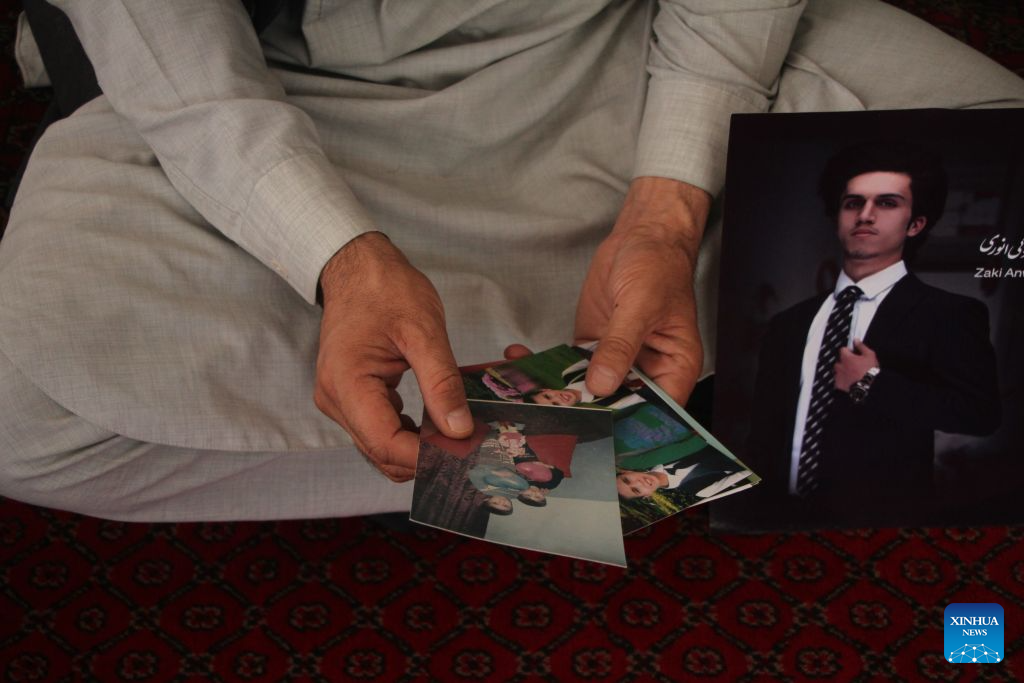
A family member shows photos of Zaki Anwari, a 17-year-old football player who fell to his death after clinging to a U.S. military aircraft as it took off from Kabul International Airport, in Kabul, Afghanistan, Sept. 14, 2021. (Photo by Saifurahman Safi/Xinhua)
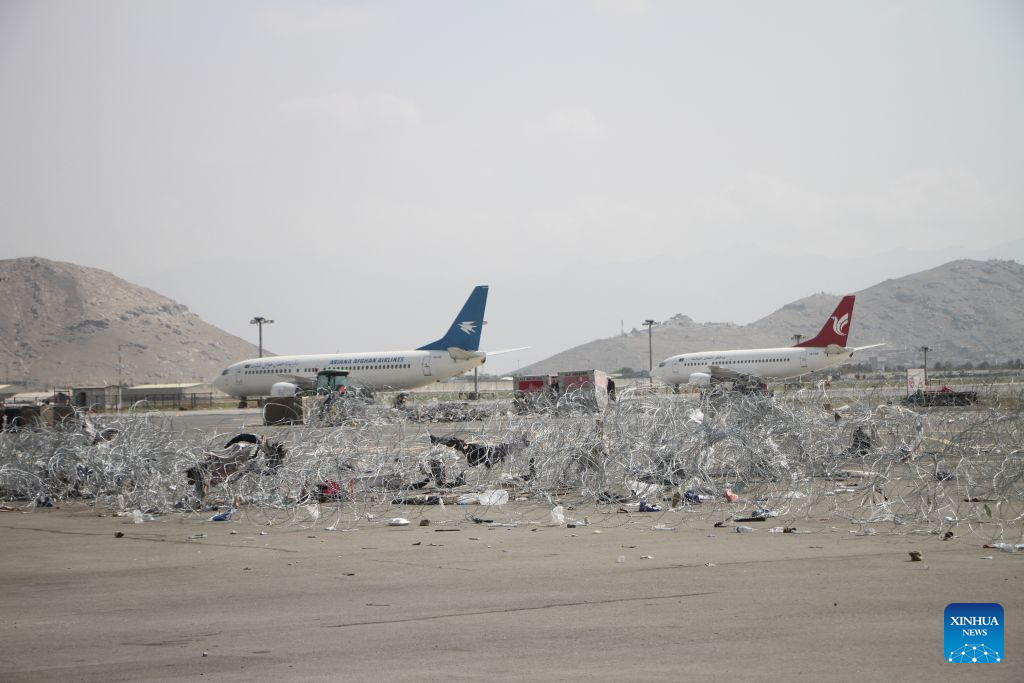
This photo taken on Aug. 31, 2021 shows the Kabul International Airport following the U.S. withdrawal from Afghanistan, in Kabul, capital of Afghanistan. (Photo by Saifurahman Safi/Xinhua)