
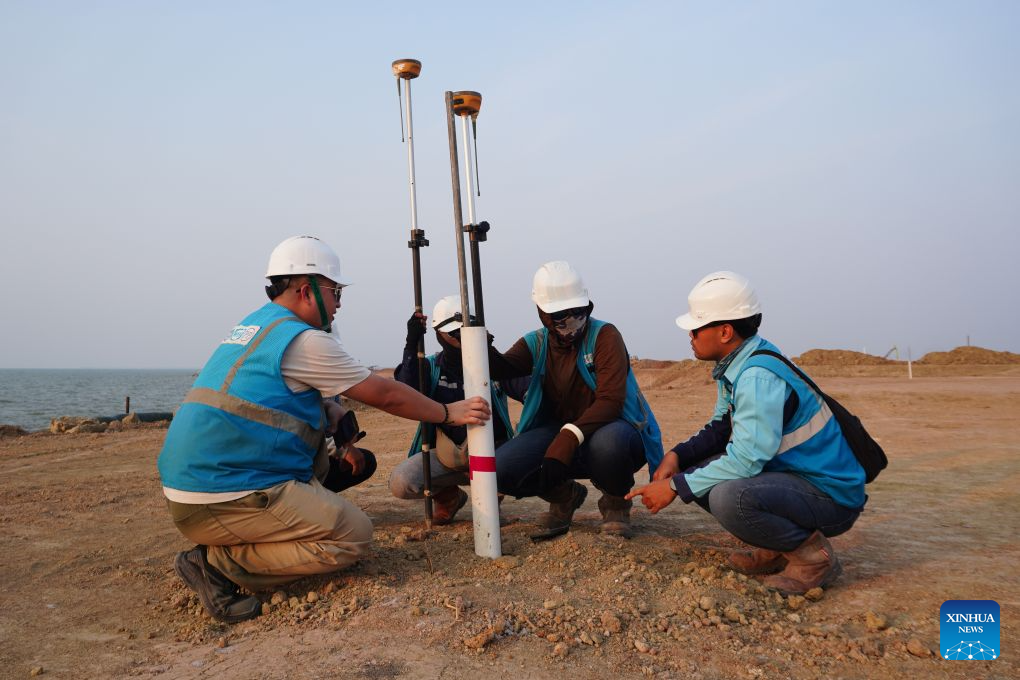
A Chinese technician (1st L) instructs local workers at a construction site of Semarang-Demak toll road 1B built by China Road and Bridge Corporation (CRBC) in the northern coast of Central Java province, Indonesia, Aug. 18, 2026. Semarang, a major port on Indonesia's Java island, traces its rich history back to the 15th century, when Chinese navigator Zheng He made multiple stops here during his historic maritime voyages. (Xinhua/Zhang Yisheng)
by Xinhua writer Zhang Yisheng
SEMARANG, Indonesia, Aug. 26 (Xinhua) -- Semarang, a major port on Indonesia's Java island, traces its rich history back to the 15th century, when Chinese navigator Zheng He made multiple stops here during his historic maritime voyages.
Historical records show that Zheng's "treasure ships" brought not only thriving trade but also lasting bonds between the two peoples. Local tradition even holds that the city was named in honor of Zheng, with the iconic Sam Poo Kong temple standing today as a timeless testament to his legacy.
Heading north from downtown Semarang, engines roared amidst waves of stifling heat. At the construction site of Indonesia's first dike-highway, Yue Zhenhong, project manager of toll road development of Semarang-Demak 1B built by China Road and Bridge Corporation (CRBC), navigated the main access route in a hard hat and blue work uniform.
Behind him, bulldozers and road rollers operated in shifts, while over a thousand dump trucks transported materials around the clock, creating a bustling scene filled with the blare of horns.
"We are working 24-hour non-stop shifts to try to complete the basic earthmoving construction before the rainy season arrives," said the 35-year-old, wiping sweat from his forehead.
Both Semarang and Demak are situated on the northern coast of Central Java province. For years, traffic congestion along the existing national highway connecting the two places has been severe. The Indonesian government hopes to ease traffic pressure and solve a long-lasting problem of tidal flooding along the coast through this project.
According to Yue, the project integrates transportation and flood control functions. Once completed, travel time between the two cities will be drastically reduced from 60 minutes during peak traffic to just 10 minutes, significantly lowering logistics costs and injecting fresh momentum into local economic growth.
However, turning the vision into reality requires overcoming formidable challenges. Deep layers of soft mud reaching depths of 30 meters beneath the seabed along the route made construction akin to "building a house on tofu." Enhancing the bearing capacity of the soft foundation while controlling construction stability and post-construction subsidence presented a tough nut to crack for the project team.
"Tailored to local geological conditions and resource availability, we creatively implemented a foundation treatment solution for very soft ground: bamboo piles and mats plus vertical and horizontal drain boards with surcharge preloading," Yue explained.
He noted that the strength of this solution lies in tapping into the local abundance of bamboo. By replacing high-carbon materials like steel and cement with bamboo, the project significantly cuts carbon emissions across its entire life cycle.
For more than 20 years of doing business in Indonesia, the CRBC has built a string of landmark projects across the archipelago country. Those projects have not only accumulated rich expertise for constructing the dike-highway but also cultivated a pool of local engineering talent.
Muhammad Rizky Pradana, a 26-year-old engineer who joined the company a year and a half ago, has developed a profound appreciation for the rigor of Chinese engineering standards.
Rizky admitted that he initially felt considerable pressure facing the project's stringent quality management requirements. However, under the hands-on guidance of his Chinese colleagues, he quickly mastered the know-how.
"The project's strict control over quality has enabled me to learn many new professional skills and management methods. Being able to grow on such a platform makes me feel truly fulfilled," he said.
For 37-year-old Mochamad Zumar Habibi, this year marks his 10th year working with the CRBC, an example of the company's long-term commitment to nurturing local staff.
Habibi said the efficiency and dedication of the Chinese enterprise have continuously inspired him. Working in the CRBC has improved his family's livelihood, making his parents and wife immensely proud of his job. "I hope to stay with the CRBC all the way until retirement."
For local residents, Chinese builders have brought not only technology and skills but also a strong sense of social responsibility.
"In the past, severe sea erosion damaged homes, roads, and fish ponds. Every time high tide came, seawater nearly 1 meter deep poured in, paralyzing the roads," recalled Kumaidi, a local village official, noting that tidal flooding had haunted his village for ages.
Upon learning of the situation, the CRBC project team extended a helping hand by elevating nearly 5 kilometers of surrounding rural roads by about 1 meter, greatly enhancing their flood-prevention capacity.
Kumaidi remarked with gratitude that travel conditions in the village have improved immensely, and residents no longer frequently suffer from being stranded by floods. Furthermore, the team installed streetlights along key sections, illuminating roads that were once pitch-black at night.
"Just like Zheng He's fleet when it arrived here centuries ago," Kumaidi said, "the Chinese builders today have also come bearing friendship and win-win cooperation." ■
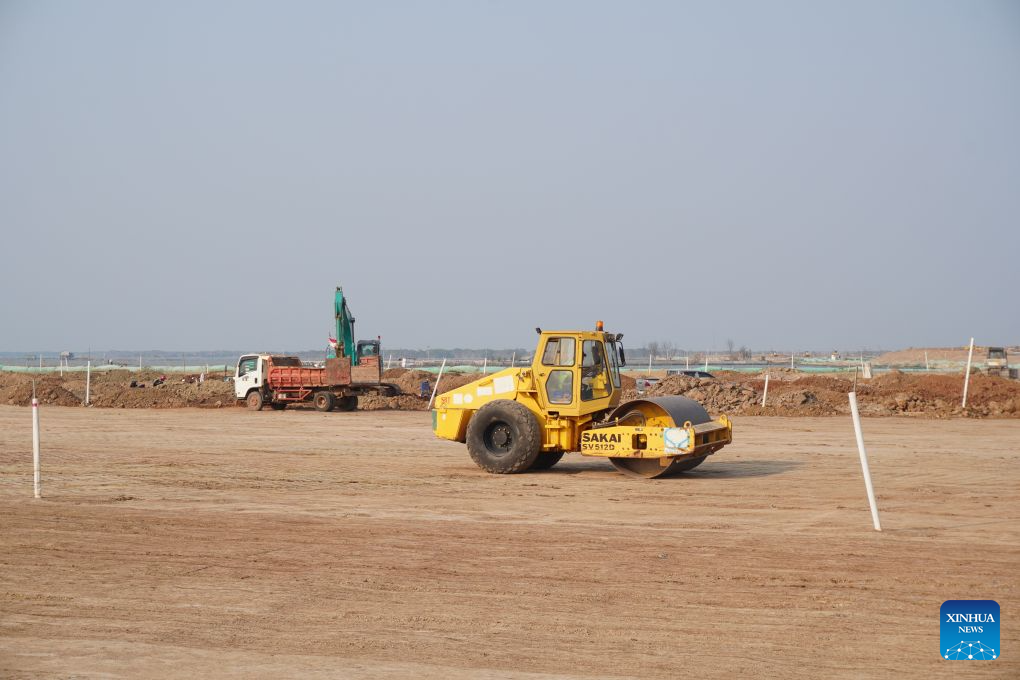
This photo taken on Aug. 18, 2026 shows the construction site of Indonesia's first dike-highway in the northern coast of Central Java province, Indonesia. Semarang, a major port on Indonesia's Java island, traces its rich history back to the 15th century, when Chinese navigator Zheng He made multiple stops here during his historic maritime voyages.(Xinhua/Zhang Yisheng)