
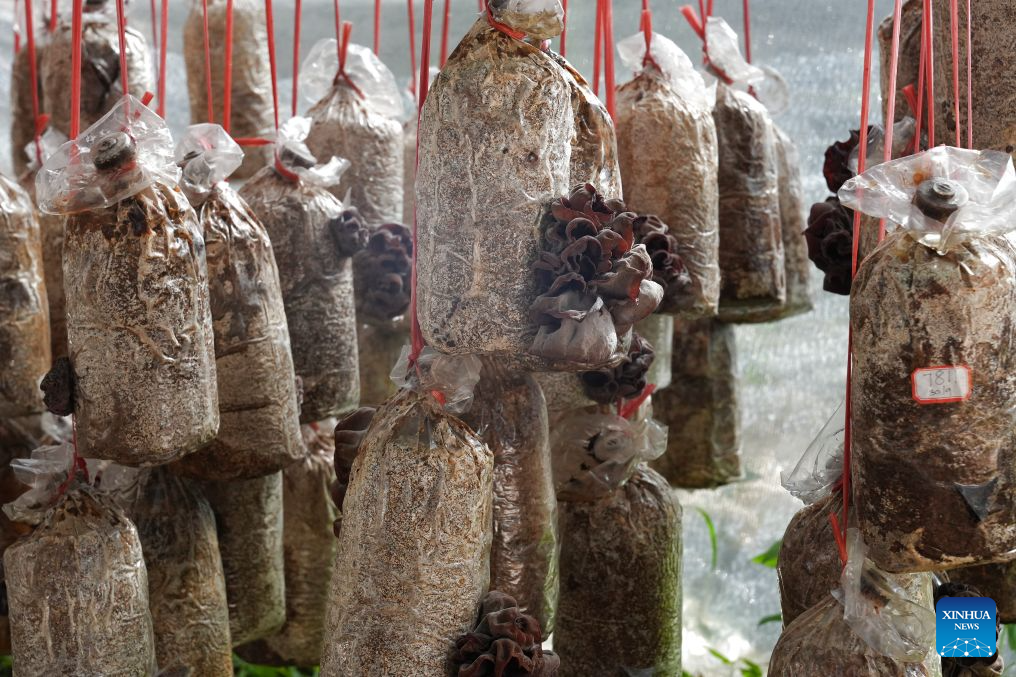
Bag-cultured wood ear mushrooms are pictured at the China-Fiji Juncao Technology Demonstration Center in Nadi, Fiji, on July 6, 2026. (Xinhua/Bai Yongquan)
by Guo Xinhui and Bai Yongquan
SUVA, Aug. 24 (Xinhua) -- On a stretch of land once scarred by salt, rows of lush green grass now ripple in the Pacific breeze. Just a few years ago, little could grow here. Today, the field stands as living proof of how a single plant is helping reshape both the landscape and the lives of local people.
The grass is known as Juncao. The Juncao technology was developed in China and introduced to Fiji more than a decade ago. Originally designed as a substrate for cultivating edible mushrooms, Juncao has since become a tool for restoring degraded land, supporting livestock farming and creating new sources of income for rural communities.
For Fiji, where soil salinity has long constrained agricultural development in some coastal areas, the technology has brought tangible results.
According to Huang Zhixin, an expert at the China-Fiji Juncao Technology Demonstration Center, planting Juncao for just four months reduced the salt content of severely saline soil from 1.67 percent to 0.4 percent.
The impact is also visible on supermarket shelves.
Inside a large supermarket in the western city of Nadi, locally grown oyster mushrooms sit neatly among fresh vegetables.
"Just a few years ago, almost all mushrooms sold in Fiji were imported, selling for more than 30 Fijian dollars (about 13 U.S. dollars) per kilogram, making them unaffordable for many families," Mere, a supermarket employee, told Xinhua.
After the introduction of Juncao cultivation technology, local production gradually expanded, bringing prices down by nearly half.
To adapt mushroom production to Fiji's tropical climate, Chinese technicians worked with local partners to develop cultivation methods suited to high temperatures, including shaded production areas, suspended growing bags and temperature-controlled storage. Today, more than ten varieties of edible fungi, including oyster mushrooms, king oyster mushrooms and wood ear mushrooms, are produced locally.
The technology has also encouraged the emergence of homegrown mushroom brands that now supply supermarkets, restaurants and hotels across the country.
For villagers, however, the biggest change often begins in their own backyards.
In Muanaira Village near Suva, 76-year-old Alusio Tawakevoudua tends rows of mushroom-growing bags beside his house. The cultivation area occupies only about 10 square meters, yet it provides a steady source of income throughout the year.
Mushrooms can be harvested every six to 10 days. Annual production reaches about 1,200 kg, earning his family roughly 18,000 Fijian dollars in additional income, Tawakevoudua said.
Beyond mushroom cultivation, Juncao is also helping address another long-standing challenge in Fiji's agriculture.
During the dry season, fresh forage shortages have traditionally driven up feed costs and exacerbated overgrazing, putting pressure on natural grasslands.
According to Zhong Siqin, another expert at the demonstration center, Juncao offers a sustainable alternative. Once planted, it can be harvested continuously for more than 20 years, producing 300 to 500 tonnes of fresh grass per hectare annually. With a crude protein content of 8 to 16 percent, it provides nutritious feed for cattle while reducing pressure on natural pastures.
Seedlings and processing equipment supplied by the demonstration center are now used by farmers across Fiji, including at Yagara Farm, the country's largest cattle ranch, where Juncao is cultivated on a large scale.
Since 2014, the China-Fiji Juncao Technology Demonstration Center has carried out three phases of technical assistance projects. To date, it has organized 67 training sessions, trained more than 2,900 local technicians, promoted Juncao cultivation on over 2,500 hectares of land, and helped more than 3,500 households achieve sustained income growth.
The project has also drawn international attention. Amson Sibanda from the United Nations Department of Economic and Social Affairs has said the technology strengthens the capacity of developing countries, enhances the self-reliance of smallholder farmers and contributes to both poverty reduction and ecological restoration.
As preparations begin for a new round of technical cooperation, Sufuawana Safara Hussein, a researcher with Fiji's Ministry of Agriculture and Waterways, is looking forward to expanding the program.
"China's Juncao has changed our land, and it has changed ordinary people's lives," she said. "We hope to continue working with China so that more villages and more families can benefit from this technology." ■
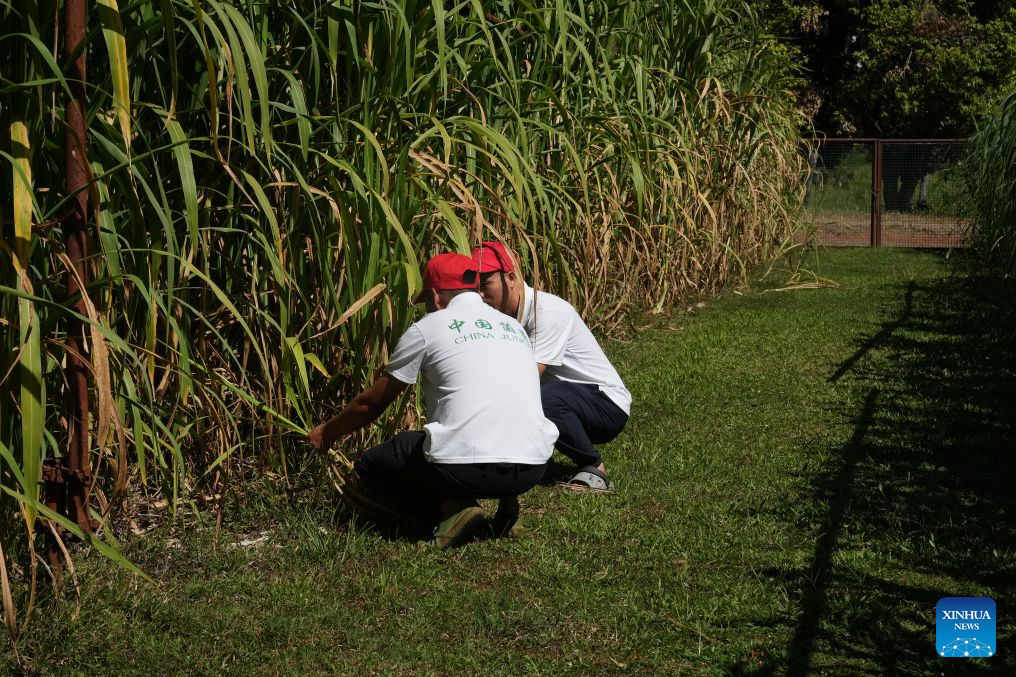
Experts inspect the growth of Juncao plants at the China-Fiji Juncao Technology Demonstration Center in Nadi, Fiji, on July 6, 2026. (Xinhua/Bai Yongquan)