
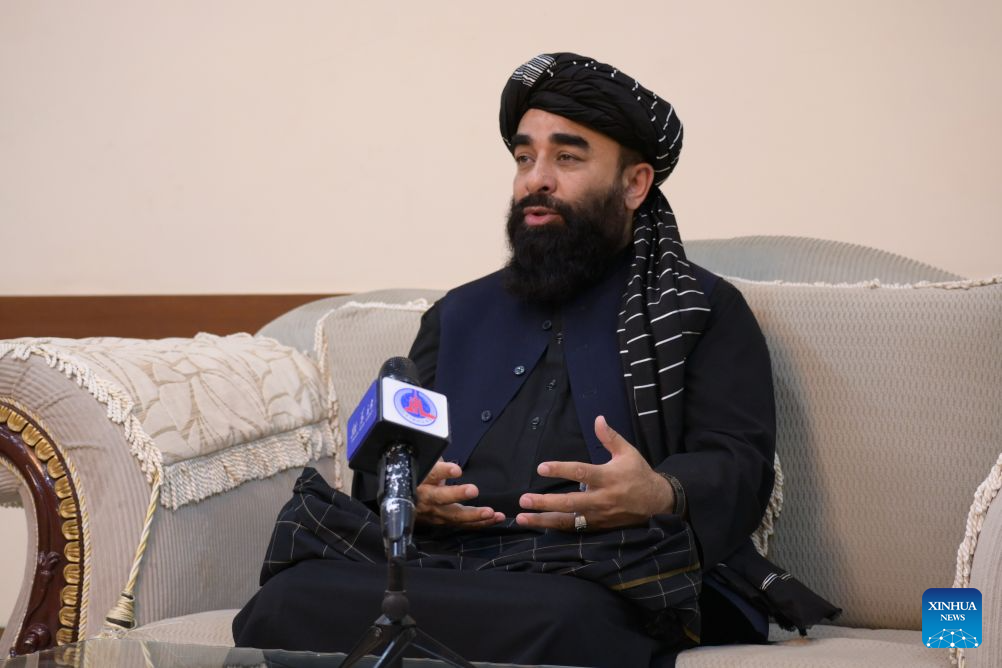
Zabihullah Mujahid, spokesman for the Afghan government, speaks in an interview with Xinhua in Kandahar province, Afghanistan, Aug. 6, 2026.(Xinhua/Zhang Yibin)
by Li Ang, Xu Shu'ao and Zhang Yibin
KABUL, Aug. 15 (Xinhua) -- White Taliban flags emblazoned with black script lined major streets across Kabul on Saturday as the Taliban celebrates the fifth anniversary of its return to power with a large-scale ceremony here.
Five years on, the war-torn country has largely moved from war to reconstruction. Overall security has improved, but creating jobs, absorbing returning refugees and reviving the economy remain formidable challenges.
SECURITY IMPROVED BUT RISKS REMAIN
Improved security has been one of the achievements most frequently highlighted by the authorities.
Since returning to power in August 2021, the Taliban has repeatedly pledged that Afghan territory would not be used by terrorist groups to threaten other countries. It has launched sustained operations against extremist groups, particularly the Islamic State Khorasan Province (ISKP), contributing to a marked decline in both the frequency and scale of terrorist attacks.
Security risks, however, have not disappeared.
Several major attacks also hit Kabul in recent years, including the assassination of Acting Minister for Refugees Khalil Ur-Rahman Haqqani in a suicide bombing in December 2024, an attack on the Ministry of Urban Development and Housing in February 2025, and an attack on a Chinese restaurant in January 2026 that killed seven people.
Meanwhile, military tensions between Afghanistan and Pakistan have periodically flared over border disputes and cross-border militant activities. From late 2025 to the spring of 2026, the confrontation escalated beyond frontier areas, with Pakistan carrying out intermittent airstrikes inside Afghanistan, including around Kabul, while Pakistani officials described the situation as an "open war." The fighting gradually subsided after the two sides returned to dialogue through international mediation.
LIVELIHOOD HARDSHIP
For many Afghans, daily life has become safer, but making a living remains difficult.
In an interview with Xinhua, Taliban spokesman Zabihullah Mujahid said the Afghan currency had stabilized at around 66 to 70 afghanis per U.S. dollar, compared with a low of around 130 after the Taliban returned to power, indicating that inflation had been brought under control.
Bread prices have also remained remarkably stable. A piece of naan, Afghanistan's staple food, has long cost around 10 afghanis, prompting some economists to describe the phenomenon as the country's unique "naan economy."
Yet stable prices have not eased livelihood pressures.
Safra, a single mother living in Kabul, supports two sons, one of whom is bedridden. The family's only income comes from occasional labor by her younger son, allowing them to afford little more than naan and potatoes each day.
In eastern Khost Province, farmer Shafiq told Xinhua that his family of nine survives on three mu of farmland and temporary jobs.
"At least everyone can have naan every day," he said.
According to Abdul Rahman, spokesman for Afghanistan's Ministry of Economy, people of working age account for about 49 percent of the country's population, while roughly 26 percent are unemployed. The end of many international aid programs and development projects has pushed unemployment even higher.
Meanwhile, the continued return of Afghans from Pakistan and Iran has added pressure on jobs, housing and public services. According to the United Nations, nearly 7 million Afghans have returned since late 2023.
During a visit to a dried-fruit processing factory and a carpet-weaving center supporting returning refugees in Balkh Province in July, UN High Commissioner for Refugees Barham Salih said that "this country has many, many challenges, many, many difficulties. We need to be there to help stabilize further, to become more inclusive, to allow for the development of the society, for all of its society, including women and girls, because it cannot be done without them, and help move Afghanistan from a story of conflict and violence and geopolitical rivalry to one of stability and peace and development, hopefully."
ECONOMIC RECOVERY
Five years on, rebuilding the economy remains one of Afghanistan's biggest challenges.
According to Afghanistan's National Procurement Commission, the government approved 562 development and infrastructure projects worth about 2 billion U.S. dollars in 2025. Since August 2021, more than 1,200 major development projects have been launched nationwide.
The UNDP also noted that procedures for obtaining large-scale mining contracts have been streamlined, with the number of approval steps reduced from 228 to 95 in an effort to encourage investment.
Oil and gas transportation, mining, thermal power and wind energy projects have all been launched in recent years.
Mujahid said such projects represent "fundamental economic growth," although many are still under construction and will take time before delivering tangible benefits.
He also acknowledged that outdated regulations have slowed reconstruction.
"In the past, obtaining a construction permit required approvals from dozens of departments. We are simplifying administrative procedures, although we have not yet reached our goal," Mujahid told Xinhua.
Long-standing U.S. financial sanctions remain another major obstacle, discouraging international investment, particularly private capital.
UNDP Administrator Alexander De Croo said the agency is working with the Afghan authorities to improve conditions for investment.
"We are working together with the Afghan authorities to see how we can make economic activity here in Afghanistan investable. Now we need to be clear, private investment is not going to solve everything, so you need a certain level of public investment, but you will use it in a very prudent way and try to use it as much as a lever to unlock private investment," De Croo told Xinhua.
Five years after the war largely came to an end, Afghanistan is discovering that the challenge today goes beyond ending the fighting; it also involves building a future. ■
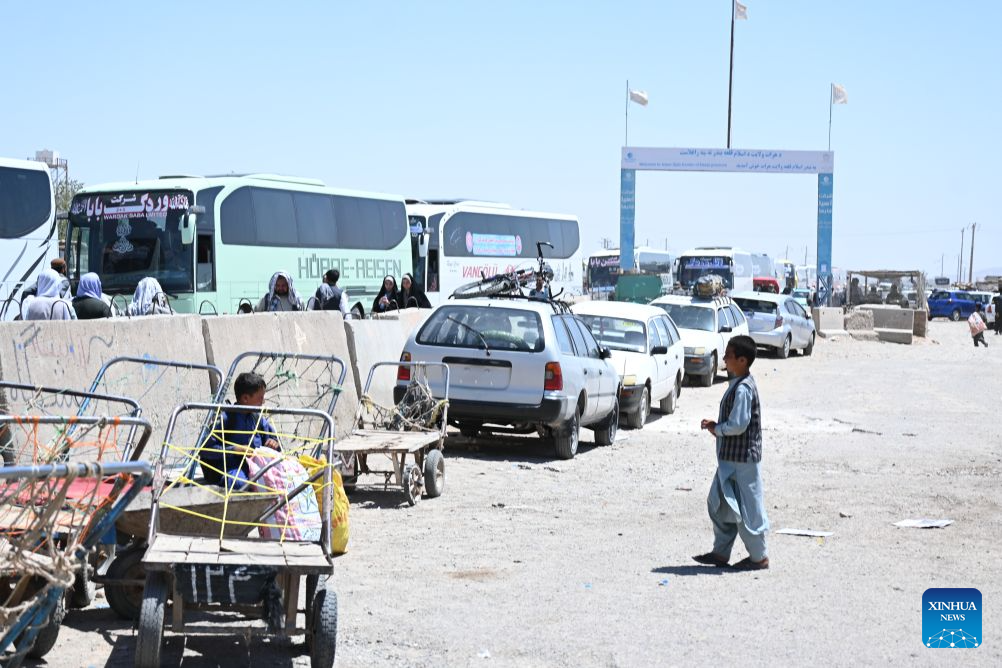
This photo taken on Aug. 10, 2026 shows a view in Islam Qala, a town along the border with Iran, in Herat province of Afghanistan. TO GO WITH "World Insights: Five years after Taliban returned to power, where does Afghanistan stand?" (Xinhua/Zhang Yibin)