
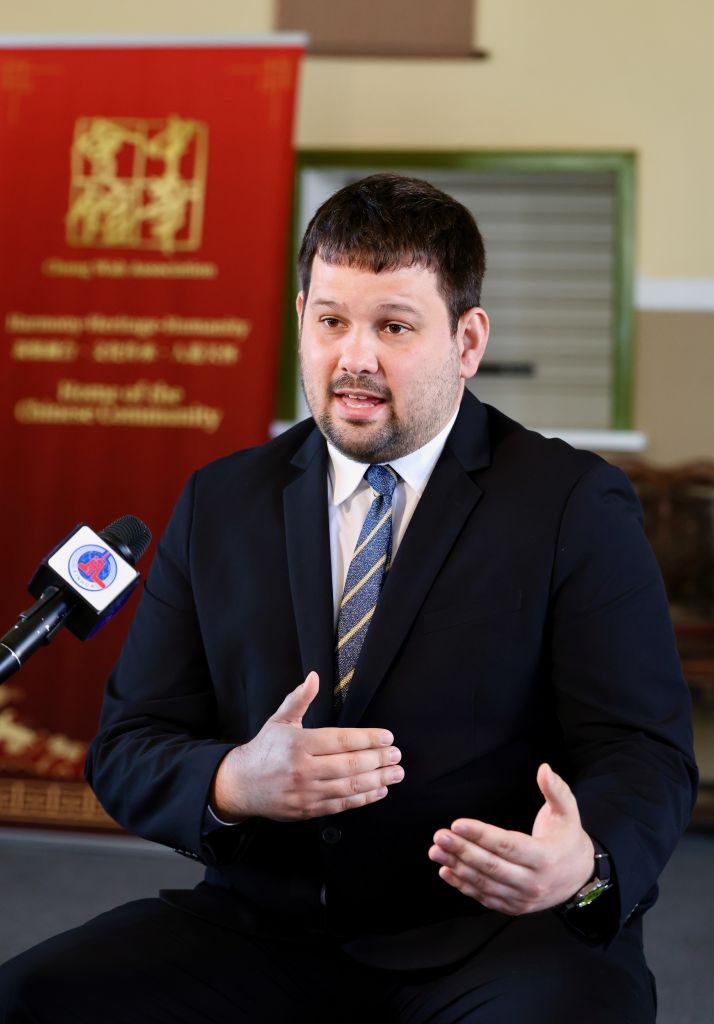
Mackenzie Lang, CEO of the Australia-China Youth Group, speaks in an interview with Xinhua in Perth, Australia, July 28, 2026. (Photo by Zhou Dan/Xinhua)
PERTH, Australia, Aug. 6 (Xinhua) -- He loves mapo tofu and fish-fragrant eggplant, devours works of sci-fi writer Hao Jingfang as well as classic "Romance of the Three Kingdoms," and can hum along to Jay Chou and Faye Wong.
These aren't just personal passions for 29-year-old Mackenzie Lang, known to his Chinese friends as Lang Makun. They also offer a window into his work as CEO of the Australia-China Youth Group, an organization that brings together some 10,000 young people from both countries.
In a recent interview with Xinhua in Perth, the capital of Western Australia, Lang shared his insights on China's social development and youth exchanges between the two countries.
"There's a great place down the road for mapo tofu," he joked, when asked about the first steps to get to know China. But he quickly shifted to a more serious note, outlining three things young Australians should understand.
First, despite differences in education systems and national contexts, young people in both countries "are all fundamentally the same underneath."
"People like sports, people like video games, people like to hang out with their friends," Lang said. "Don't be too intimidated by any differences of culture, because we all have the same passions and hopes underneath all of that."
Second, China is changing at a breathtaking pace. "Even going to the same places in Beijing or in Shanghai that I went to over a decade ago, everything is vastly different," he said. "For young people, just keep in mind often that the things that you might have learned about China, even if they're only a couple of years out of date, they're not really representative of the current situation."
Third, Chinese people are remarkably welcoming to foreign visitors. Lang noted that combined with the convenience of mobile payments, delivery services and other infrastructure, traveling in China is far easier than many imagine.
"The fundamental similarity between people of all ages across everywhere in the world is that everyone wants a good life," Lang said. "I think that we're all capable of being good neighbors to each other. It's just a question of reaching out with curiosity and openness and understanding that other people want similar things to you."
Lang's interest in China first took root in a high school elective, through a small Chinese language class -- just eight students by the end -- taught by an Australian teacher who made all the difference with her passion in the culture. But it was his first trip to China in 2013 that turned curiosity into conviction.
"My parents took me to Beijing, I think it was definitely the largest city I'd ever been to by then coming from Brisbane," he recalled, still with a hint of awe. "It was just astounding to see the dynamism. There was so much. There was ancient history. There were modern skyscrapers. You could see that things were changing in front of you while there was also a respect for the past."
"That was probably when I began to develop a lot of my interest towards Chinese culture, because I knew I would never run out of things to learn," he added.
Lang studied Chinese language, history and economics at university, increasingly fascinated by "how different so many of the things China was doing were from what we were doing in Australia." After graduation, he found a way to stay engaged with Australia-China space through the Australia-China Youth Group, and eventually took on a larger role within the organization.
Looking back on more than a decade of engagement, he acknowledged the ups and downs in the bilateral relationship, but he has also seen "a resilience in that people are willing to continue engaging regardless of disagreements or misunderstandings."
Diplomatic relations were only established in 1972, Lang noted, but people-to-people connections went back much further -- to the 19th century, when Chinese migrants first settled in Australia and Australians began traveling to China in search of economic opportunity.
"I've been so honored and touched to work with people from both Australia and China who believe in the relationship firmly, who believe that because of our proximity to each other, because of our shared history, we do have a future together and we want to make sure it's a good future," Lang said, voicing his optimism for the bilateral ties.
"The most important thing that we can do is to make sure that we're all working towards a world of more understanding," he said, proposing work that starts with youth by "exposing them to opportunities to learn about the other country's culture, to travel to the other country, and to engage with people from the other country."
Young Australians drawn to China tend to fall into two groups, Lang observed. One is captivated by the country's 5,000-year history and traditional arts ranging from calligraphy, architecture to clothing. The other is fascinated by its economic vitality and technological innovation, particularly the future-forward vibe of cities like Shenzhen and Hangzhou.
Lang also noted a shift within China: as living standards have risen, so has enthusiasm for history and tradition -- the hanfu revival being one example. "You see a lot more people interested in going to even the smaller museums," he said. "There's a lot more interest from Chinese people in engaging with their own history and culture, and a great increase in domestic tourism."
Lang believes the best way to strengthen mutual understanding is to travel to the other country, and China's visa-free policies are helping.
"It gives people more confidence in terms of planning their trips. It also encourages people to diversify where they travel to," Lang explained, "Everyone goes to Shanghai, but if we can get people to also visit Ningbo, that's really good. Everyone goes to Guangzhou or Shenzhen, but if we can also get them to visit Zhuhai, that's really good."
Lang's most recent trip to China took him to the ancient fortress of Diaoyu City in Hechuan, Chongqing. At a hotpot restaurant, the hosts were so delighted to see foreign visitors that they insisted on not taking his money. For Lang, the warmth of that meal speaks to a larger truth: a vivid China that he hopes more young Australians will discover on their own. ■