
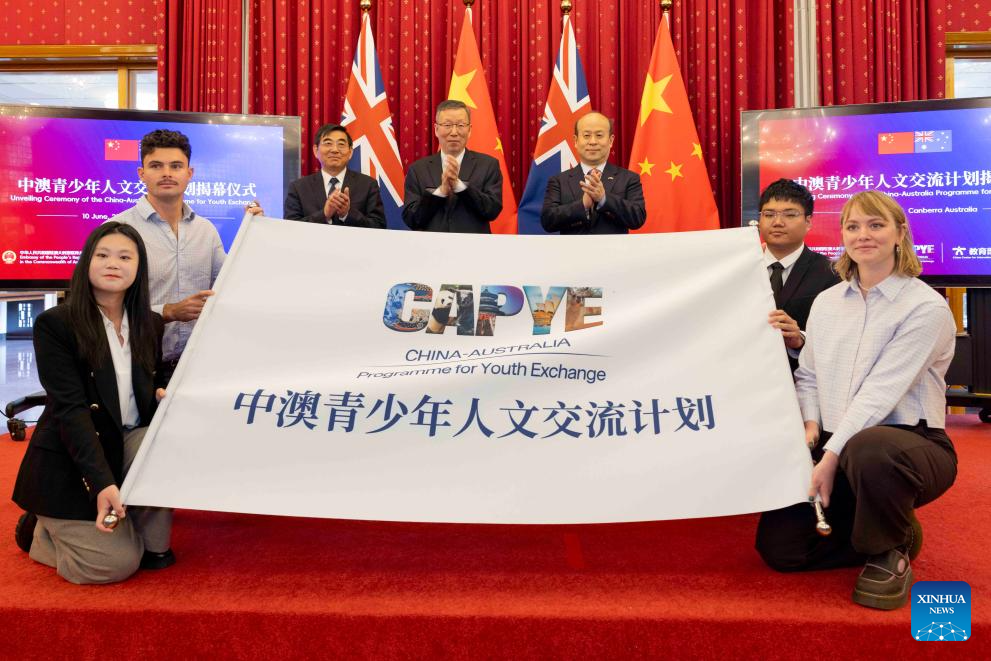
Participants pose for a group photo during the launch ceremony of the China-Australia Program for Youth Exchange (CAPYE) at the Chinese Embassy in Canberra, Australia, June 10, 2026. The launch ceremony of the China-Australia Program for Youth Exchange (CAPYE) was held here on Wednesday, bringing together more than 100 representatives from universities and the education sector of both countries. (Photo by Chu Chen/Xinhua)
CANBERRA, June 10 (Xinhua) -- The soft thud of arrows landing in a traditional Chinese pitch-pot game mingled with the scratch of brush strokes on red paper as young Australians and Chinese gathered to experience each other's cultures and forge new connections at the Chinese Embassy in Australia in Canberra.
The launch ceremony of the China-Australia Program for Youth Exchange (CAPYE) was held on Wednesday, bringing together more than 100 representatives from universities and the education sector of both countries.
Jointly initiated by the Chinese Embassy in Australia and the China Center for International People-to-people Exchange under the Chinese Ministry of Education, the program aims to implement the important consensus reached by Chinese and Australian leaders on inviting more Australian youth for study visits to China.
At the event, participants explored a variety of traditional Chinese cultural activities, including calligraphy, paper-cutting, lacquer fan painting and pitch-pot, an ancient game dating back more than two millennia.
Addressing the ceremony, Wang Jiayi, vice minister of education, noted that student flows between China and Australia have continued to expand.
Describing the program as an innovative step towards bridging cultural differences through genuine human connection, he extended his sincere invitation to young Australians to come to China to experience a country that is dynamic, diverse and full of life.
Chinese Ambassador to Australia Xiao Qian, referring to young people from both countries as successors to the cause of China-Australia friendship, said, "I hope you will be practitioners of mutual learning among civilizations, builders of bridges of friendship, and pioneers of practical cooperation."
This year's program features a series of activities including dragon boat competitions, music exchanges and study tours covering marine ecology, artificial intelligence, traditional Chinese medicine, ceramics and martial arts, providing immersive experiences for participants from both countries.
For Nobel Prize-winning astrophysicist Brian Schmidt, people-to-people exchanges are the "foundation" of China-Australia relations and "absolutely essential."
Noting his long-lasting friendship with his fellow astronomers he met in his early 20s, Schmidt said in an interview with Xinhua, "By building thousands upon thousands of relationships now, we can make sure that a decade or two decades in the future ... we always have those relationships to start anchoring and bringing things together."
"By creating more and more strands of connection, we're essentially building a stronger set of connections for the future that will withstand whatever the world brings us, if necessary, or will allow us to help solve the many challenging things that humanity faces on planet Earth," he added.
For young Australians, the impact of such exchanges is already tangible.
Peter Collins, a marine biology and ecology student at The University of Queensland, participated in a four-week study tour to China in 2025. During visits to Chinese cities including Chengdu, Ya'an, Nanjing and Shanghai, Collins and his fellows visited businesses and scientific research facilities and experienced Chinese culture through cooking, language classes, and site visits.
"While these experiences were incredibly valuable, it was the people we met who made the greatest impact," he said. "Through the program, I formed meaningful friendships with Chinese students, sharing conversations, playing sports, and gaining new perspectives."
Programs like this bridge cultural gaps, foster genuine connection, and equip young people to collaborate across borders, he noted. "My experience in China showed me that understanding one another is the foundation for collaboration, innovation, and lasting relationships," he said.
Among those preparing for their first visit to China is Jude Schimer, a student from the University of Adelaide and a member of his university's rowing club. Together with his teammates, Schimer will travel to China as part of an exchange program.
"What I'm really looking forward to is connecting with Chinese students, being able to talk to them about what their dreams and aspirations are," he said, believing theirs will be similar to his.
Excited to be in China and experience "a culture that is so vastly different from Australia," he noted his role as an ambassador of the bilateral friendship -- "prioritizing what unites us."
"There's a huge role for young people to play in bridging that gap and bridging the understanding with each other," he said.
Rongyu Li, chair of the Universities Australia Deputy Vice-Chancellor International Committee, said meaningful cooperation in any field ultimately depends on people-to-people connections, and direct exchanges between young people help broaden perspectives and foster a more balanced and objective understanding of each other.
Li said that as more Australian students visit China through exchange programs, they gain firsthand experiences that enable them to tell authentic stories about the country.
"These young people may one day become important drivers of cultural exchanges, educational cooperation and broader engagement between our two countries, and genuine ambassadors of friendship who connect the peoples of China and Australia," he said.
For the young participants gathered in Canberra, the launch ceremony marked only the beginning. The larger story of China-Australia people-to-people exchanges -- built on curiosity, understanding and friendship -- is only just unfolding. ■
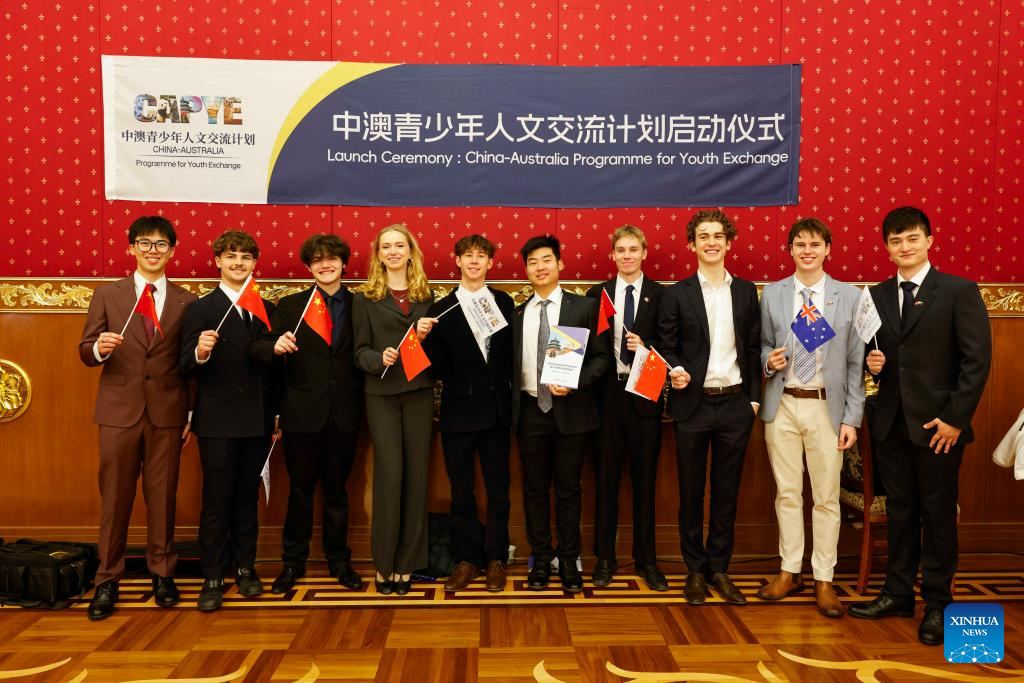
Participants pose for a group photo during the launch ceremony of the China-Australia Program for Youth Exchange (CAPYE) at the Chinese Embassy in Canberra, Australia, June 10, 2026. The launch ceremony of the China-Australia Program for Youth Exchange (CAPYE) was held here on Wednesday, bringing together more than 100 representatives from universities and the education sector of both countries. (Photo by Chu Chen/Xinhua)
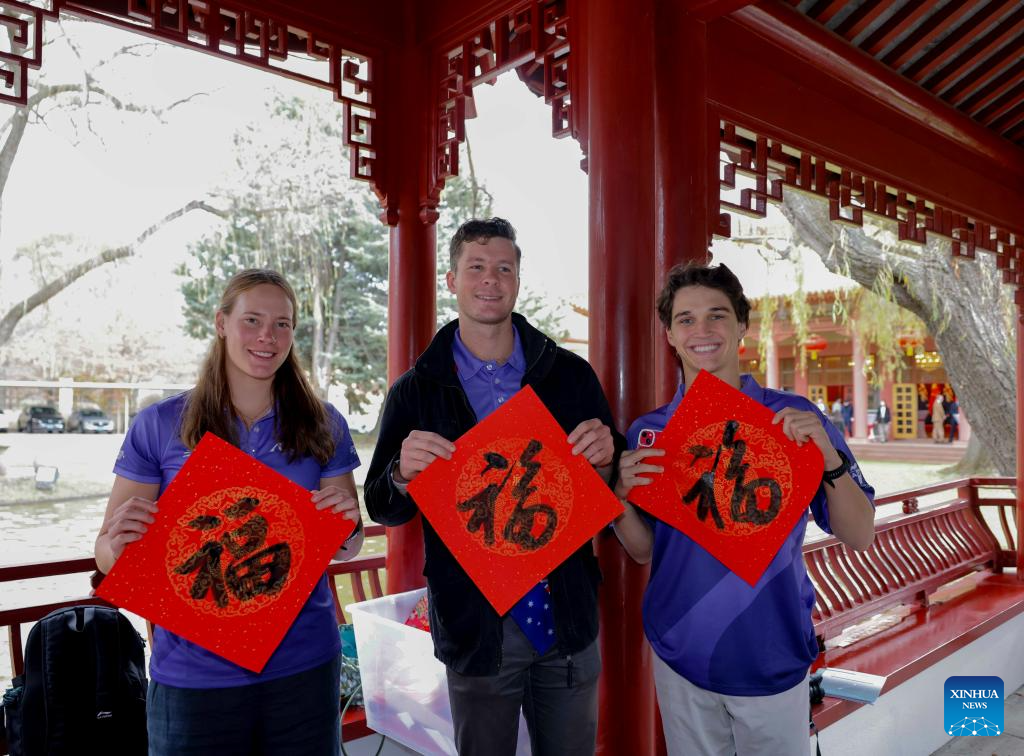
Young participants display the Chinese character "Fu," which means good fortune, at the Chinese Embassy in Canberra, Australia, June 10, 2026. The launch ceremony of the China-Australia Program for Youth Exchange (CAPYE) was held here on Wednesday, bringing together more than 100 representatives from universities and the education sector of both countries. (Photo by Chu Chen/Xinhua)