
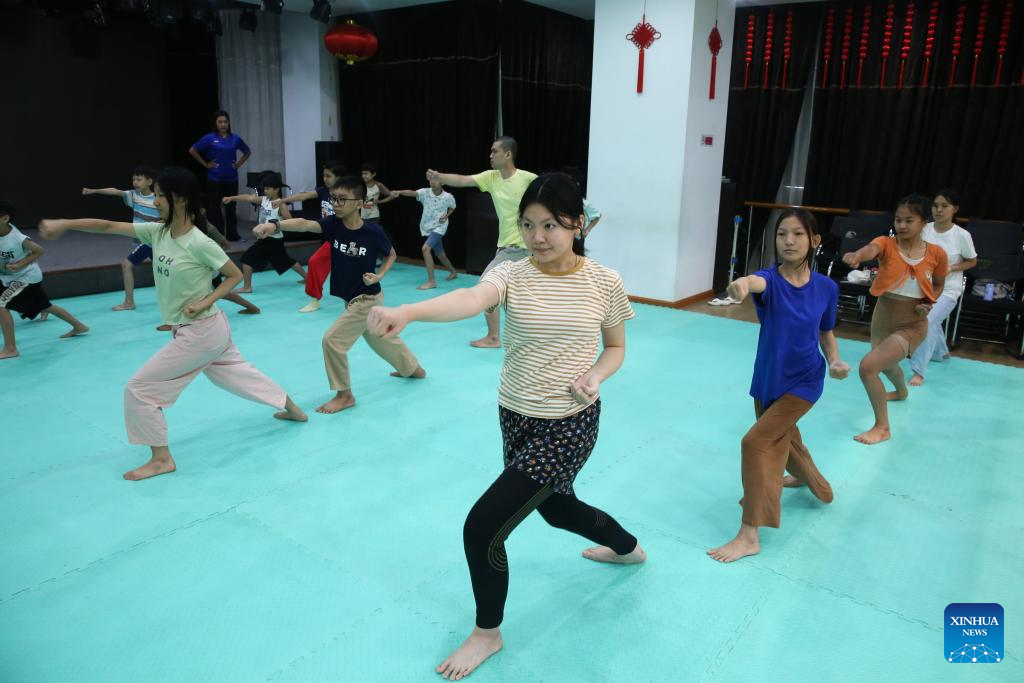
Students attend a Wushu training class at the China Cultural Center in Yangon, Myanmar, April 23, 2026. (Xinhua/Myo Kyaw Soe)
YANGON, April 23 (Xinhua) -- On a warm summer morning, rhythmic footsteps and swift hand movements fill the China Cultural Center in Yangon as focused, energetic children practice Wushu, a traditional Chinese martial art that is steadily gaining popularity among Myanmar's youth.
For many students, the summer course of Wushu (Long Fist) offers more than a way to stay active. It builds discipline, improves health, and connects them with another culture. The course runs from March 24 to May 28, with classes held three days a week for students aged five and older.
Fifteen-year-old Phyu Phyu Thin Thant joined with a clear goal. "I am interested in self-defense, including Wushu, so I joined it during the summer," she said. "We not only learn self-defense techniques, but also stretching exercises that improve our health."
Her interest in Chinese culture goes beyond martial arts. Having studied Chinese since the age of three, she sees the course as a valuable opportunity and encourages others to join.
For 14-year-old Su Yati Aung, Wushu is both practical and enjoyable. "I am interested in martial arts for self-defense, and I learned techniques during the class," she said.
She is also interested in music and recently completed a month-long course learning the Guzheng, a traditional Chinese instrument.
"I made new friends during the class. Practicing Wushu helps improve my health," she added.
Having attended a Chinese kindergarten, she has been familiar with the language and culture from an early age. She expressed gratitude to the center and hopes for more courses in the future.
Twelve-year-old Kyal Sin Aung joined with an older sibling, drawn by a shared interest in martial arts. Like many peers, he has studied Chinese since early childhood.
For parents, the benefits are clear. Daw Kyokwan Sio, 49, mother of Su Yati Aung and Kyal Sin Aung, enrolled her children to encourage a more active lifestyle.
"At home, they usually spend their free time playing games," she said. "I want them to develop physically, improve their health, and make new friends." She added that the classes help reduce time spent on mobile phones.
The program is led by Daw Aye Thitsar Myint, a coach from the Myanmar Wushu Federation with two decades of experience and three years of coaching.
"Wushu is suitable for all ages," she said. "Young people can practice Changquan (Long Fist) and Nanquan (Southern Fist), while adults can choose Tai Chi for health. It benefits the whole body."
Changquan, the style taught in the summer class, requires full-body coordination. "You have to move your torso, arms, and legs at the same time, which teaches body control," she explained.
Training starts with basics such as punching and footwork, then moves to muscle relaxation. "Only when the muscles are relaxed can they perform the main techniques well," she said.
The benefits extend beyond fitness. "They improve their health and physical development, gain better focus, and learn teamwork," she said.
The initiative is part of a broader effort by the China Cultural Center in Yangon to promote cultural exchange. The center's director Xiang Jianbo said the summer programs aim to leverage the summer season to provide Myanmar's youth and cultural enthusiasts with a high-quality platform to experience and learn about outstanding traditional Chinese culture firsthand.
He added that the center aims to meet the growing demand of the local population for understanding Chinese culture, enrich their summer cultural life, and allow them to experience the unique charm of Chinese culture in a relaxed and enjoyable atmosphere.
Noting that culture is a bridge for communication, he said this type of cultural training program plays a crucial and positive role in deepening the "Paukphaw" (fraternal) friendship between China and Myanmar.
By regularly holding cultural training courses, he added, the center hopes traditional Chinese culture will take root in Myanmar. ■
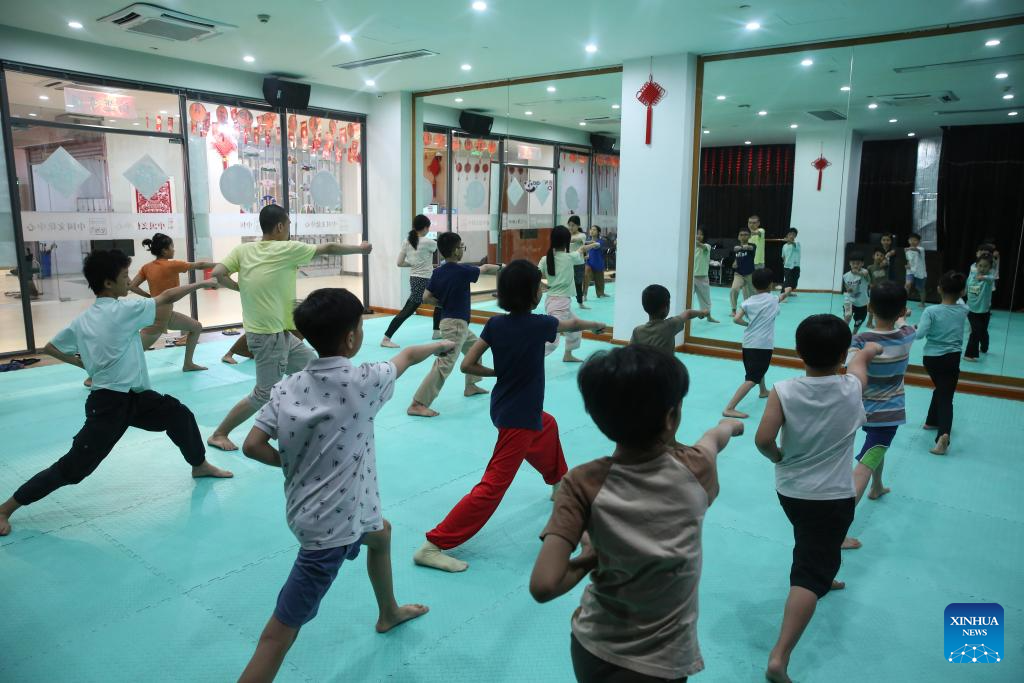
Students attend a Wushu training class at the China Cultural Center in Yangon, Myanmar, April 23, 2026. (Xinhua/Myo Kyaw Soe)