
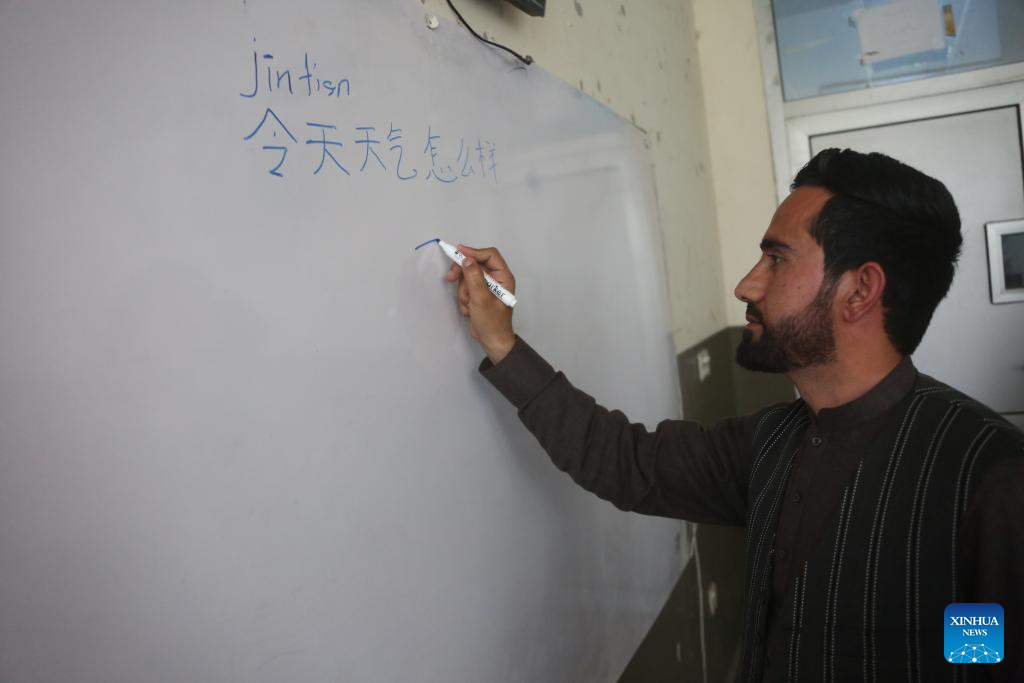
A teacher gives a Chinese language lesson at Nangarhar University in Jalalabad, Nangarhar province, Afghanistan, April 12, 2026. Under the framework of Afghanistan's Confucius Institute, a Chinese language course was established at Nangarhar University in 2018. Since then, it has provided opportunities for more than 130 Afghan youth to learn Chinese.(Photo by Saifurahman Safi/Xinhua)
JALALABAD, Afghanistan, April 19 (Xinhua) -- Every morning, with firm determination and hope for a bright future, 20-year-old Bakhtiar Aryubzi walks into the Chinese-language classroom at Nangarhar University in eastern Afghanistan.
For him and a growing number of young Afghans, mastering Chinese is more than a practical skill; it is a pathway to connect cultures, foster understanding, and open doors between Afghanistan and neighboring China.
The interest in learning Chinese is surging not only in the capital but also day by day across the east of the country. While job opportunities and scholarships draw many students, the deeper motivation for many lies in cultural exchange, the chance to share Afghan heritage while embracing Chinese traditions, history, and values.
"Learning the Chinese language has many job and practical opportunities," Aryubzi said. Beyond language study, he sees it as a bridge between peoples. "The Chinese language is not only a means of conveying and understanding, but also a way of entering a new culture and getting to know it. I can share our cultures by translating into this language and make exchanges happen."
Fellow student Abdullah Momand shares that vision. Passionate about Chinese for years, he hopes mastery of the language will spread cultures while strengthening political ties. "I want to pursue a master's degree in China and play an active role in the political relations between China and Afghanistan," Momand told Xinhua inside his Chinese class.
"I want to become familiar with Chinese culture and its ancient sites." Like his peers, he views learning Chinese as a guarantee of a bright future and encourages his brothers and sisters to join him. "Those who learn Chinese have many opportunities available to them," he said. "The more knowledge people gain, the greater their interest in learning the Chinese language becomes," he added.
Abdul Kabir Halimi, who journeyed hundreds of kilometers from the remote, mountainous province of Nuristan to Nangarhar University, is now at his HSK 4 level and already speaks Chinese fluently.
"From a long time, I was interested in learning Chinese, but because our province is remote, there were no educational opportunities there, so I came here," he said. He is witnessing the rewards of his year-long efforts and envisions even greater possibilities ahead.
"If we learn Chinese well, there are many job opportunities in embassies, mining, trade, and education," he added with enthusiasm. His ultimate goal reaches beyond employment: "My goal is to go to China; I can study Chinese literature there."
At the Confucius Institute in eastern Afghanistan, instructor Abdul Basir Baryal has taught Chinese at Nangarhar University for five years and watches the enthusiasm grow. "With each passing day, the interest of young people in learning Chinese in the eastern zone of the country is increasing," he told Xinhua.
He pointed to two main drivers: expanding job opportunities, especially in the mining sector and with Chinese companies, and the chance to study in China through government scholarships. "Currently, we have around 40 to 50 students whom we teach in three shifts," Baryal said.
Yet challenges remain. Baryal noted the lack of adequate facilities, including standard classrooms, sufficient teaching materials, and a dedicated building for Chinese instruction. "We are facing the lack of standard classrooms for learning Chinese; we make do with the basic facilities we have."
Hedayatullah Hakimi, deputy dean of the Faculty of Languages and Literature at Nangarhar University, confirms the nationwide surge. "Not only in this region (the East), but across all of Afghanistan, the entire new generation is striving to learn Chinese," Hakimi told Xinhua.
Under the framework of Afghanistan's Confucius Institute, a Chinese language course was established at Nangarhar University in 2018. Since then, it has provided opportunities for more than 130 Afghan youth to learn Chinese.
The growing fascination with the Chinese language among Afghan youth reflects broader aspirations for cultural dialogue and practical advancement in a country seeking stronger international partnerships.
Through language, students like Aryubzi, Momand, and Halimi see themselves not only gaining economic opportunities but actively contributing to mutual understanding, translating texts, sharing traditions, and building lasting people-to-people connections between Afghanistan and China. ■
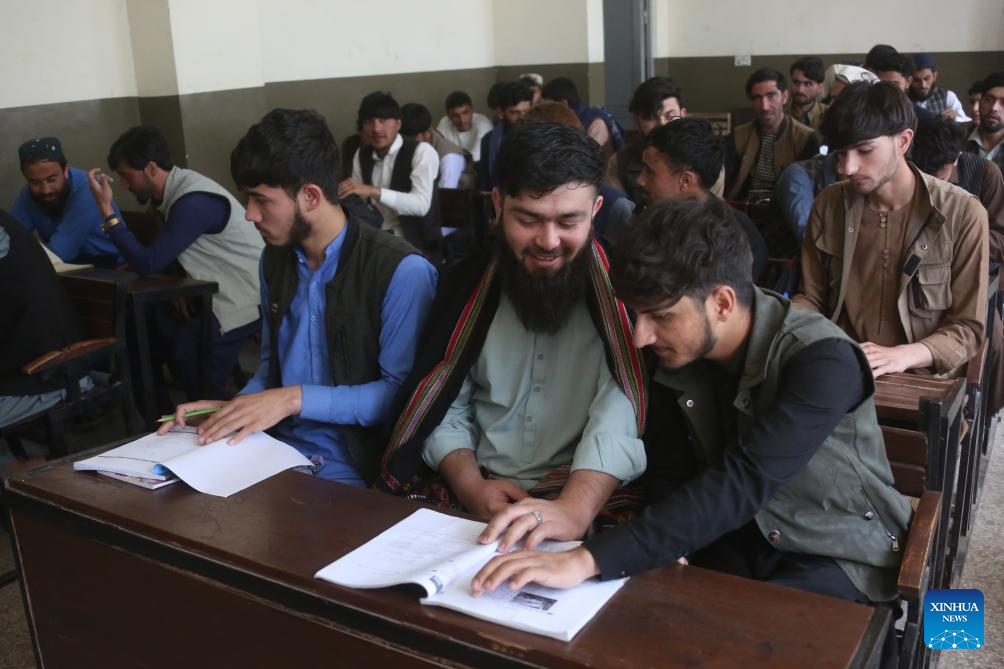
Students attend a Chinese language class at Nangarhar University in Jalalabad, Nangarhar province, Afghanistan, April 12, 2026. Under the framework of Afghanistan's Confucius Institute, a Chinese language course was established at Nangarhar University in 2018. Since then, it has provided opportunities for more than 130 Afghan youth to learn Chinese.(Photo by Saifurahman Safi/Xinhua)