
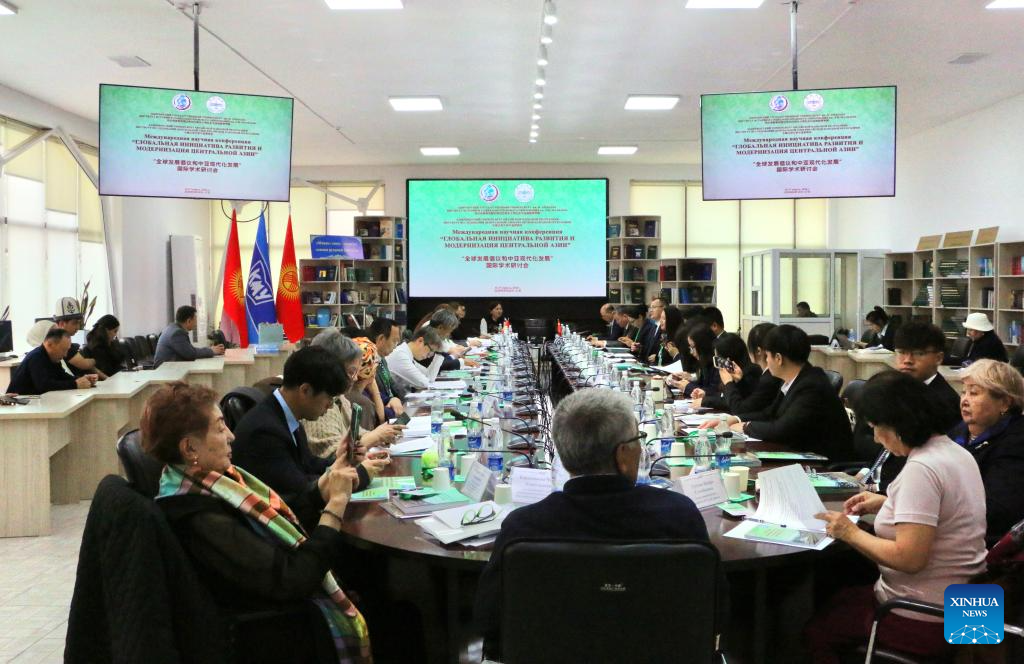
This photo taken on April 16, 2026 shows a scene during an international symposium on modernizing Central Asia in Bishkek, Kyrgyzstan. (Xinhua/Jiang Youlin)
BISHKEK, April 17 (Xinhua) -- An international symposium on modernizing Central Asia on Thursday examined ways in which China's Global Development Initiative could bolster growth and development in the region.
Marat Imankulov, an advisor to the president of Kyrgyzstan, said that identifying sustainable development pathways, achieving economic modernization, and strengthening regional cooperation are of practical significance for Central Asian nations. He noted that the Chinese initiative provides a platform for discussing poverty reduction, infrastructure development, digitalization, the green economy, and cultivating talent.
Li Hua, minister counselor at the Chinese Embassy in Kyrgyzstan, said that major cooperation projects between China and Central Asian countries are being steadily implemented, with connectivity continuously improving. He added that an integrated framework for cooperation is taking shape.
"China will bring more development opportunities to Central Asian countries through high-quality development and high-level opening-up, and work with all parties to forge a broad path toward shared modernization," Li said.
Chinara Kashkaraeva, a senior lecturer in the Department of International Relations and Law at the Diplomatic Academy of the Ministry of Foreign Affairs of Kyrgyzstan, said that the Belt and Road Initiative is one of the most important initiatives today. She noted it aligns with Kyrgyzstan's interests and contributes to modernization in Central Asia, which explains the region's active response.
Jiao Yiqiang, a professor at the Institute of Politics and International Relations at Lanzhou University, said that "China has never sought modernization alone, but has strived for collective development and mutually beneficial cooperation with all countries."
The symposium, jointly organized by Kyrgyz State University named after I. Arabaev and Lanzhou University, brought together nearly 40 experts and scholars from China and Central Asia to discuss the impact of China's initiatives on regional modernization, cooperation models, and the policy landscape in Central Asia. ■