
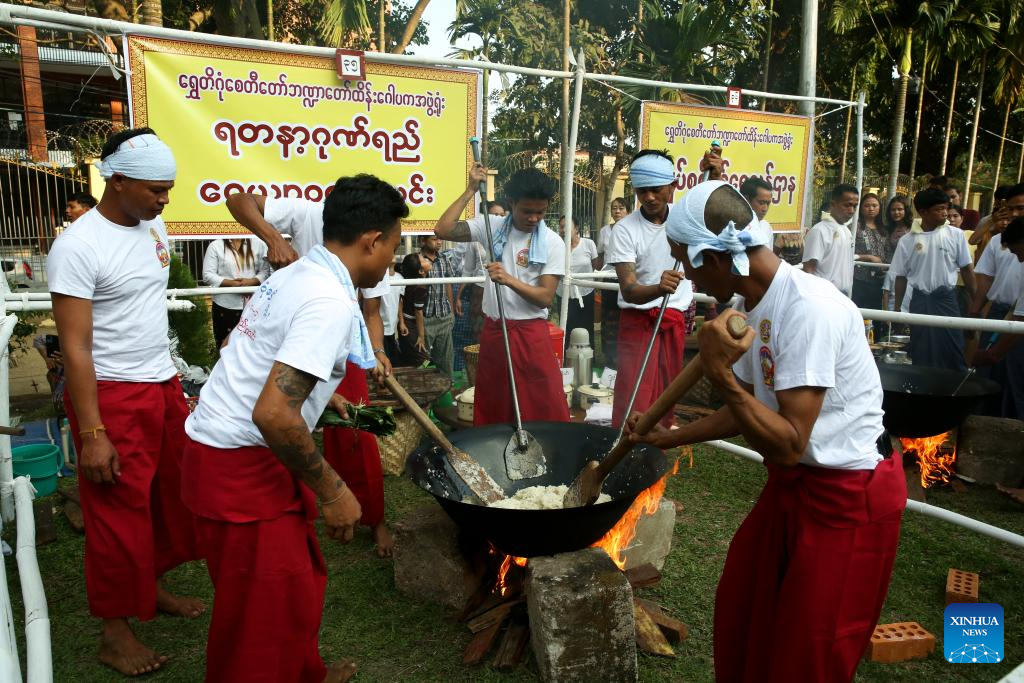
People participate in a Htamane-making competition at the Shwedagon Pagoda in Yangon, Myanmar, Jan. 31, 2026. Htamane, the festival's signature dish, is made from glutinous rice, sesame seeds, peanuts, coconut slices, and ginger. (Xinhua/Myo Kyaw Soe)
YANGON, Feb. 1 (Xinhua) -- On Saturday afternoon, the eve of the full moon of Tabodwe, Shwedagon Pagoda towered over Yangon as Myanmar's most sacred landmark and the heart of a living cultural tradition.
Excitement filled the pagoda grounds as 36 teams gathered at its base to take part in the annual Htamane-making competition.
Yangon Region Chief Minister U Soe Thein officially opened the competition, marking the start of one of Myanmar's most cherished traditional celebrations.
Now in its 18th year at Shwedagon Pagoda, the annual Htamane-making contest has been held. The festival celebrated Myanmar's cultural and religious heritage while uniting communities through the preparation of Htamane.
Htamane, the festival's signature dish, is made from glutinous rice, sesame seeds, peanuts, coconut slices, and ginger.
U Hla Thein, 62, from the Traditional Medicine Practitioners' Group, said he joined the competition out of love for Htamane and Myanmar culture. "The participation is less about winning and more about preserving tradition and passing inherited skills to younger generations."
Having participated for over eight years, he said "unity is essential," adding that he received Htamane-making knowledge from his parents and was passing it down to his sons and nephews.
Nearby, U San Win, 74, leader of the Dhamma Pala Association, supervised his team, offering guidance rather than stirring due to his age.
He said Htamane-making symbolizes unity, explaining that no one can succeed alone and that cooperation determines success.
The Htamane mixture is stirred continuously with water until it thickens, before roasted sesame seeds, peanuts, and coconut slices are added.
Teams used large wooden paddles, requiring strength and coordination, and judges assessed hygiene, ingredients, texture, and flavor, the teams said.
Although prizes were awarded, participants said the true spirit of the competition lay in teamwork and cultural preservation.
Beyond the contest, the festival featured traditional music and dance, creating a vibrant celebration of Myanmar's heritage.
U Aung Myo, 49, from a traditional entertainment troupe, performed with traditional Shan drums to encourage participants and celebrate the once-a-year event.
Among the competitors was the Shwe Thitsar association, the only all-women team in the competition.
Member Daw Pyone Pyone Htay, in her 40s, said the team was proud to compete despite the physical challenge of stirring heavy mixtures.
She said offering the prepared Htamane to the Buddha and monks brought great joy and spiritual merit to the team.
She added that teamwork created a strong sense of togetherness and showed that women could take part equally in the tradition. "It's exciting to compete against male teams, but we're happy knowing the food we make will be offered to the Buddha the next morning."
Spectator May Myat Noe Oo attended with her family, and the festival inspired her son to one day join a Htamane team. Her 11-year-old son, Mg Zarni Aung, said, "I love the event. I want to participate in the teams when I grow older."
The prepared Htamane will be offered to monks and shared with the public the next day, reflecting the festival's spirit of generosity and unity.
Across Myanmar, similar celebrations were held to mark the full moon of Tabodwe, reinforcing the country's strong Buddhist tradition of charity.
The state-owned daily The Mirror reported on Saturday that many ministries and government offices also organized Htamane cook-offs across the country.
The report added that the traditional Htamane cook-off is a unique cultural festival. It aims to preserve ancient traditions while fostering a spirit of mutual support, cooperation, and national unity.
This year, the full moon day of Tabodwe, the 11th month of Myanmar lunar calendar, falls on Feb. 1. ■
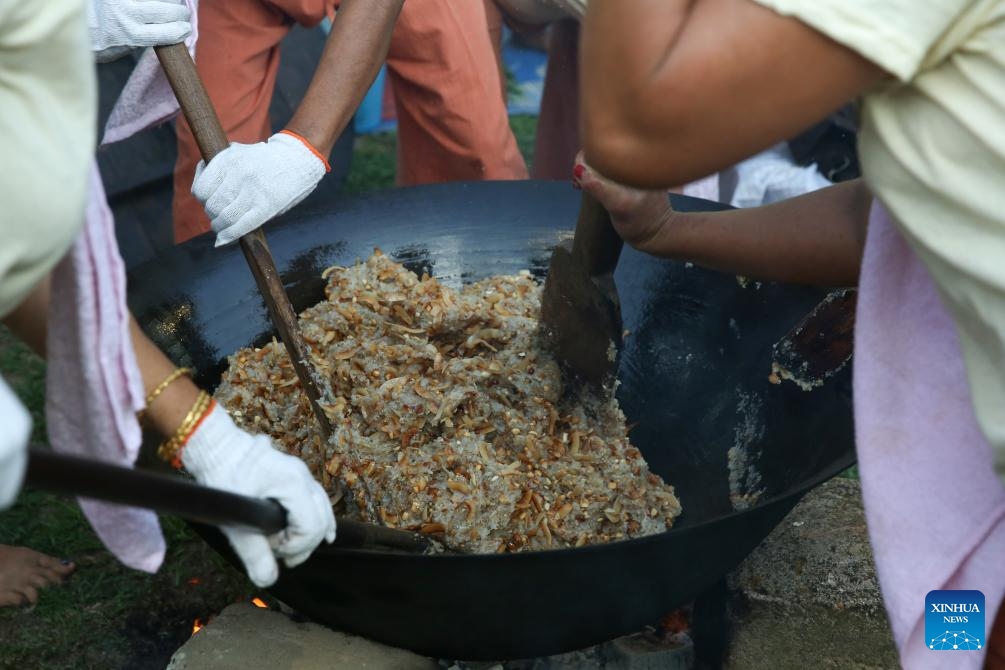
People participate in a Htamane-making competition at the Shwedagon Pagoda in Yangon, Myanmar, Jan. 31, 2026.
Htamane, the festival's signature dish, is made from glutinous rice, sesame seeds, peanuts, coconut slices, and ginger. (Xinhua/Myo Kyaw Soe)
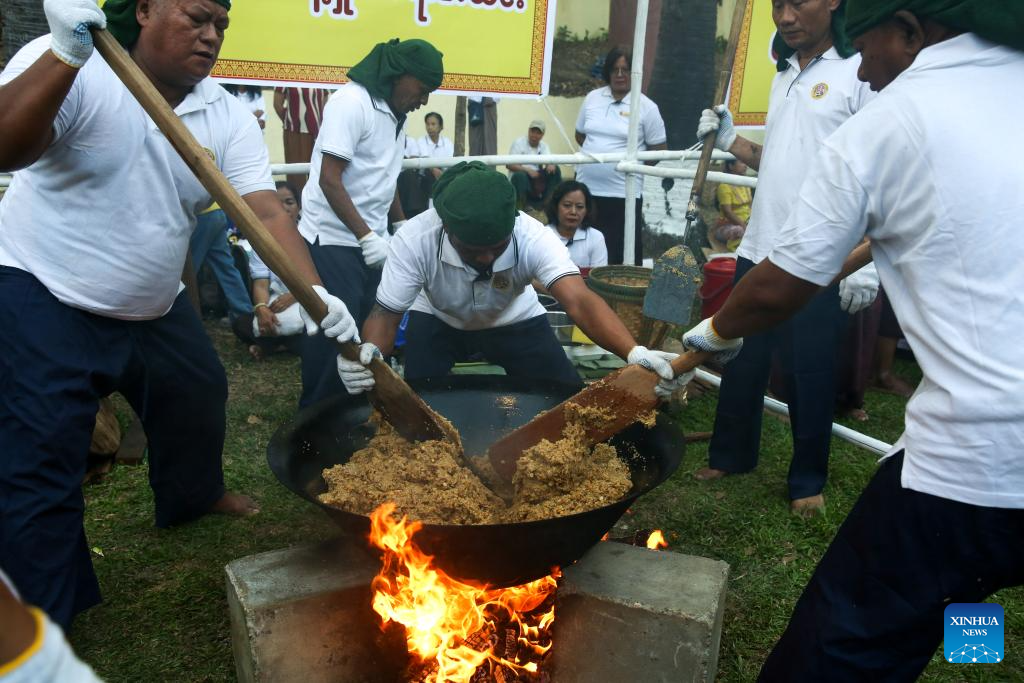
People participate in a Htamane-making competition at the Shwedagon Pagoda in Yangon, Myanmar, Jan. 31, 2026.
Htamane, the festival's signature dish, is made from glutinous rice, sesame seeds, peanuts, coconut slices, and ginger. (Xinhua/Myo Kyaw Soe)