
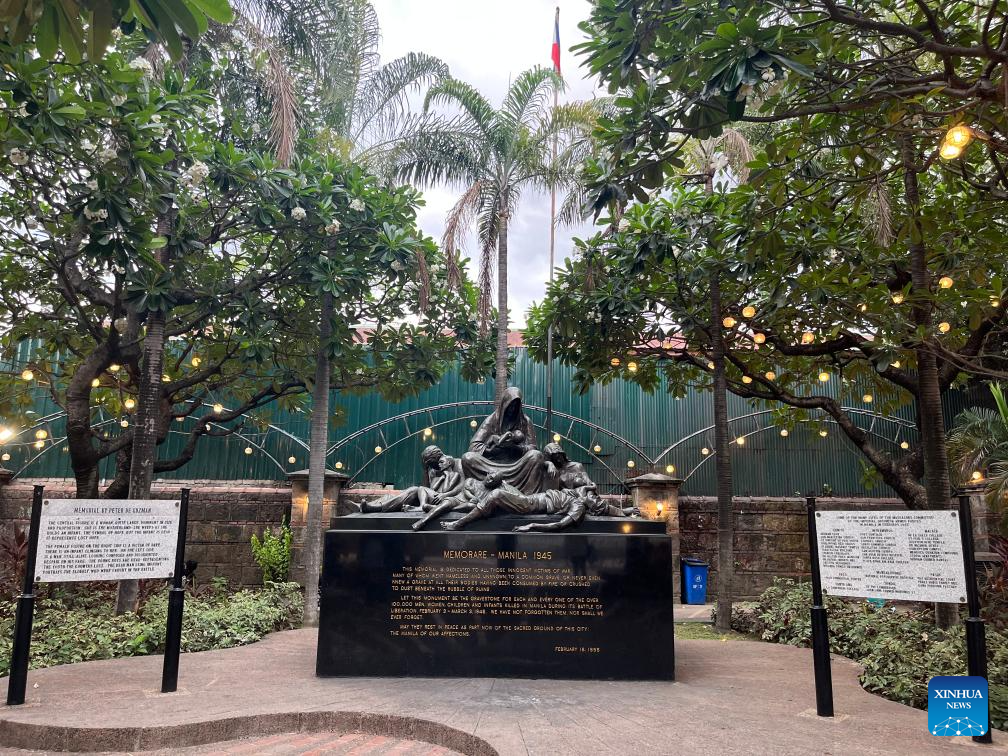
This photo shows the Memorare Manila Monument located in Intramuros, Manila, the Philippines, March 22, 2025. (Xinhua/Zhang Yisheng)
by Xinhua writer Zhang Yisheng
MANILA, Jan. 30 (Xinhua) -- In the heart of the Philippine capital, the Memorare Manila Monument, erected to honor the over 100,000 civilians slaughtered in 1945, stands in stark contrast to recent efforts by historical revisionists in Japan to distort wartime history.
These revisionists have a single aim: to downplay or deny the country's aggression and sanitize historical narratives surrounding Japan's well-documented atrocities committed during World War II.
But beyond political debate, the blood-stained reality of the Japanese occupation remains an indelible part of collective memory, a living warning that no amount of revisionism can erase.
BOMBING AN OPEN CITY
Before the outbreak of the Pacific War, Manila was known as the "Pearl of the Orient." That legacy, however, was nearly obliterated during more than three years of Japanese occupation, as the capital was reduced to ruins and mass graves.
The tragedy began on Dec. 8, 1941, only hours after Japan attacked the U.S. naval base at Pearl Harbor. Japanese forces soon landed on Luzon Island and advanced rapidly toward Manila.
On Dec. 26, 1941, Manila was declared an "open city" in a desperate bid to shield its civilians and centuries of cultural heritage from the machinery of war. Under international law, this meant the city was undefended and should not have been attacked.
Yet, the Imperial Japanese Army responded with a rain of fire. Japanese aircraft systematically pummeled the capital, reducing historic buildings to rubble and turning schools and hospitals into graveyards.
Japanese troops also carried out brutal reprisals against captured soldiers and civilians. Many surrendered troops, wounded or not, were executed, with some burned alive. Civilians accused of defying occupation rules were tortured and killed.
This early flagrant disregard for civilian life set the tone for the years of terror that followed.
BATAAN DEATH MARCH
Following the surrender of U.S. and Filipino forces on April 9, 1942, the Japanese troops carried out one of the most brutal war crimes in the Pacific theater: the Bataan Death March.
About 78,000 Filipino and American prisoners of war were forced to march roughly 145 km from the tip of the Bataan Peninsula to Camp O'Donnell under extreme conditions. For days, they were denied food, water and medical care.
Historical records tell of the "sun treatment," where prisoners were forced to stand motionless in the blistering noon heat until they collapsed.
Along the way, survivors later recalled, those who faltered were bayoneted, while those who begged for water were shot.
Historians estimate that as many as 15,000 prisoners died during the march, while tens of thousands more died during subsequent internment due to systematic abuse and neglect.
REALITY BEHIND "CO-PROSPERITY"
Japanese wartime propaganda branded the occupation as a mission to "liberate" Asia from Western colonialism. In reality, the Filipino people soon found themselves under a far more predatory yoke.
Imperial Japan plundered the archipelago's resources, orchestrating a man-made famine that decimated rural communities. Education was weaponized through mandatory Japanese-language indoctrination.
Between 1942 and 1945, approximately 1,000 Filipino women were forced into sexual slavery as "comfort women." For many survivors, the suffering lingered long after the war ended.
In 2017, a memorial statue honoring "comfort women" was erected in Manila, only to be removed months later following intense diplomatic pressure from Tokyo.
Women's groups, including GABRIELA and Lila Pilipina, condemned the removal and have continued to demand justice, calling for an official apology, compensation and the inclusion of comfort women's experiences in Japan's historical records and textbooks.
"It is very sad that unlike postwar Germany which had officially apologized for their World War II atrocities and has zealously upheld correct history to ensure peace, Japan has not yet made the same clear break from the past, it has not yet officially apologized for past war crimes and not yet consistently upheld accurate war history," Wilson Flores, a Philippine analyst of economics and politics, told Xinhua.
"NIGHTMARISH" MANILA
The occupation reached its horrific crescendo in February 1945. As Allied forces liberated the city block by block, trapped Japanese troops turned their desperation into a massacre.
From Feb. 3 to March 3, Manila became the site of the bloodiest urban battle of the Pacific War. More than 100,000 civilians were slaughtered -- bayoneted, shot, burned alive or raped in deliberate acts of mass violence.
In the walled city of Intramuros, Japanese troops sealed all gates and turned the ancient district into a killing field. Lots of men were herded into Fort Santiago and systematically killed.
The carnage radiated into the surrounding districts. In Malate, at Saint Paul's College, a dining hall became a death trap as explosives were detonated among hundreds of terrified residents seeking refuge.
By the time the fighting ended, more than 600 city blocks were destroyed, along with centuries of cultural and architectural heritage.
Henry Keys, a war correspondent who witnessed the aftermath, wrote that Manila had become "a city of nightmarish horror," comparing its devastation to the atrocities committed by Japanese forces in Nanjing.
"History is not a collection of dead facts; it is a living warning," said Flores, also a columnist for local media. "Remembering the atrocities committed in the Philippines means remaining vigilant against the resurgence of the ideologies that made them possible."
Flores added: "Eight decades have passed, and the ruins of Manila have been rebuilt, but the call for historical truth must never be silenced." ■