
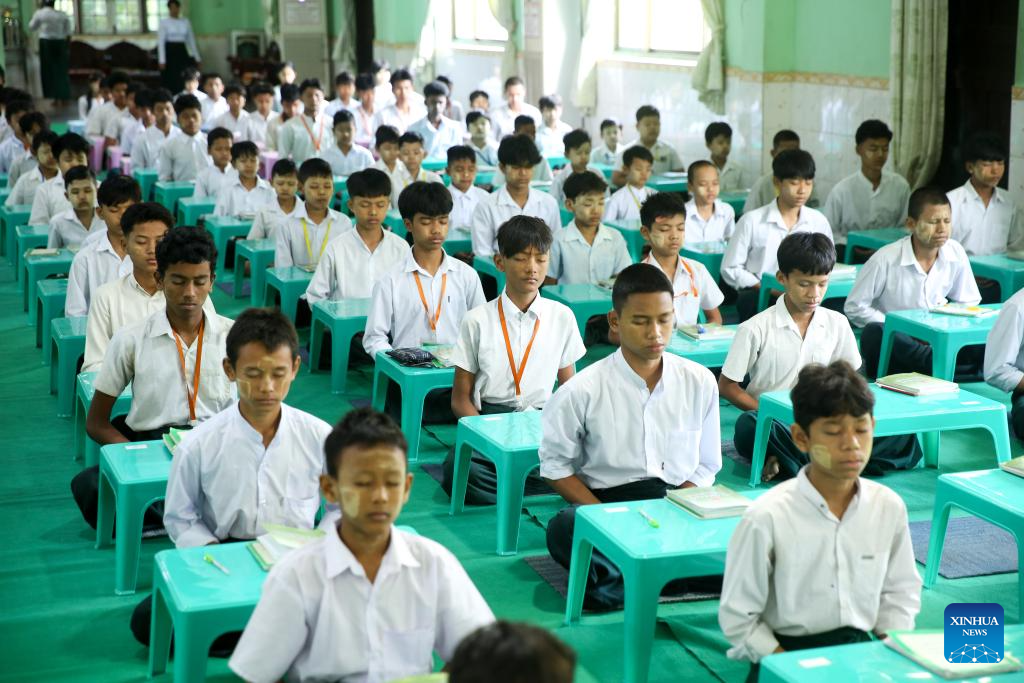
Students attend a meditation course at a post-primary monastic school in Yangon, Myanmar, Dec. 11, 2025. (Xinhua/Myo Kyaw Soe)
YANGON, Dec. 21 (Xinhua) -- As the morning sun filters through the quiet halls of a post-primary monastic school in Dala township, Yangon region, 14-year-old Wai Yan Tun sits cross-legged, eyes gently closed, his attention fixed on his breathing.
For him, this moment of stillness is as familiar as opening a textbook. On World Meditation Day, observed this Sunday, his daily routine reflects a tradition deeply rooted in Myanmar's education system.
Across the country, meditation is not an occasional exercise but a regular part of basic education school life, particularly in monastic and government schools.
Children are often introduced to the practice at an early age and continue it throughout their school years, learning to calm their minds before turning to lessons in mathematics, language, and science.
Wai Yan Tun, now an eighth grader, has been meditating since kindergarten. He said the practice has shaped not only his school performance but also his emotional life.
"Meditation makes me feel calm and peaceful," he said. "It makes my mind more concentrated, which helps my studying become easier."
The challenge, he admitted, is keeping his thoughts from drifting. When possible, he prefers quiet spaces like pagodas, where silence makes focus easier.
For 15-year-old Wai Wai Phyo, meditation did not come easily at first. She remembered beginning the practice in fourth grade, struggling with physical discomfort. "At the beginning, I felt stiffness and pain in my legs, and it was difficult to focus," she said.
Years later, after meditating for about half an hour each school day, she felt the difference. "Meditation helps me understand and solve mathematics problems."
Similar experiences are shared far beyond Dala. In Ayeyarwady region's Bogale township, 14-year-old Kaung Zaw Latt also began meditating at a young age. "When I meditate, my mind becomes quiet," he said.
"I can listen better in class, and I don't get angry easily." Like many children, his early attempts were marked by wandering thoughts.
"My thoughts kept going everywhere," he said. "Now I know how to bring them back to my breathing."
To raise awareness about meditation and its benefits, the United Nations proclaimed Dec. 21 as World Meditation Day, recalling the right of everyone to the enjoyment of the highest attainable standard of physical and mental health.
Guiding the local young meditators is U Nyanika, the Buddhist monk in charge of the Ahlekyaung post-primary monastic school in Dala township. With about 1,000 students from kindergarten to eighth grade, many from challenging backgrounds, he believes meditation is essential. "If they meditate, they change," he said. "Our intention is to train their minds."
Discipline, he explained, is taught in two ways: correcting behavior through instruction and shaping the mind through meditation. Students begin with basic breathing techniques, focusing on the tip of the nostrils, U Nyanika said.
Younger children meditate for five to ten minutes, while older students sit for up to thirty. In a world increasingly dominated by screens, he sees meditation as more important than ever. "Nowadays, children have mobile phone influence and addiction," he said. "Meditation can reduce such addiction and bad influence."
Teachers witness the transformation firsthand. U Hein Yazar, a 23-year-old fourth-grade teacher at the monastic school in Dala, starts each school day with a short meditation session.
"Since they arrive at school, they meditate before studying," he said. "By meditating regularly, the children's minds become calm, and their brains feel refreshed."
He believes the habit can shape a lifetime. "If they practice meditation their whole life, their lives will become calm and peaceful," he said.
The impact of meditation extends beyond school grounds. At the Dhamma Joti Vipassana Meditation Centre, 42-year-old volunteer Ko Myo Myint Oo has helped run children's meditation courses for more than a decade.
The courses, divided into ages eight to 12 and 13 to 16, serve around 150 participants at a time, including children from detention centers.
"Meditation helps children control and train their minds," he said. "If their minds become peaceful, they can take care of themselves and others."
For him, the lesson is simple but profound. "Our main intention is to train them to be the master of their own mind," he said. ■
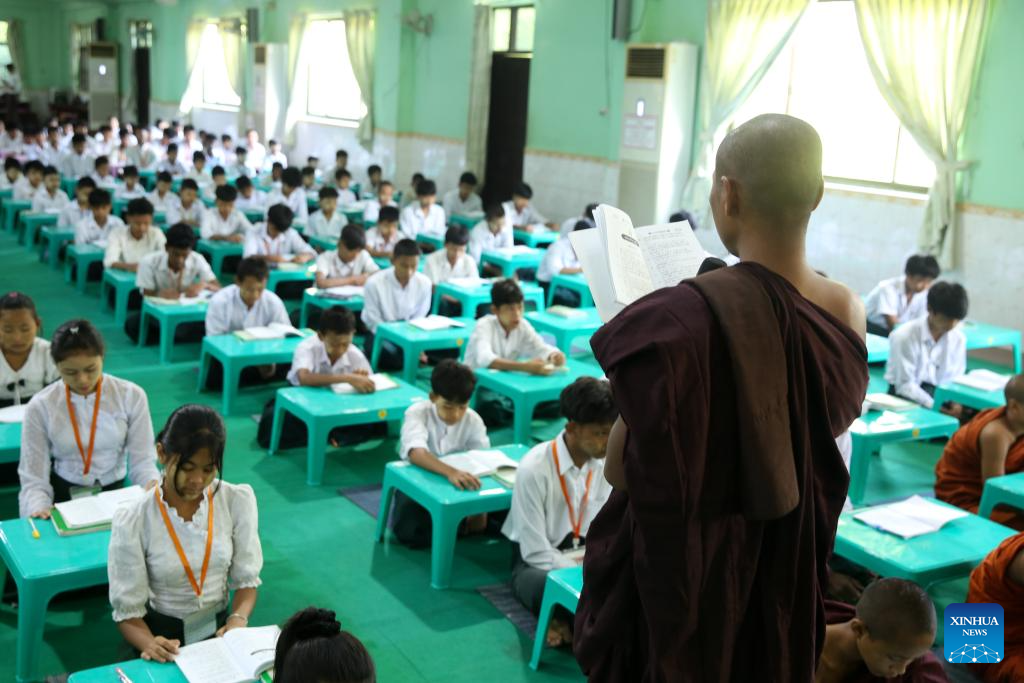
A Buddhist monk teaches a lesson during a meditation course at a post-primary monastic school in Yangon, Myanmar, Dec. 11, 2025. (Xinhua/Myo Kyaw Soe)
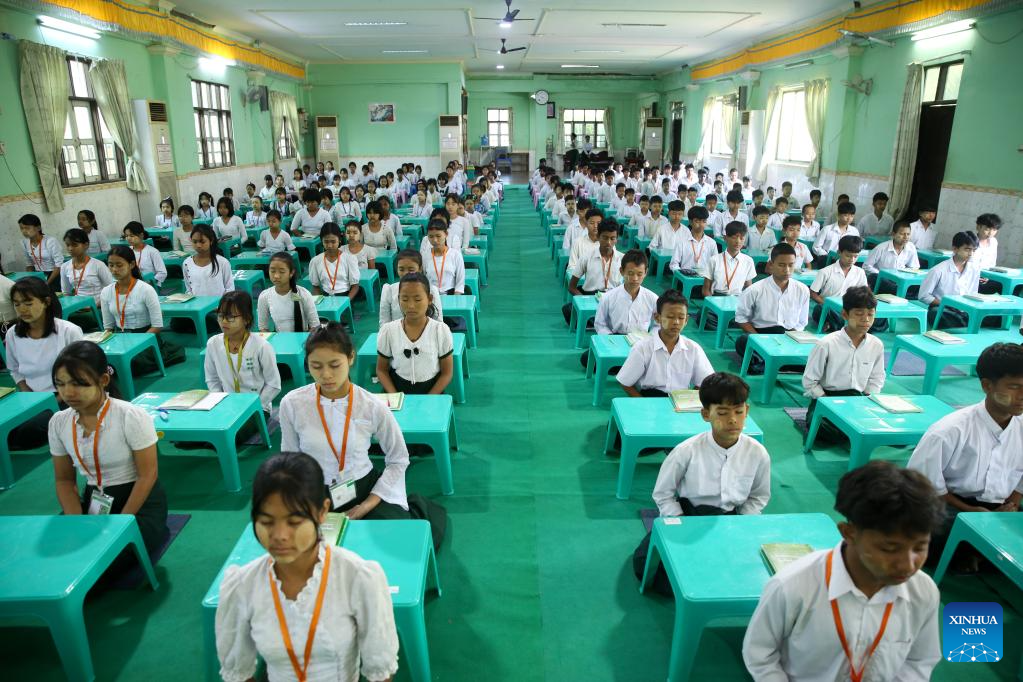
Students attend a meditation course at a post-primary monastic school in Yangon, Myanmar, Dec. 11, 2025. (Xinhua/Myo Kyaw Soe)