
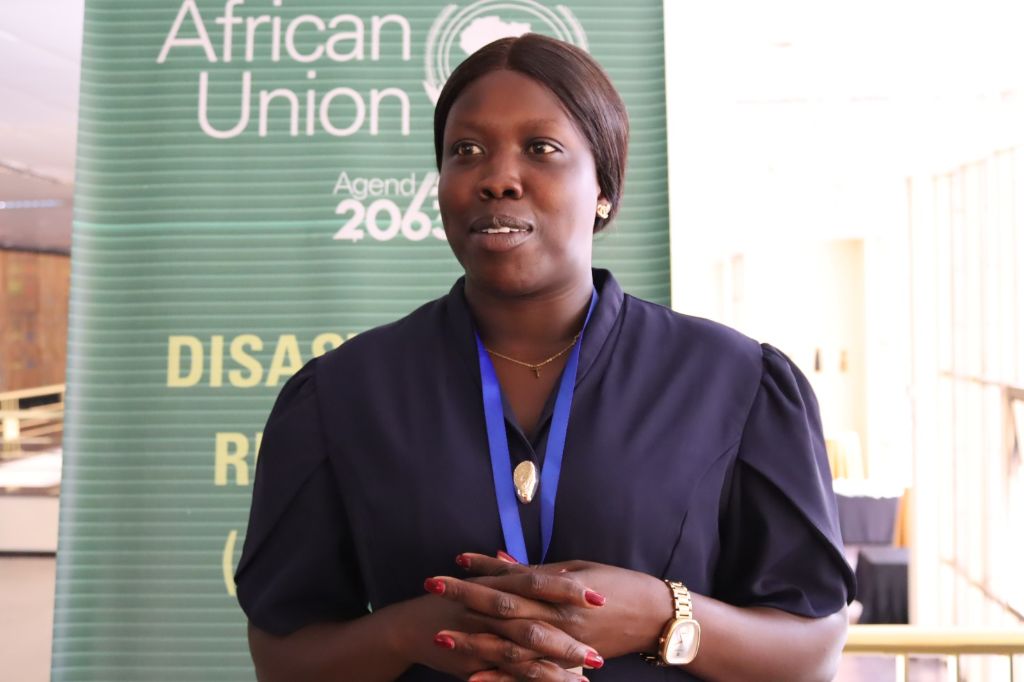
Monicah Abuk Akol, a South Sudanese early warning system specialist, speaks during an interview in Addis Ababa, Ethiopia, Nov. 25, 2026. (Xinhua)
ADDIS ABABA, Nov. 29 (Xinhua) -- African climate specialists stand to gain valuable technical insights from their Chinese counterparts, especially in the use of advanced artificial intelligence (AI) and global information system (GIS) for a more precise weather forecasting and early warning system (EWS), according to African climate experts.
They made the remarks after Chinese climate experts shared advanced technologies and expertise with African counterparts during a training workshop on EWS, AI and GIS at the African Union (AU) headquarters, in Addis Ababa, the capital of Ethiopia.
The workshop, co-hosted by the AU Commission, the Chinese Mission to the AU, and the Alliance of National and International Science Organizations for the Belt and Road Regions, ran from Monday through Friday, attracting nearly 70 participants.
Monicah Abuk Akol, a South Sudanese EWS specialist, underscored the significance of boosting collaboration with China to help Africa strengthen its resilience and mitigate impacts of extreme weather conditions linked with the 2026/2027 El Nino.
"The Chinese experts have actually trained us on how we can command the AI. Instead of leaving the AI to do the work by itself, we should train it to be able to assist us in our daily work, monitor climate change, support weather forecasting, and generate information for early preparedness and action," she told Xinhua in a recent interview.
Akol, an assistant inspector of early warning programs and projects at South Sudan's ministry of humanitarian affairs and disaster management, added that "the Chinese experts have also shared with us different modules and templates to help gather accurate data on climate vulnerability and exposure, conduct precise weather forecasts and thereby reduce disaster."
Asmaa Darag, one of the participants from Egypt, noted that some African countries lack the capacity to generate accurate data on early warning systems, leading to less trustworthy climate forecasting and detection of risks.
"The Chinese counterparts shared with us some models that they are using to gather data, using advanced AI and GIS. We got a good knowledge of those models," said Darag, stressing that China and the AU have undertaken various exchange programs to help African countries make precise weather forecasts and advance early warning systems.
Tian Bingwei, an associate professor at Sichuan University, was one of the Chinese climate experts who were sharing expertise at the training workshop.
"I think China has lots of technologies that can be shared with African countries, especially those supported by satellite and unmanned aerial vehicles, remote sensing, and artificial intelligence. Those technologies are helpful to build stronger multi-hazard early warning systems in Africa," Tian said, urging African countries to shift away from traditional early warning systems to advanced technologies to prevent possible climate-driven disasters. ■