
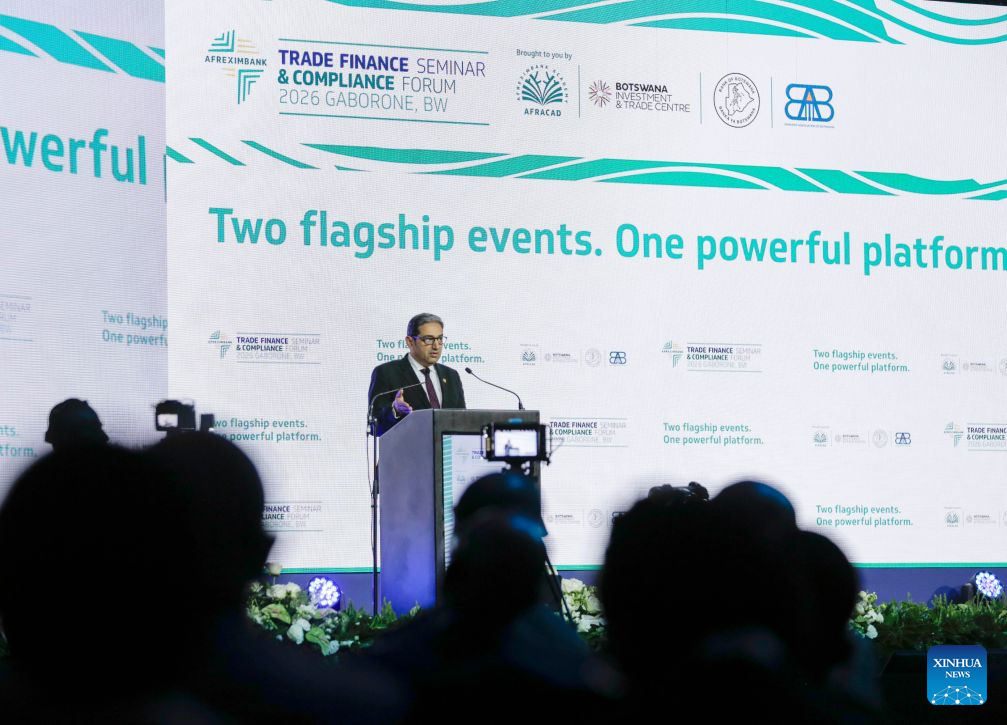
Haytham El Maayergi, executive vice-president of the Global Trade Bank at Afreximbank, speaks at the opening of the three-day African Export-Import Bank (Afreximbank) Trade Finance Seminar and Compliance Forum 2026 in Gaborone, Botswana, Nov. 16, 2026. (Xinhua/Tshekiso Tebalo)
GABORONE, Nov. 16 (Xinhua) -- Africa loses more than 5 billion U.S. dollars a year in settling intra-African trade in foreign currencies, an executive of the African Export-Import Bank (Afreximbank) said Monday, calling for wider adoption of a regional payment system.
Haytham El Maayergi, executive vice-president of the Global Trade Bank at Afreximbank, made the remarks in a keynote address at the opening of the three-day Afreximbank Trade Finance Seminar and Compliance Forum 2026 held at the Gaborone International Convention Center in the capital of Botswana.
El Maayergi urged countries yet to join the Pan-African Payment and Settlement System (PAPSS), which settles payments in local currencies across more than 30 African countries, to onboard.
"Finance enables trade and compliance provides trust," he said, noting that intra-African trade grew by 5.5 percent in 2025 but still accounts for only about 14 percent of Africa's total trade.
Fifty countries have ratified the African Continental Free Trade Area agreement, but only 12 are actively trading under it. "We have opened the market. Our task now is to make that market work," he said.
Bank of Botswana Governor Lesego Moseki also pointed to PAPSS as a way to support intra-African commerce, stressing that its success depends on central banks working together on oversight, anti-money-laundering safeguards and interoperability.
Moseki said compliance should be seen as a strategic asset that builds resilience, trust and competitiveness. He warned that fragmented cross-border regulations can raise costs, slow transactions and push legitimate trade into informal channels, and called for greater cooperation among regulators, banks and development finance institutions.
Botswana's Assistant Minister of Trade and Entrepreneurship Baratiwa Mathoothe said the gathering, including a Factoring Workshop on Thursday, creates a platform to bridge financial liquidity with regulatory integrity and turn Africa's trade potential into bankable cross-border transactions.
Mathoothe said the event aims to narrow the trade finance deficit, especially for small and medium-sized enterprises, to redefine compliance as a driver of trust, transparency and global market integration, and to showcase AI-driven anti-money-laundering tools.
Anthony Sefako, chief operations officer of the Botswana Investment and Trade Center, said Botswana is targeting an increase in manufacturing exports from 11.2 percent in 2024 to 23 percent by 2036 under its Botswana Economic Transformation Program. ■
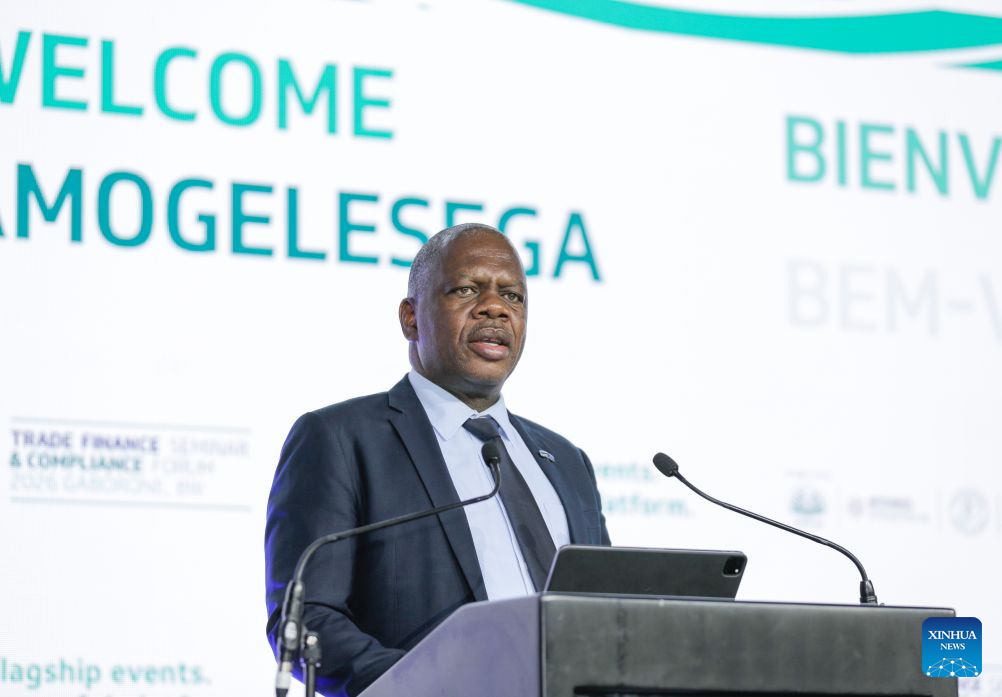
Bank of Botswana Governor Lesego Moseki speaks at the opening of the three-day African Export-Import Bank (Afreximbank) Trade Finance Seminar and Compliance Forum 2026 in Gaborone, Botswana, Nov. 16, 2026. (Xinhua/Tshekiso Tebalo)