
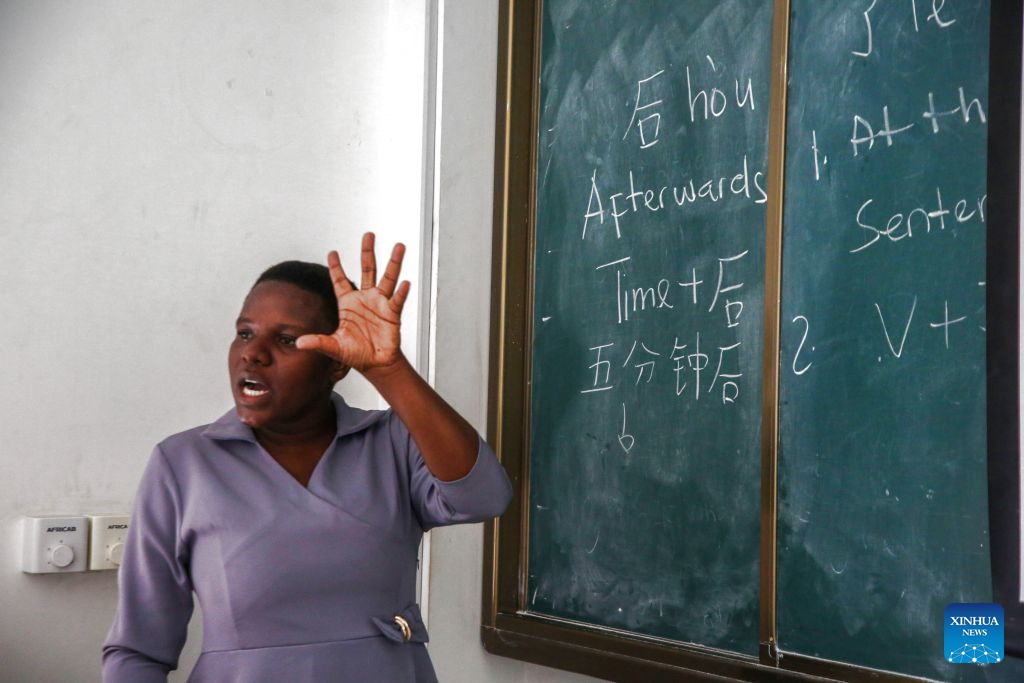
Tanzanian Chinese language teacher Gloria Mshana explains Chinese grammar to students in front of the blackboard at the Confucius Institute at the University of Dar es Salaam in Dar es Salaam, Tanzania, Oct. 1, 2026. As the world prepares to mark World Teachers' Day on Oct. 5, Chinese and Tanzanian educators are joining forces to expand Chinese language education in Tanzania, blending native linguistic expertise with localized cultural insights. (Xinhua/Emmanuel Herman)
DAR ES SALAAM, Oct. 4 (Xinhua) -- As the world prepares to mark World Teachers' Day on Oct. 5, Chinese and Tanzanian educators are joining forces to expand Chinese language education in Tanzania, blending native linguistic expertise with localized cultural insights.
For Gloria Mshana, a Tanzanian teacher, teaching Chinese goes far beyond explaining vocabulary and grammar. It involves connecting an unfamiliar language to local experiences.
When teaching about the four seasons, Mshana draws on her firsthand experience of living in China to describe spring, summer, autumn, and winter to Tanzanian students, who are less familiar with such distinct seasonal changes.
However, maximizing classroom impact requires a truly collaborative approach. When introducing Chinese cuisine, for instance, native Chinese teachers explain the nuances and cultural background of culinary terms. Mshana then follows up with pictures, videos, and relatable examples, bridging the gap between Chinese traditions and Tanzanian hospitality.
This localized approach highlights the strength of the bilateral teaching partnership. While Chinese instructors provide professional linguistic expertise, their Tanzanian colleagues help bridge communication barriers, particularly for beginners fluent in Kiswahili.
For Liu Mu, a Chinese volunteer teacher at Ardhi University, a teaching center under the Confucius Institute at the University of Dar es Salaam (CI-UDSM), such cooperation has proved vital. Managing 350 students in her second year, Liu relied on local colleagues to better understand their learning habits.
This seamless daily collaboration is reinforced through the institute's regular pedagogical exchanges, such as weekly joint workshops held every Wednesday afternoon to address classroom challenges.
Xu Qian, Chinese director of CI-UDSM, noted that the institute's current faculty, comprising seven local Tanzanian teachers, six Chinese teachers, and 18 Chinese volunteers, is a key strength, enabling a highly complementary teaching model.
"Chinese teachers bring linguistic expertise and professional training, while Tanzanian teachers deeply understand the local context, students' learning habits and specific challenges," Xu said.
Driven by strong demand, enrollment at the institute has soared to roughly six times its pre-2020 levels, with registered learners exceeding 1,000 this year.
The impact also extends beyond universities. Masudi Jumanne Kidaso, a 36-year-old teacher at African Prestige Primary School, is currently a beginner-level Chinese learner himself, but he aspires to introduce the language to his own pupils.
Encouraged by his Chinese instructors, Kidaso is now developing an introductory textbook for children, using songs, games, and language clubs to teach basic conversations.
"I believe this project will help more Tanzanian children begin learning Chinese at an early stage," Kidaso said.
Through daily interaction, these educators are sharing knowledge, adapting teaching methods to local needs, and helping students navigate cultural differences. As interest in the Chinese language grows across Tanzania, their collaboration is broadening access to the language while opening doors for future educational, professional, and cultural exchanges. ■
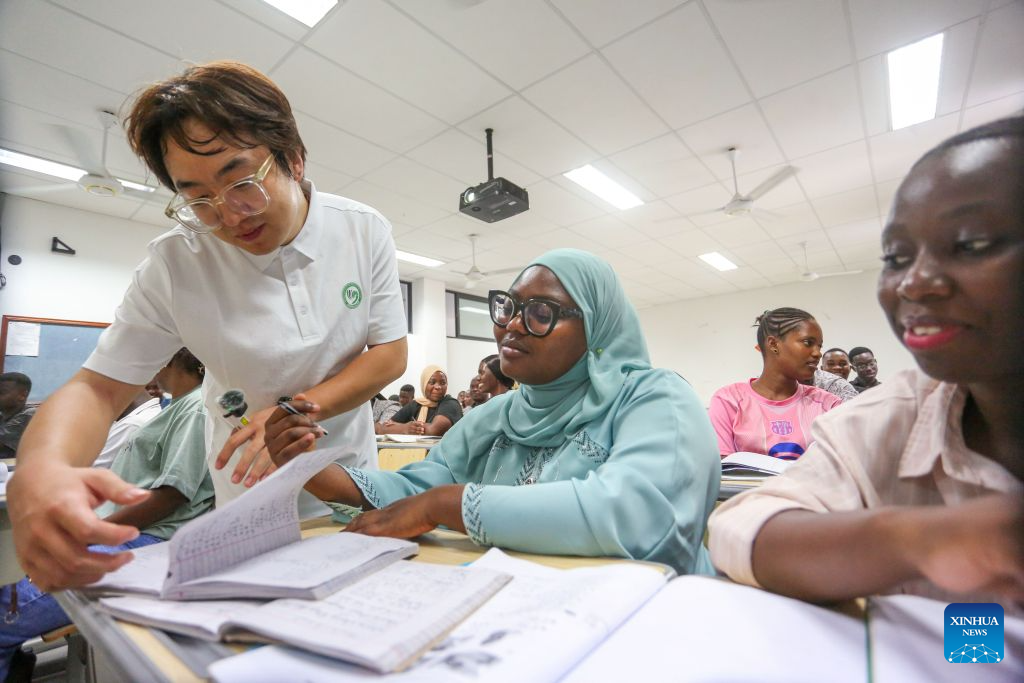
Chinese volunteer teacher Liu Mu guides a student during a class at the Confucius Institute at the University of Dar es Salaam in Dar es Salaam, Tanzania, Oct. 1, 2026.As the world prepares to mark World Teachers' Day on Oct. 5, Chinese and Tanzanian educators are joining forces to expand Chinese language education in Tanzania, blending native linguistic expertise with localized cultural insights. (Xinhua/Emmanuel Herman)
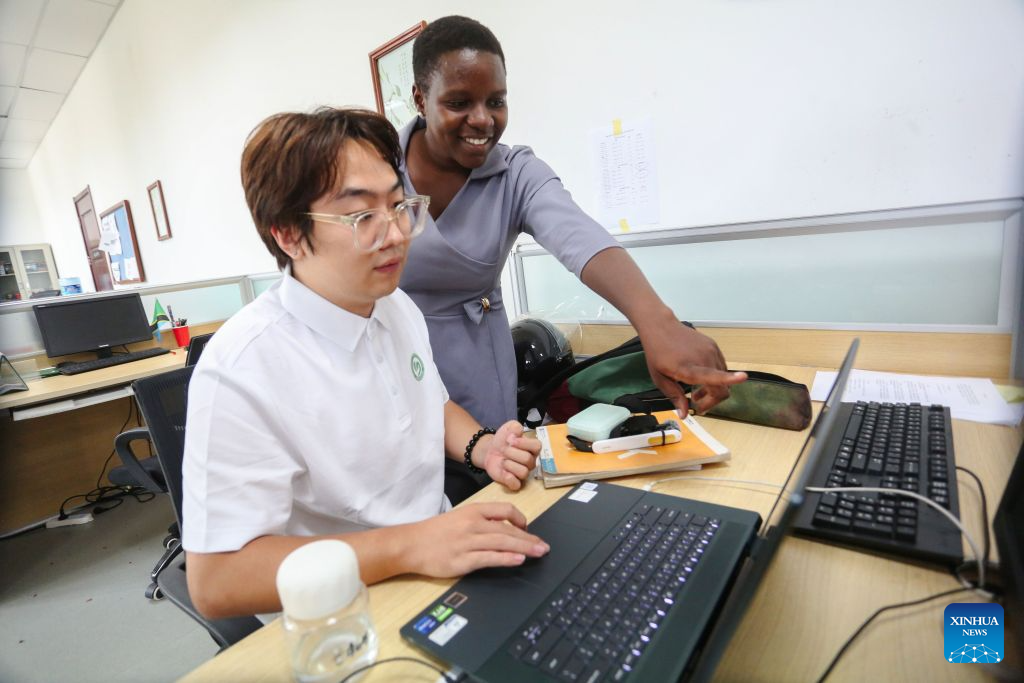
Tanzanian Chinese language teacher Gloria Mshana (R) exchanges teaching insights with Chinese volunteer teacher Liu Mu at the Confucius Institute at the University of Dar es Salaam in Dar es Salaam, Tanzania, Oct. 1, 2026. As the world prepares to mark World Teachers' Day on Oct. 5, Chinese and Tanzanian educators are joining forces to expand Chinese language education in Tanzania, blending native linguistic expertise with localized cultural insights.(Xinhua/Emmanuel Herman)
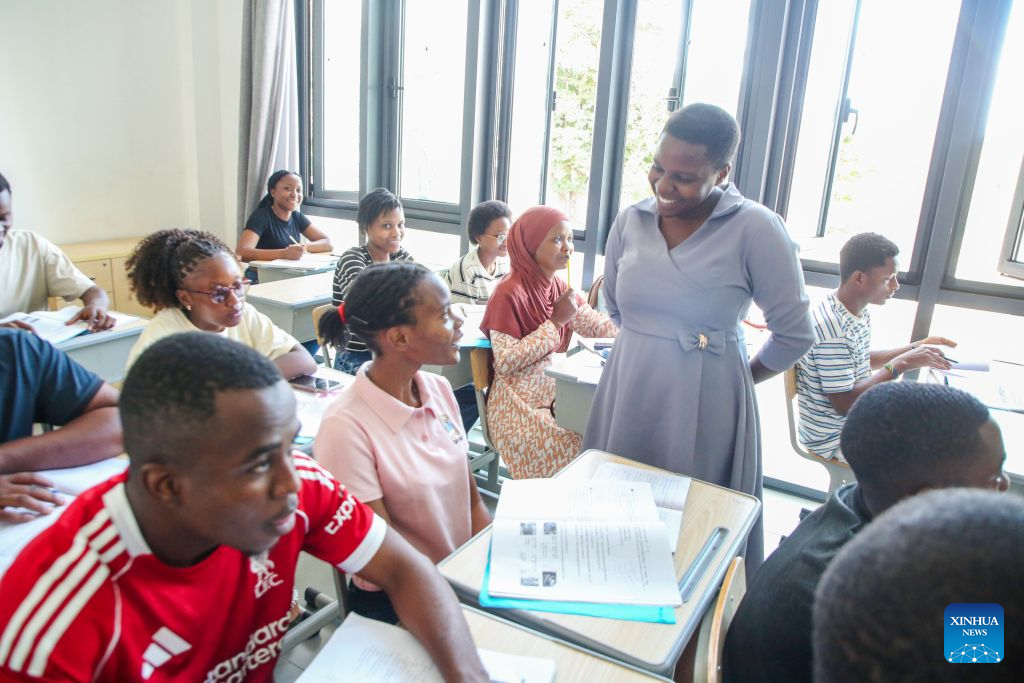
Tanzanian Chinese language teacher Gloria Mshana walks among the students to guide a class at the Confucius Institute at the University of Dar es Salaam in Dar es Salaam, Tanzania, Oct. 1, 2026. As the world prepares to mark World Teachers' Day on Oct. 5, Chinese and Tanzanian educators are joining forces to expand Chinese language education in Tanzania, blending native linguistic expertise with localized cultural insights.(Xinhua/Emmanuel Herman)