
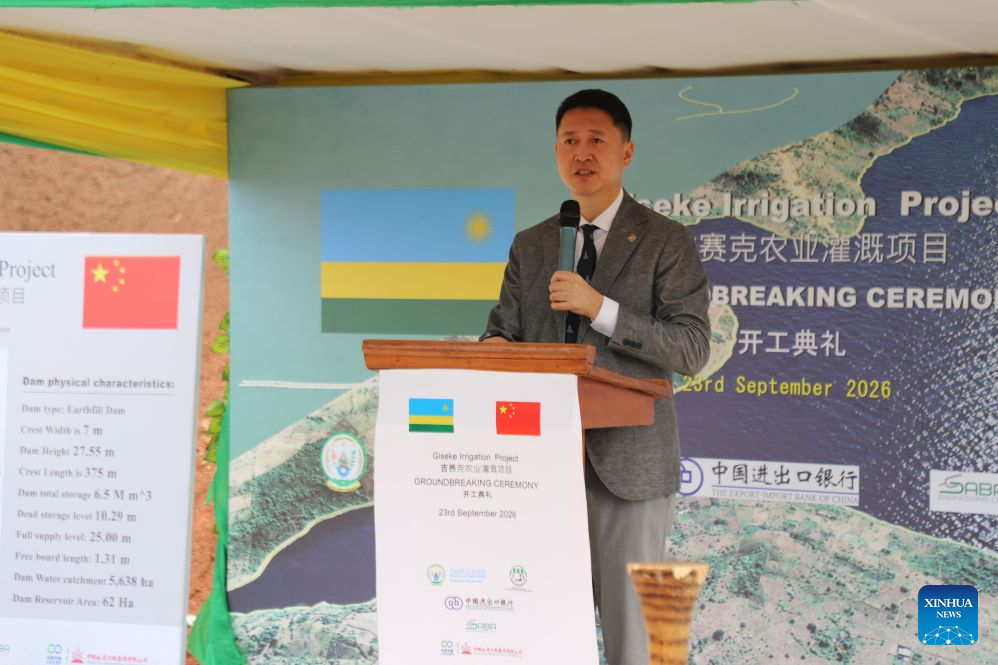
Chinese Ambassador to Rwanda Gao Wenqi delivers a speech during the groundbreaking ceremony for the Giseke Irrigation Project in Gisagara District in Southern Province, Rwanda, on Sept. 23, 2026. (Xinhua/Liu Youmin)
KIGALI, Sept. 24 (Xinhua) -- Rwanda and China have launched the groundbreaking of the Giseke Irrigation Project, a major investment aimed at transforming agriculture, strengthening climate resilience and improving farmers' access to reliable water.
The groundbreaking ceremony, held on Wednesday in Gisagara District in Rwanda's Southern Province, brought together government officials, the Chinese embassy, development partners, local authorities, farmers, contractors and other stakeholders.
The project was financed by the Export-Import Bank of China and constructed by China Geo-Engineering Corporation. With an estimated investment of 47 million U.S. dollars, the project will develop a dam with a storage capacity of about 6.5 million cubic meters, a modern pressurized irrigation system covering more than 2,600 hectares of net irrigated land, and about 48.8 km of lined canals.
Speaking at the ceremony, Rwandan Minister of Agriculture and Animal Resources Telesphore Ndabamenye said the project represents an important step in Rwanda's efforts to build a modern and climate-resilient agricultural sector.
"Today is an important milestone in our continued efforts to transform Rwanda's agriculture into a modern, productive, resilient and commercially oriented sector," Ndabamenye said.
He noted that the irrigation infrastructure would reduce farmers' dependence on rainfall, which has increasingly become unreliable due to changing climatic conditions, while enabling farmers to better plan production and respond to market demand.
"The availability of reliable irrigation water will create an enabling environment for more predictable and commercially oriented agricultural production," the minister said, adding that the investment is expected to increase production, improve farmers' incomes, create jobs and strengthen agricultural value chains.
Ndabamenye expressed appreciation to China and the Export-Import Bank of China for supporting the project, describing Giseke as a strong demonstration of the Rwanda-China partnership in agricultural transformation and infrastructure development.
Speaking at the event, Chinese Ambassador to Rwanda Gao Wenqi said the project comes at a time when developing countries are facing the combined challenges of climate change, erratic rainfall and food insecurity.
"For developing nations, sound agricultural infrastructure constitutes a cornerstone for poverty reduction, food security and rural prosperity," Gao said.
He described the Giseke project as a tangible outcome of China-Rwanda practical cooperation and South-South cooperation, noting that it aligns with Rwanda's national agricultural modernization priorities.
Gao said the project will integrate water storage, conveyance, on-farm irrigation and supporting infrastructure. Once operational, it is expected to provide reliable irrigation to thousands of hectares of farmland, helping smallholder farmers gradually shift from rain-fed farming to more stable and productive irrigated agriculture.
Beyond irrigation infrastructure, the project will include rural access road improvements, technical training and knowledge-sharing, creating opportunities for employment and improving the movement of agricultural inputs and produce, Gao said.
Gao called on Rwandan and Chinese partners to maintain close cooperation throughout implementation and ensure that the project becomes a high-quality demonstration of agricultural and water-resource cooperation.
The Giseke Irrigation Project is expected to contribute to increased agricultural productivity and food security while creating opportunities for higher-value crop production, improved market access, and stronger agricultural value chains in Gisagara and surrounding areas, according to the Ministry of Agriculture and Animal Resources. ■
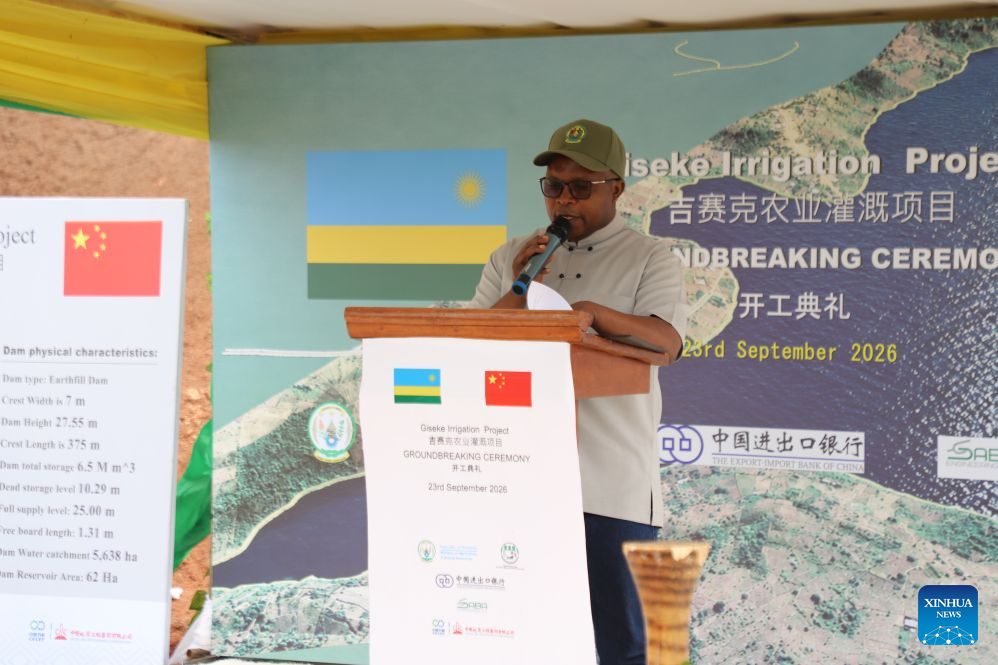
Rwandan Minister of Agriculture and Animal Resources Telesphore Ndabamenye delivers a speech during the groundbreaking ceremony for the Giseke Irrigation Project in Gisagara District in Southern Province, Rwanda, on Sept. 23, 2026. (Xinhua/Liu Youmin)