
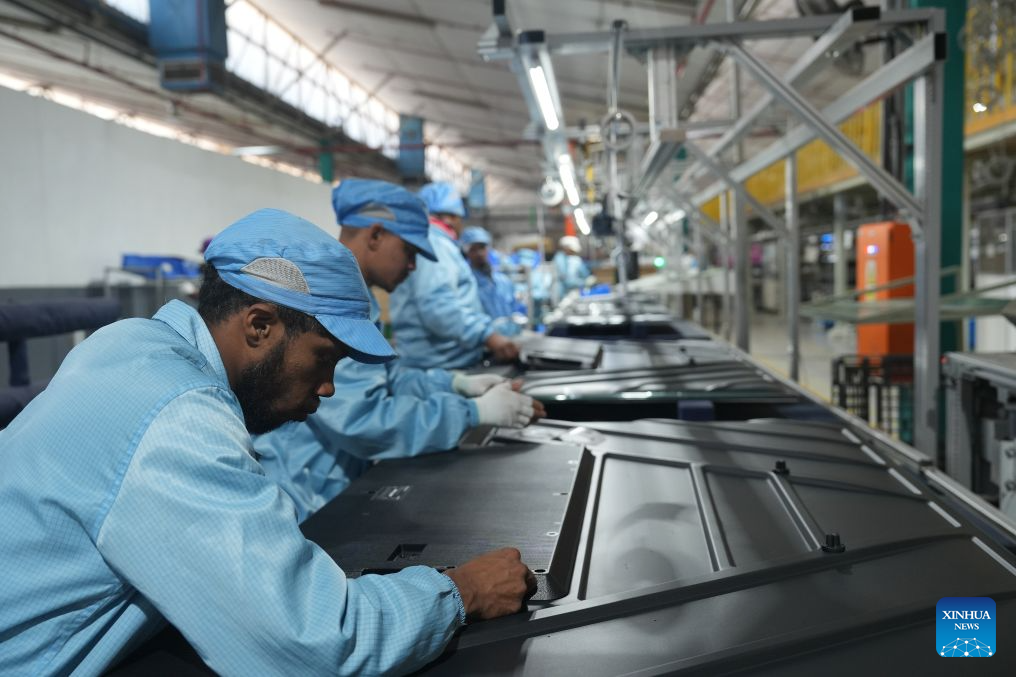
Local employees work on the production line at the TV factory in Hisense South Africa Industrial Park in Cape Town, South Africa, Aug. 11, 2026. (Xinhua/Wang Lei)
by Xinhua writers Wang Lei, Wang Xiaomei and Deng Bingxue
CAPE TOWN, Aug. 15 (Xinhua) -- "Since I joined Hisense, my life has changed. We've grown, I've grown with Hisense."
For Hugh Stephens, those words capture more than a career spanning more than a decade at Hisense South Africa (Hisense SA) Industrial Park. They tell the story of how a new job opportunity in Atlantis grew into a journey of personal and professional development.
In 2013, the factory where Stephens worked pulled out of the town, leaving him facing an uncertain future. Around the same time, Chinese home appliance giant Hisense established its industrial park in Atlantis, a town about 50 kilometers north of Cape Town.
"I decided that I have to come check it out at Hisense," Stephens told Xinhua.
He stayed.
More than a decade later, the local man who joined Hisense as a "normal worker" has become a Mainboard Repair Technician at the TV Factory in the park, taking on new responsibilities and developing skills along the way.
His story begins with a job. But it is also a story of growth -- his own, and that of a Chinese company growing alongside its local workforce.
"When I got here, I started at the front of the (production) line," Stephens recalled. "I learned from the Hisense engineers, from the Chinese engineers. They taught us everything I know now."
"Now I'm working as a (mainboard) repairman and it's very good for me, because I've grown with the company," he said.
The change he described is not limited to his career. Stephens said he has also seen improvements in his life outside the workplace, from expanding his home to enjoying better living conditions and a better lifestyle.
Like Stephens, Marlon Jacobs joined Hisense SA Industrial Park when it was established in 2013, starting out as a general worker with no experience in refrigeration. Today, he is an Assembly and Quality Technician at the Fridge Factory in the park.
"Everything in my life has improved ever since 2013, and I'm standing here as an example of that in itself," Jacobs told Xinhua.
"Thirteen years ago, I was unemployed. I did not have a job, so not having a job means you're not able to support your family the way you want to," he said. "Today I'm standing here, a better person being able to supply and support for my family, so that means a great deal. And I really appreciate what Hisense did for me and for the whole of Atlantis."
Like many of his colleagues, Jacobs has also bought a car as his income has grown, and now drives to work every day. The growing number of employees' cars has even filled the park's parking area, with some workers having to park in an open space outside.
His career has also been a journey of learning. Starting from welding, Jacobs went on to learn machine and product repairs, becoming the factory's first welding repair person before moving into a team leader role managing two teams of more than 100 people and eventually becoming a technician.
"I'm a refrigerator technician because of the skills that I've learned through the Chinese," he said, referring to the knowledge he gained while working closely with his Chinese colleagues.
For Jacobs, the benefits also extend beyond his own career. "It's not only work, it's skills also being transferred to local people," he said, pointing to the training and skills development opportunities available to workers at Hisense.
That skills transfer is reflected in the training provided on the production floor, according to Mou Xing, a Chinese Process Engineer at the TV Factory. New local employees receive training on the production process, hands-on instruction for their respective tasks, safety training and on-site observation before starting work. They also receive ongoing guidance and checks during production.
As local employees gain experience, some have begun to take on greater responsibilities. "After systematic training, South African local employees can independently complete the main work of their departments and handle and provide feedback on problems," Mou said. "For example, Minnies can take over the entire department's work when I am on leave."
The local employee Mou referred to is Ayrton Minnies, a Process Technician Team Leader at the TV Factory. His job at Hisense was his first, and he chose it out of an interest in electronics.
"By working for all these years now, I've made a lot of progress in my life," Minnies said. "I would say there's a lot of skills I've picked up during my time at Hisense."
He put that learning simply: "Basically, I've learned how to make my own TV, not basically my own TV, but how it looks into the inside and everything."
Beyond his own growth, Minnies said Hisense has also had a positive impact on Atlantis by providing jobs for local residents.
Today, the two factories at Hisense SA Industrial Park employ around 760 local people. "At the Fridge Factory, we have approximately 550 local employees," Lorenzo McKinna, Production Supervisor at the factory, told Xinhua.
"Many of the employees that's working here, as you know, it's from the local community," he said, adding that the company provided on-the-job training so employees did not have to go outside the factory to acquire those skills.
According to McKinna, while creating jobs, the industrial park has also helped drive the development of the local industrial chain. "We have quite a few suppliers, local suppliers, that have benefited from the Hisense factory being here."
The experiences of Minnies and McKinna are borne out by the broader impact of Hisense SA Industrial Park, said Jiang Shun, Deputy General Manager of Hisense SA and General Manager of the industrial park.
According to Jiang, the park has created about 1,000 direct jobs and over 5,000 indirect jobs locally, while about 70 percent of management positions are held by local employees.
The park has also helped drive employment along the local supply chain, with nearby foam and carton factories among those supplying it. More than a dozen local companies have so far been integrated into its supporting industrial chain, Jiang said, adding that the park has also helped them adopt new technologies, processes and equipment.
In his view, the experience at Hisense SA is a direct rebuttal to the recent "China squeeze" narrative advanced by some Western think tanks and media outlets, which argues that China's manufacturing capacity not only challenges Western industries but also crowds out industrialization opportunities in the Global South countries.
For Africa, Jiang noted, the arrival of Chinese companies brings not only job opportunities but also advanced manufacturing technologies and expertise that can help raise the level of local manufacturing.
"Only by raising the level of local manufacturing can you get the whole African economy moving," Jiang said. "I don't think it's a squeeze. It definitely plays a leading role."
Jiang's view was echoed by Hugh. "They're not squeezing, they're just trying to create jobs," he said.
Hugh hoped Hisense SA would continue to expand. "I want them to grow, you know, to bring more job opportunities, because people can learn more from other people, you know, from Chinese people," he said. ■
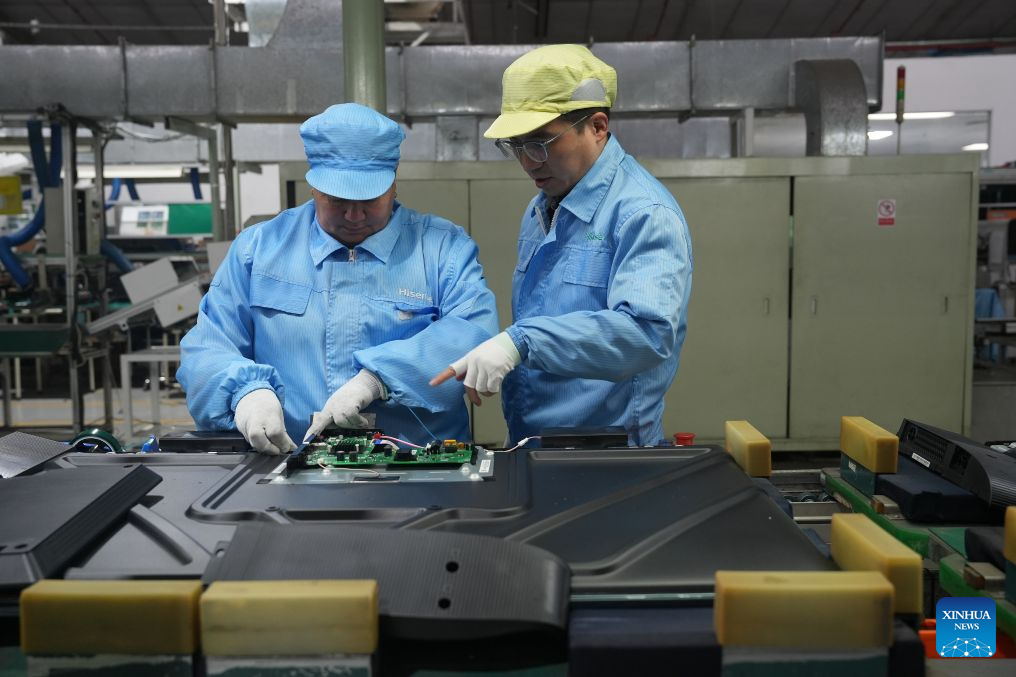
A Chinese engineer (R) guides a local employee on the production line at the TV factory in Hisense South Africa Industrial Park in Cape Town, South Africa, Aug. 11, 2026. (Xinhua/Wang Lei)
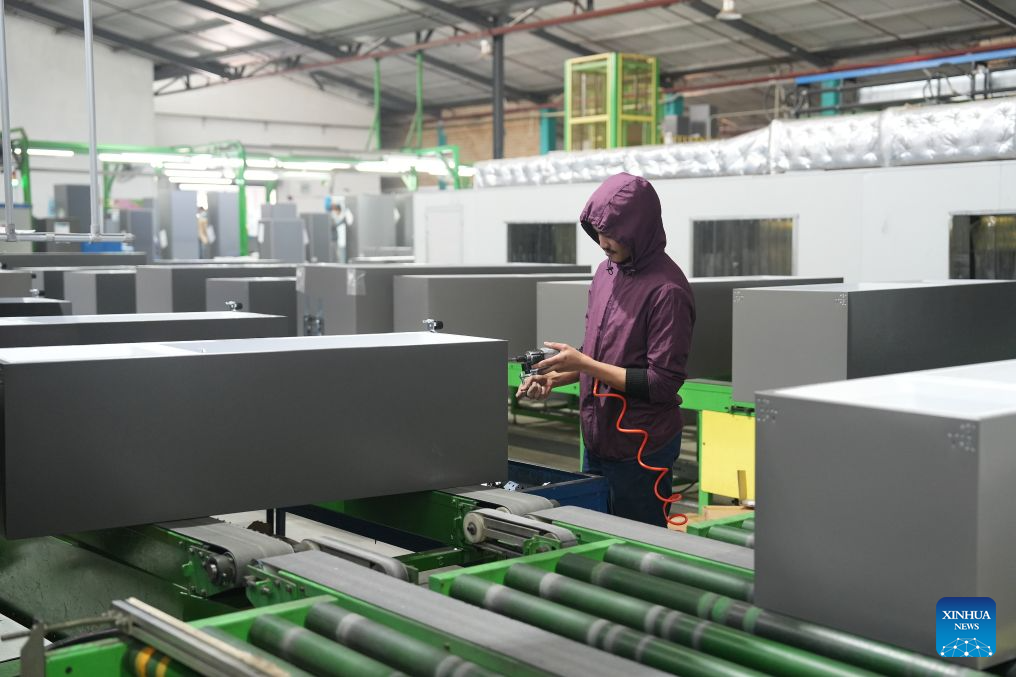
A local employee works on the production line at the fridge factory in Hisense South Africa Industrial Park in Cape Town, South Africa, Aug. 11, 2026. (Xinhua/Wang Lei)