
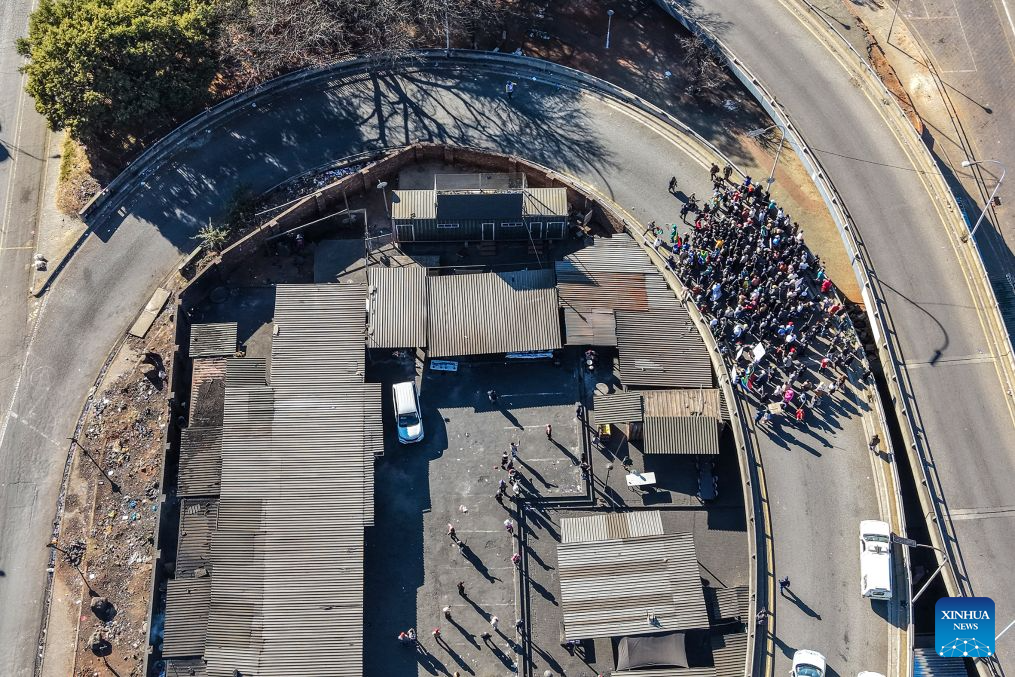
An aerial drone photo taken on June 30, 2026 shows protesters marching during a massive demonstration against illegal immigration in Johannesburg, South Africa. (Photo by Shiraaz Mohamed/Xinhua)
by Ndumiso Mlilo
JOHANNESBURG, Aug. 5 (Xinhua) -- South Africa's anti-migrant protests have entered a prolonged and increasingly complex phase, evolving into a regular every-Thursday protest that is reshaping public debate over immigration, security, and governance.
While civic groups behind the protests have vowed to sustain pressure until undocumented migrants leave the country, the government is seeking to balance tougher immigration enforcement with constitutional protections, and international organizations and academics are warning against xenophobia and the long-term costs of social polarization.
PROTESTS PERSIST
The anti-immigration group March and March on Monday held a press conference, pledging to continue nationwide marches every Thursday until what it calls illegal foreigners leave South Africa.
Speaking to Xinhua on Tuesday, the group's spokesperson Sandile Dube described the movement as a success, claiming that some undocumented migrants had voluntarily returned to their home countries after the group's so-called June 30 ultimatum.
"We have communicated our message to all South Africans well. We will continue to march every Thursday, and we will sue some government agencies like the police in court over accepting bribes or protecting foreigners," Dube added.
Beyond demonstrations, the anti-immigration group plans to intensify legal action. Dube said it has established the South Africa First Forum, a social justice litigation body, and the March and March Foundation, a humanitarian non-profit organization, to take legal action against illegal migrants.
Since April, anti-immigration protests have spread across all nine provinces, reflecting growing public concerns over illegal immigration amid South Africa's sluggish economy, persistently high unemployment, and strained public services.
On June 30, during the so-called national shutdown by the group, there were over 120 marches held all over the country.
The movement has also heightened tensions across the country. As anti-immigrant sentiment intensified, foreign nationals from Malawi, Mozambique, Zimbabwe, Kenya, Ghana, Nigeria, and other African countries have either been evacuated or opted for voluntary repatriation.
The developments have also triggered diplomatic concerns, with Ghana and Nigeria formally protesting the treatment of their nationals.
BALANCED APPROACH
The South African government has sought to walk a fine line between responding to public concerns over illegal immigration and preventing anti-immigration sentiment from descending into violence.
Speaking to Xinhua, Deputy Minister of The Presidency Kenny Morolong said that South Africa remains a constitutional democracy that respects the rights of all people residing in the country while enforcing immigration laws to address undocumented migration.
"South Africans are not xenophobic," Morolong reiterated, noting that the government is arresting those opportunistic individuals committing crimes in the name of the anti-migrant crusade.
At the same time, Pretoria has stepped up immigration enforcement. The government established a repatriation processing center in Limpopo Province's Musina near the Beitbridge border with Zimbabwe, where 68,138 migrants were processed for deportation or voluntary repatriation between June 14 and July 24, according to the latest figures released by the Inter-Ministerial Committee on Migration.
Mmamoloko Kubayi, chairperson of the Inter-Ministerial Committee on Migration, said that the Border Management Authority processed 72,906 repatriations involving various nationalities at ports of entry between June 7 and July 14.
Yet, international organizations cautioned against treating migration as the root cause of South Africa's socioeconomic challenges.
In a written response to Xinhua, the International Organization for Migration (IOM) estimated that South Africa hosts between 2.8 million and 3 million international migrants, accounting for approximately 4 to 5 percent of the population, broadly in line with global averages.
"Within Africa, South Africa is a major destination country," the agency said, adding that migration is driven by economic hardship, unemployment, inequality, and limited access to regular migration pathways in countries of origin, among others.
It argued that South Africa's own challenges, including high unemployment, inequality, and pressure on public services, stem primarily from structural economic factors, internal migration, and rapid urbanization rather than migration itself.
IOM emphasized that migration governance requires coordinated regional cooperation under the rule of law, stressing that "violence, vigilantism, and incitement are unacceptable."
The agency supported South Africa in strengthening migration governance through border management reforms and the digitalization of immigration systems, it said, while calling for "accurate, evidence-based communication" to counter misinformation and reduce social tensions.
DEEPER CHALLENGES
The ongoing protests have sparked growing concern among academics and policy experts that South Africa's response to migration could carry significant domestic and international consequences.
Themba Maseko, head of the Wits School of Governance at the University of the Witwatersrand, argued that the government should more actively communicate South Africa's development achievements to counter the country's increasingly negative international image created by extensive media coverage of anti-migrant protests.
Elijah Masubelele, deputy executive director of the Cape Town-based non-governmental organization and think tank Institute for Justice and Reconciliation, warned that xenophobic attacks in the name of growing anti-immigrant marches risk undermining South Africa's image.
"These incidents will weaken South Africa's standing and trust. It will undermine our diplomatic relations with other African countries, Pan-Africanism, and our human rights stance," he said.
Masubelele added that migrants have increasingly become scapegoats for deeper structural problems, including weak economic growth, high unemployment, inequality, and governance shortcomings.
Meanwhile, signs of divergence are emerging even within the anti-migrant movement. Ngizwe Mchunu, an anti-immigration activist who previously participated in the marches, said that South Africans cannot protest indefinitely.
"As much as we did not accomplish everything we set out to do, we cannot march forever. That is the truth, because we have no intention of collapsing the economy," he said. ■
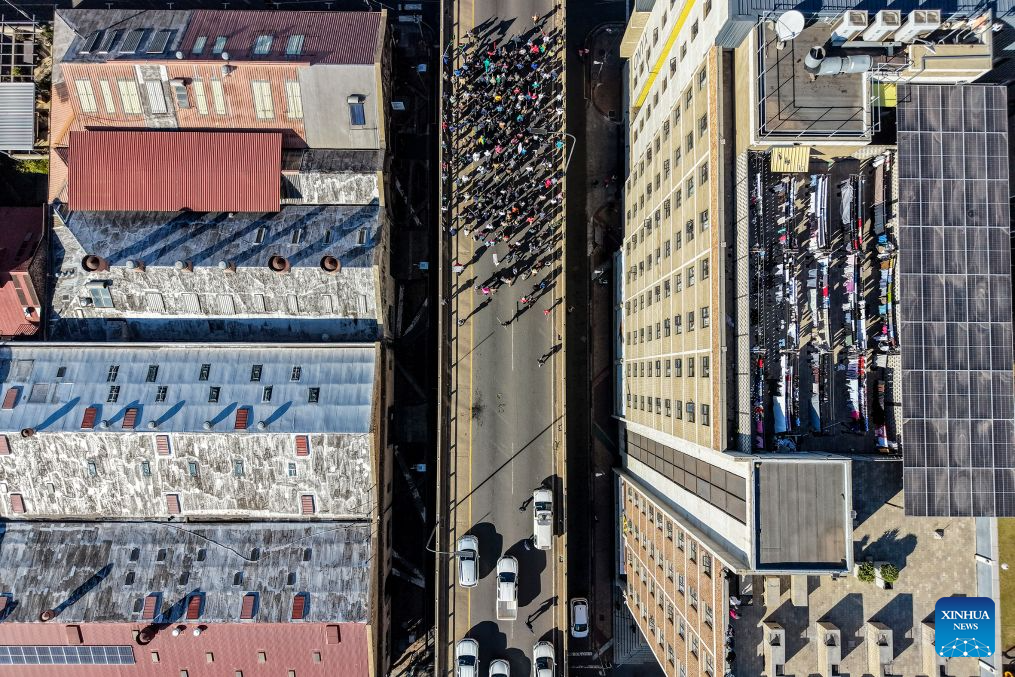
An aerial drone photo taken on June 30, 2026 shows protesters marching during a massive demonstration against illegal immigration in Johannesburg, South Africa. (Photo by Shiraaz Mohamed/Xinhua)