
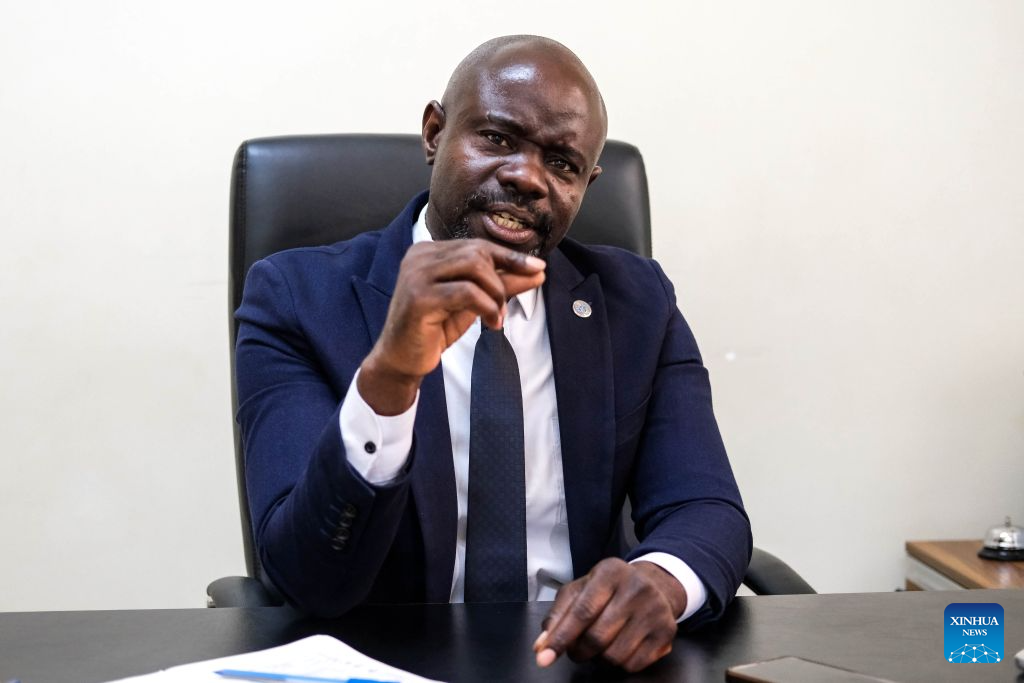
Atek Kagirita, Uganda's Ebola Bundibugyo virus disease incident commander at the Ministry of Health, speaks to Xinhua in an interview in Kampala, Uganda, July 30, 2026. (Photo by Hajarah Nalwadda/Xinhua)
KAMPALA, Aug. 4 (Xinhua) -- Uganda's swift containment of its latest Ebola outbreak demonstrates the importance of strong leadership, an experienced public health system and rapid response mechanisms, a senior health official has said.
While neighboring Democratic Republic of the Congo (DRC) continues to contain the Ebola spread, Uganda declared its latest outbreak over after recording 20 confirmed cases, 15 of them imported from eastern DRC.
Atek Kagirita, Uganda's Ebola Bundibugyo virus disease incident commander at the Ministry of Health, said the East African country has successfully managed nine Ebola outbreaks over the past 25 years, and has built a robust response system spanning from the central government to the village level, enabling authorities to respond rapidly whenever an Ebola case is detected.
In a recent interview with Xinhua, Kagirita, who also serves as director of the Public Health Emergency Operations Center under the Ministry of Health, said strong leadership at every level is essential to containing outbreaks.
He said response plans are immediately activated from the national level down to districts and villages once an outbreak is confirmed.
"People know Ebola, they know it kills, they know it is tough and they respond quickly," he said.
Kagirita said Uganda has also developed a strong surveillance network over the years. At the community level, residents remain vigilant and promptly report suspected cases or newcomers to their villages. Once a suspected case is identified, contacts are rapidly traced and quarantined to prevent further transmission.
"If I quarantine my contacts, then they will not produce other contacts," he said, adding that all contacts linked to confirmed cases during the latest outbreak were successfully traced and quarantined.
"That close monitoring helps us to quickly identify any Ebola case. The moment we detect you early, the outcome would be much better," he said.
Kagirita said the country's response is supported by experienced medical teams, laboratory capacity and both fixed and mobile testing facilities.
Uganda declared the outbreak on May 15 after confirming an imported Ebola case from the DRC. In response, authorities closed the border to passenger traffic while allowing cargo transit to continue, reducing the risk of further transmission.
Uganda also deployed two laboratories along its border with eastern DRC. Beyond providing technical expertise, the country established large mobile laboratories on the Congolese side of the border capable of testing up to 1,000 samples a day, Kagirita said.
Uganda's support for the DRC, together with its own rapid containment efforts, contributes to global health security, he said.
"We are there primarily to protect global health security because, if we do not intervene, many cases could spread to other countries," he said.
At a meeting with Ugandan health officials on Monday, Director General of the Africa Centers for Disease Control and Prevention Jean Kaseya praised Uganda's strong leadership and coordinated response in containing the outbreak.
Kagirita also argued against imposing travel restrictions on Ebola-affected countries, saying evidence shows that only 29 Ebola cases were exported outside Africa throughout the history of the disease. He said those cases mainly resulted from countries repatriating infected citizens for treatment.
Uganda's Ministry of Health declared the end of the latest outbreak on July 28, before the completion of the World Health Organization's standard 42-day countdown period following the discharge of the last patient. Uganda discharged its last Ebola patient on July 16 after the individual tested negative for the virus. ■