
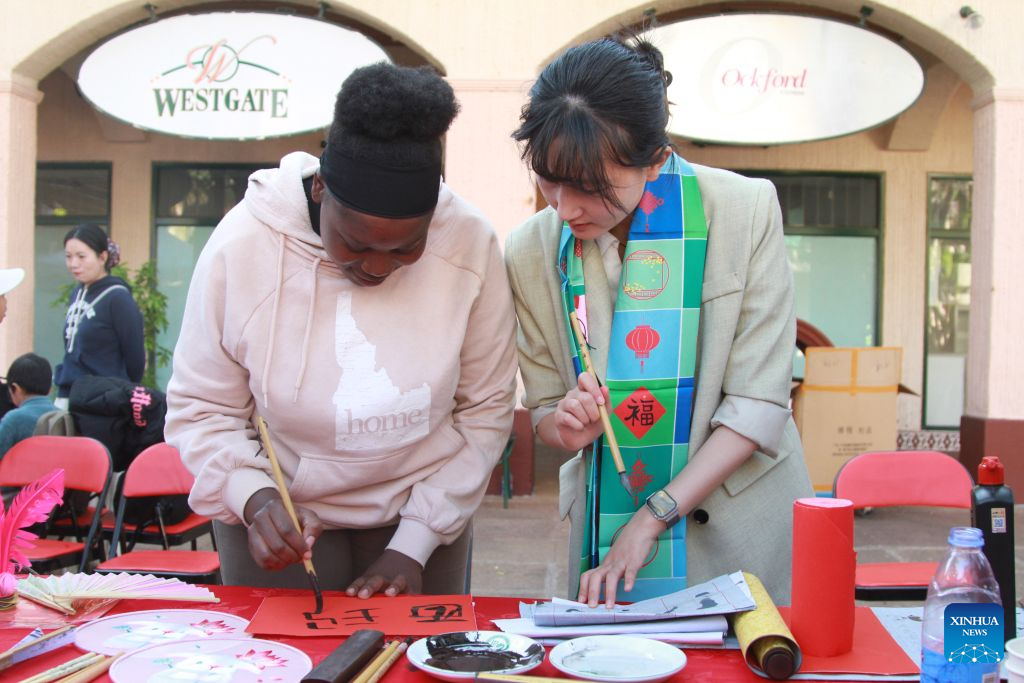
A local woman (L) tries her hand at Chinese calligraphy during the Asian Cultural Festival 2026 in Harare, Zimbabwe, on Aug. 1, 2026. (Photo by Tafara Mugwara/Xinhua)
HARARE, Aug. 2 (Xinhua) -- Laughter and cheers rippled through a packed cinema in Harare, Zimbabwe's capital, on Saturday as scenes from the vibrant Chinese comedy-drama "One and Only" unfolded on the big screen.
Screened as a highlight of the Asian Cultural Festival 2026 held from July 31 to Aug. 1, the youth-centric film blended elements of sports and street dance, deeply resonating with an energetic, mostly young local audience.
Co-hosted by the Chinese Embassy in Zimbabwe alongside six other Asian embassies and Diplomatic Media, the festival used cinematic art to showcase Asian culture and foster cross-cultural friendship.
Before the lights dimmed for the screening, attendees immersed themselves in traditional Chinese culture through interactive workshops, trying their hand at calligraphy and learning how to use chopsticks.
As 2026 marks the China-Africa Year of People-to-People Exchanges, such immersive cinematic and cultural experiences are offering Zimbabwean audiences a captivating window into contemporary Chinese society while further deepening long-standing bilateral ties.
Addressing the festival on Friday, Chinese Ambassador to Zimbabwe Zhou Ding highlighted the universal appeal of cinematic exchange, noting that core Asian values such as family, community, resilience, and mutual respect align closely with Zimbabwe's Ubuntu philosophy.
"We share the belief that a person is a person through other people," the ambassador said, adding that true strength lies in togetherness.
Luckson Murumbi, a film enthusiast from Harare, noted that movies provide profound insights into China's traditions, societal values, and technological progress.
"You can see the transformation of China, from the traditional martial arts films we watched as children to modern productions; you can truly see the progress of China's development," Murumbi said.
For local students, screen media has also become a dynamic and practical learning tool, helping them strengthen their language skills while gaining a deeper understanding of Chinese society.
"Film is a vivid reflection of society, and watching Chinese films is a great way of immersing myself in the language, the culture, and the traditions," said Rumbidzai Msimanga, a Chinese language learner from Harare.
She added that the rise of streaming platforms now allows her to easily access a wider array of Chinese movies and television series on her mobile devices.
Speaking at the festival, Mqabuko Dube, director for Africa, Asia and the Pacific at the Zimbabwean Ministry of Foreign Affairs and International Trade, highlighted the vital role of such cross-cultural initiatives in building stronger international bridges.
"By promoting cultural exchange, tourism, education, and investment, we continue to deepen the long-standing friendship between Zimbabwe and our Asian partners while creating opportunities that contribute to national development and people-to-people connections," Dube said. ■