
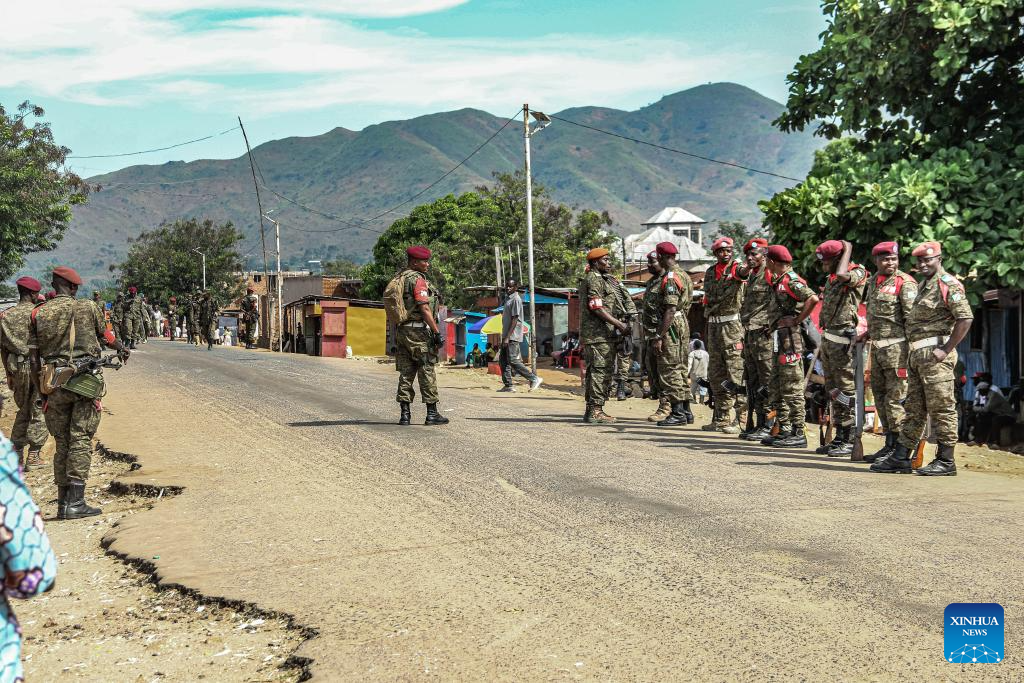
Soldiers of the Democratic Republic of the Congo military are seen in Sange, a town in eastern DRC, on May 12, 2026. (Str/Xinhua)
SANGE, DR Congo, May 14 (Xinhua) -- In the dusty streets of Sange, a trading town on the Ruzizi Plain in eastern Democratic Republic of the Congo (DRC), the humming of government military vehicles has replaced, for now, the sound of gun fighting.
On Tuesday, army trucks rolled into Sange, days after members of the March 23 Movement (M23) rebel group left the town and several nearby areas north of Uvira, South Kivu's temporary provincial capital and a key commercial and military corridor near the borders with Rwanda and Burundi.
Soldiers were patrolling, some riding motorcycles, others on foot, the streets still carrying the marks of recent fighting.
Residents watched from doorways and roadside stalls, relieved that the rebels were gone, but unsure if it was just a lull in hostilities or would lead to lasting peace.
In this part of the DRC, retreat is rarely a simple word -- it can mean a frontline moving, a political signal being sent, or fear shifting from one town to another.
Sange had been one of the M23's last footholds on the Ruzizi Plain after the group withdrew earlier from Uvira. The departure has allowed the DRC military and pro-government Wazalendo fighters to return to the area.
Dunia Kashindi Fabien, commander of the 33rd military region, addressed residents on Tuesday after the deployment, linking the army's return to the government's broader diplomatic campaign.
"I think you were following how the supreme commander defended you on the international stage," he said. "For that, I wanted to present my compassion on behalf of the chief of the general staff."
Across the town, signs of a cautious restart were visible. Some shops reopened. Motorcycles carried passengers again. People moved through streets that had recently been emptied by fear.
But the damage was still visible: broken homes, abandoned belongings, and military material left behind after the latest round of fighting.
"When the M23 entered Sange, fear settled in," said Mulinda Augustin, a young resident. "People could not move around as they wanted. People lived in uncertainty. They were terrorized. They were not free."
He said daily activity had been blocked during the rebel presence, but had begun to resume after the pullout. "God helped so that they withdrew," he said. "Now activities have resumed as before."
For local authorities, the first task is not celebration, but control.
Jean de Dieu Mabiswa Selemani, administrator of Uvira territory, said the deployment of security forces was the priority before police and other state services returned.
"The priorities are first the deployment of the defense and security forces," he said. "After this deployment, all these officials who fled their entities, including the territorial administrator and his team, will have to be in Sange to continue administering this population that has suffered for a long time."
The movement around Sange is part of a broader M23 pullback from several positions around Uvira.
But the group has not left South Kivu.
Local media reports and security sources say that M23 rebels have regrouped farther north around Kamanyola, a strategic town near the point where the borders of the DRC, Rwanda, and Burundi meet.
That has brought panic to some residents there, even as the road between Kamanyola and Uvira reportedly remains open.
That is why the mood in Sange is mixed.
The town has changed hands, but the war has not ended, said local observers. The fighters have moved, but the fear has not fully gone.
M23 rebels have seized large areas of eastern Congo since late 2021. The DRC has accused neighboring Rwanda of backing the group, an accusation repeatedly rejected by Kigali.
The latest pullback comes amid renewed diplomatic pressure on the warring parties to respect a ceasefire and advance peace efforts.
And on the Ruzizi Plain, diplomacy is measured less by statements than by whether families can reopen shops, return to fields, and send children back to school without listening for the next convoy. ■
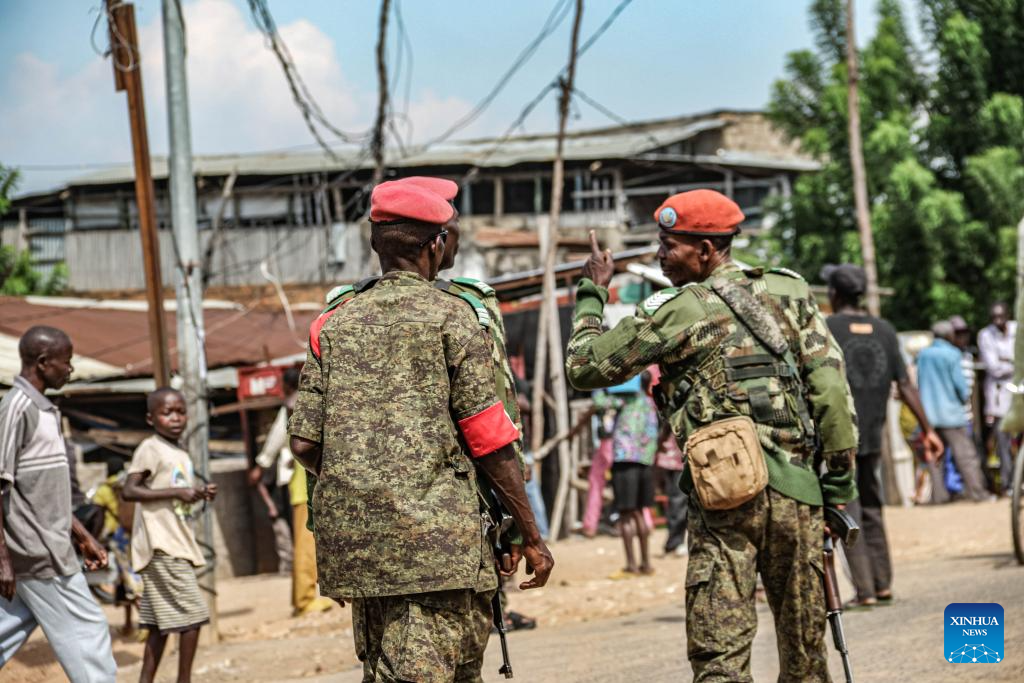
Soldiers of the Democratic Republic of the Congo military are seen in Sange, a town in eastern DRC, on May 12, 2026. (Str/Xinhua)