
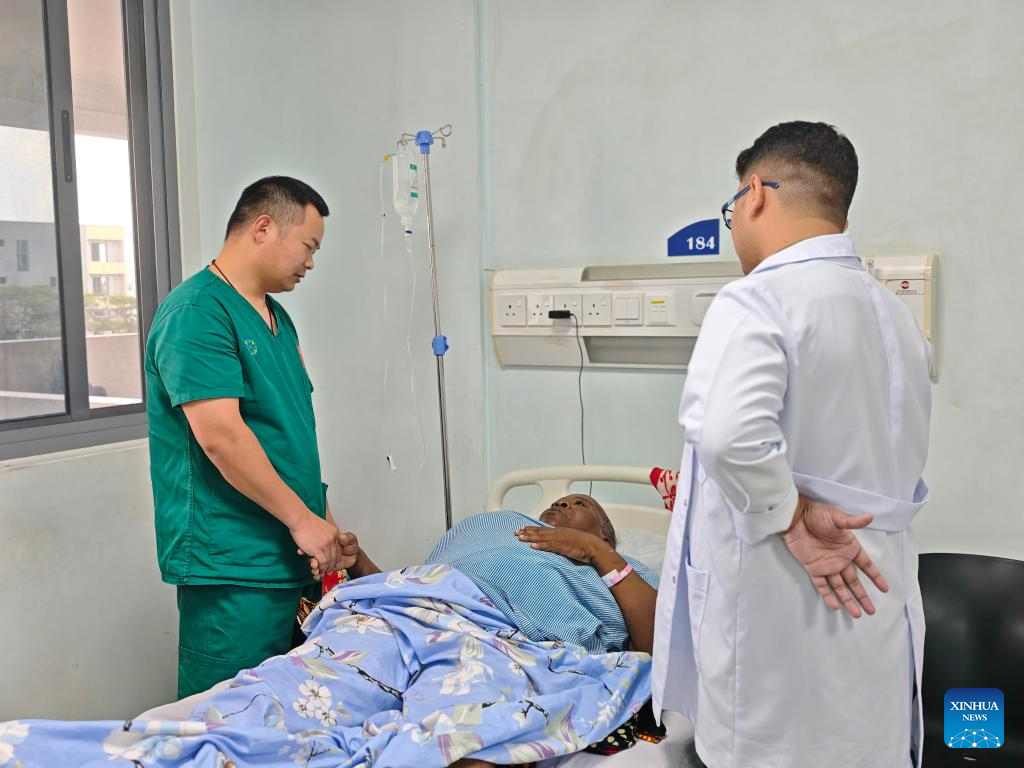
Bao Zengtao (L), a Chinese general surgery specialist, checks on a patient's recovery status in Zanzibar, Tanzania, March 17, 2026. (The 35th Chinese medical team to Zanzibar/Handout via Xinhua)
ZANZIBAR, Tanzania, May 11 (Xinhua) -- For nearly two years, 46-year-old Khadija Suleiman struggled with constant pain and limited mobility, as a massive abdominal swelling made even the simplest daily activities difficult.
The mother of three from Tanzania's Zanzibar had already undergone two unsuccessful operations after developing an incisional hernia following gynecological surgery.
Each time, she hoped the problem had been solved, only for the condition to return, larger and more painful than before.
"I could barely move freely or live a normal life," Suleiman recalled after she was recently discharged from Lumumba Hospital on Unguja Island. "I was losing hope."
However, hope was rekindled recently when doctors from the 35th Chinese medical team to Zanzibar joined local surgeons to perform the hospital's first complex giant abdominal wall incisional hernia mesh repair surgery.
Leading the operation was Bao Zengtao, a Chinese general surgery specialist working alongside local surgeon Haithem Salim and other Tanzanian staff.
Bao, head of the 35th Chinese medical team to Zanzibar, said Suleiman's condition was particularly complicated because previous surgeries had failed and extensive internal adhesions had formed over time.
After reviewing CT scans and conducting detailed examinations, the Chinese and Tanzanian doctors developed a comprehensive surgical plan to safely repair the hernia while minimizing postoperative risks.
During the operation, the team discovered additional complications, including severe colonic dilation and small intestine adhesions, which significantly increased the complexity of the procedure.
To reduce abdominal pressure and improve recovery prospects, the surgeons first performed a right hemicolectomy and partial small intestine adhesion release and resection before carrying out the abdominal wall hernia repair using surgical mesh. They also reconstructed damaged abdominal skin to improve healing.
After nearly five and a half hours, the operation was successfully completed. Bao conducted daily ward rounds and supervised Suleiman's recovery through personalized rehabilitation and close monitoring.
Gradually, she regained strength. She progressed from a liquid diet to eating independently, while the large abdominal bulge that had dominated her life disappeared.
With tears in her eyes, Suleiman clasped Bao's hand tightly and expressed gratitude to the medical team. "The Chinese doctors gave me a second chance at life," she said.
For local surgeon Salim, the surgery marked a major professional milestone.
"This was my first time participating in such a complex abdominal wall hernia repair," he said. "Working closely with the Chinese experts has greatly strengthened my confidence and skills."
He added that the cooperation provided valuable hands-on experience to help improve local surgical capacity for treating difficult cases in the future.
The surgery has been hailed by doctors at Lumumba Hospital as an important breakthrough for Zanzibar's healthcare services, demonstrating how medical cooperation between China and Tanzania is helping expand access to advanced treatment while strengthening local expertise.
"A total of over 10,000 outpatient visits and more than 6,679 inpatient admissions have been completed since we came here last year in September," Bao said.
The team has performed 1,564 emergency and elective surgeries, provided traditional Chinese medicine therapies and acupuncture to 1,340 patients, treated over 366 critically ill cases, and assisted in 318 deliveries, he added.
More than 50 new medical techniques have been introduced. The team has also conducted 19 outreach free clinics at Chinese enterprises in Tanzania and local communities, offering health education, free medical check-ups, specialist consultations, and traditional Chinese medicine experiences, benefiting over 5,000 people. ■