
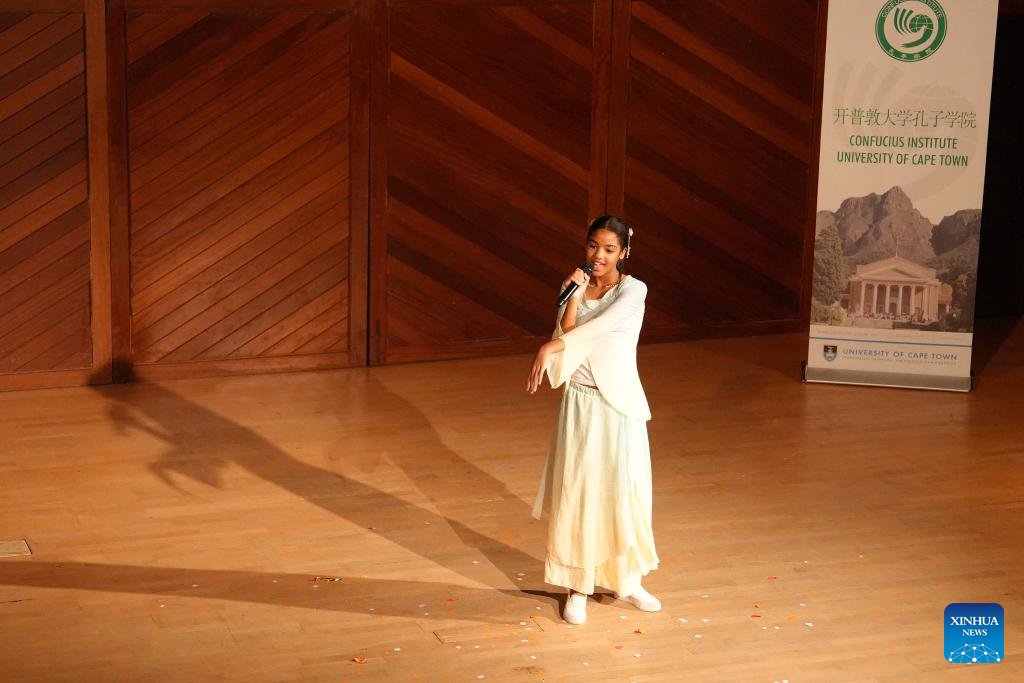
A contestant performs at the fifth Chinese Singing Competition of the Confucius Institute at the University of Cape Town, in Cape Town, South Africa, April 18, 2026. Young students from across Cape Town, South Africa's legislative capital, brought energy and enthusiasm to a celebration of Chinese culture on Saturday, as the Confucius Institute at the University of Cape Town (CIUCT) staged its fifth Chinese Singing Competition, highlighting the idea that music can serve as a bridge between cultures.(Xinhua/Wang Lei)
CAPE TOWN, April 18 (Xinhua) -- Young students from across Cape Town, South Africa's legislative capital, brought energy and enthusiasm to a celebration of Chinese culture on Saturday, as the Confucius Institute at the University of Cape Town (CIUCT) staged its fifth Chinese Singing Competition, highlighting the idea that music can serve as a bridge between cultures.
As a special event marking this year's International Chinese Language Day, the competition took place at Groote Schuur High School, a well-known local campus, under the theme "iSing" and was co-organized by the school and the Confucius Institute at Stellenbosch University. Participants from universities, secondary schools, and primary schools competed in two divisions: a university category and a combined primary and secondary school group.
Deputy Consul-General of China in Cape Town, Wang Xiao, in her opening address of the event, highlighted the deep cultural roots embodied in the Chinese language. "As one of the oldest languages in the world, Chinese dates back thousands of years and is spoken across the world," she said.
"Chinese songs, as a highly engaging cultural medium, not only help learners improve their Chinese proficiency, but also enable them to experience firsthand the depth and emotional richness of Chinese culture through melody and lyrics," said Wang.
"We look forward to seeing more South African friends learn Chinese, which will open for you the window on modern China and the Chinese civilization," she added.
Throughout the competition, contestants with varying levels of Chinese proficiency and learning experience delivered confident and enthusiastic performances, earning rounds of applause and cheers from the audience. Their repertoire ranged from classic songs such as "Olive Tree" and "Evening Bell Ringing at Nanping Hill" to more contemporary hits like "Blue and White Porcelain" and "Lonely Warrior."
A performance of the children's song "Little Bugs Flying" by a group of local primary school students stood out as one of the highlights of the event, igniting the audience as many joined in clapping and singing along.
In the end, a duet from the University of Cape Town, Arielle Denis and Hannah Engel, won first prize in the university category with their performance of "Free," while Chazz Hendricks from Floreat Primary School took the top prize in the primary and secondary school division with "The Snail and the Oriole."
Denis and Engel told Xinhua that they both began learning Chinese in Grade 8 and have made many new friends along the way.
They added that they hope to pursue careers in international translation or law in the future, noting that learning Chinese and singing Chinese songs not only deepens their understanding of Chinese culture but also benefits their future career prospects.
"Learning Chinese to help people, learning the language that they speak -- I think that would be very beneficial to help me in the future," Engel said.
After the event, Danie Visser, director of the University of Cape Town's International Office and foreign director of CIUCT, told Xinhua that music serves as a bridge between different cultures, and that in the context of the 2026 China-Africa Year of People-to-People Exchanges, cultural activities such as Chinese singing competitions play a vital role in building such connections.
"Of course one can't build a bridge by just thinking about it. You have to do something to build it, so events like this, each one of them is a block in the bridge," Visser said.
He also noted that with China's growing strength and the deepening ties between China and Africa, the influence of the Chinese language is expanding. He expressed the expectation that more South African schools will incorporate Chinese into their curricula, helping students develop language skills from an early age.
"Now, Chinese is the upcoming language, the lingua franca of the world," he said. "I think whenever there is a time to learn Mandarin, it is now." ■
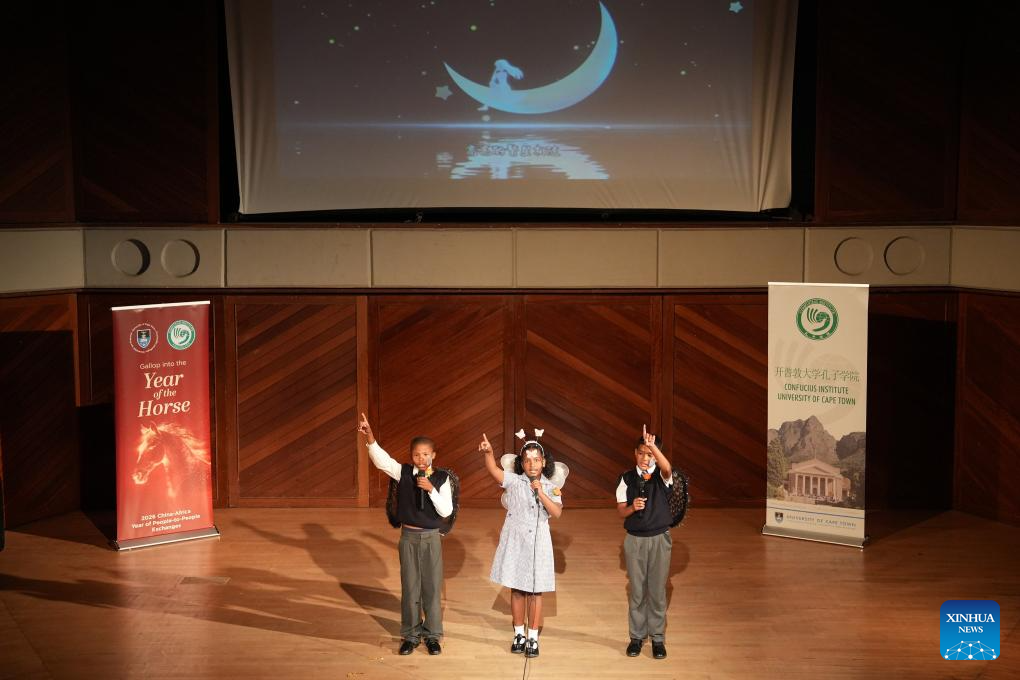
Contestants perform at the fifth Chinese Singing Competition of the Confucius Institute at the University of Cape Town, in Cape Town, South Africa, April 18, 2026. Young students from across Cape Town, South Africa's legislative capital, brought energy and enthusiasm to a celebration of Chinese culture on Saturday, as the Confucius Institute at the University of Cape Town (CIUCT) staged its fifth Chinese Singing Competition, highlighting the idea that music can serve as a bridge between cultures.(Xinhua/Wang Lei)
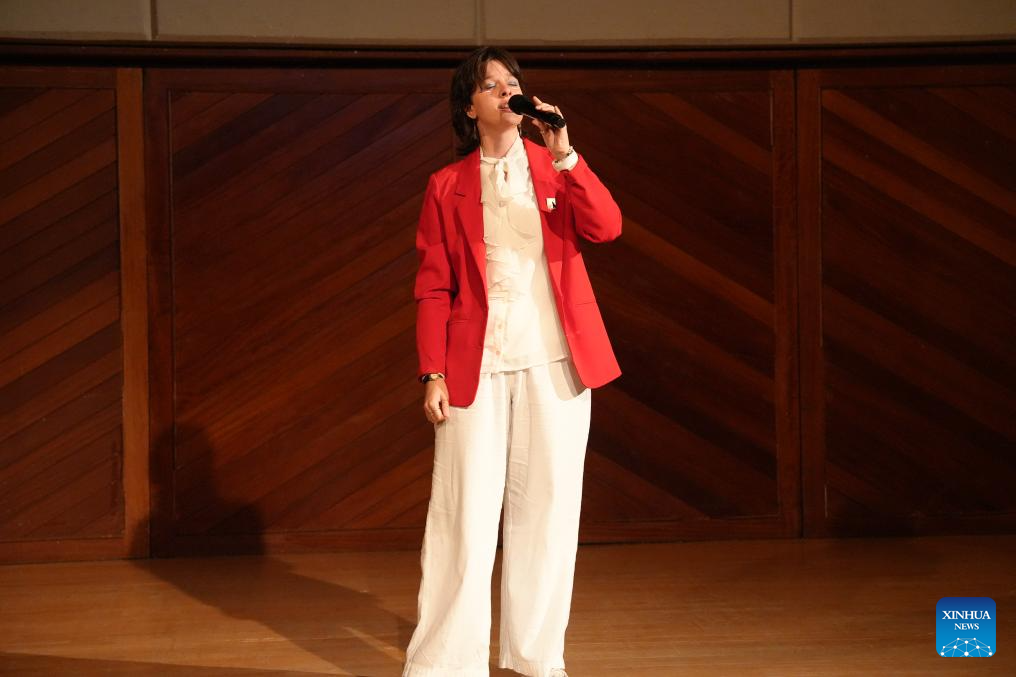
A contestant performs at the fifth Chinese Singing Competition of the Confucius Institute at the University of Cape Town, in Cape Town, South Africa, April 18, 2026. Young students from across Cape Town, South Africa's legislative capital, brought energy and enthusiasm to a celebration of Chinese culture on Saturday, as the Confucius Institute at the University of Cape Town (CIUCT) staged its fifth Chinese Singing Competition, highlighting the idea that music can serve as a bridge between cultures.(Xinhua/Wang Lei)
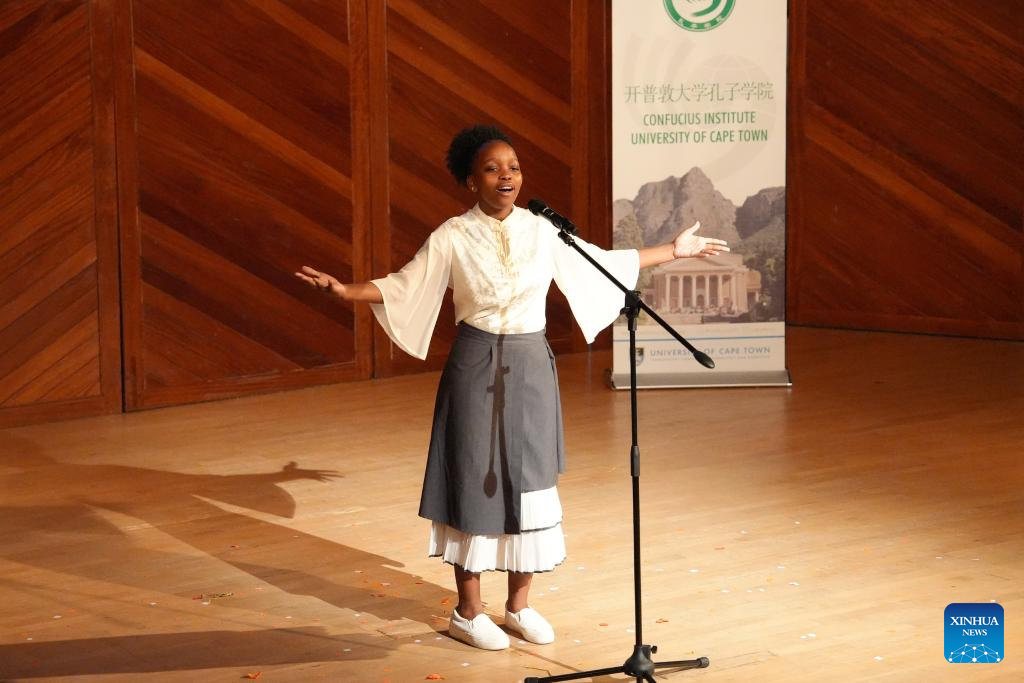
A contestant performs at the fifth Chinese Singing Competition of the Confucius Institute at the University of Cape Town, in Cape Town, South Africa, April 18, 2026. Young students from across Cape Town, South Africa's legislative capital, brought energy and enthusiasm to a celebration of Chinese culture on Saturday, as the Confucius Institute at the University of Cape Town (CIUCT) staged its fifth Chinese Singing Competition, highlighting the idea that music can serve as a bridge between cultures.(Xinhua/Wang Lei)