
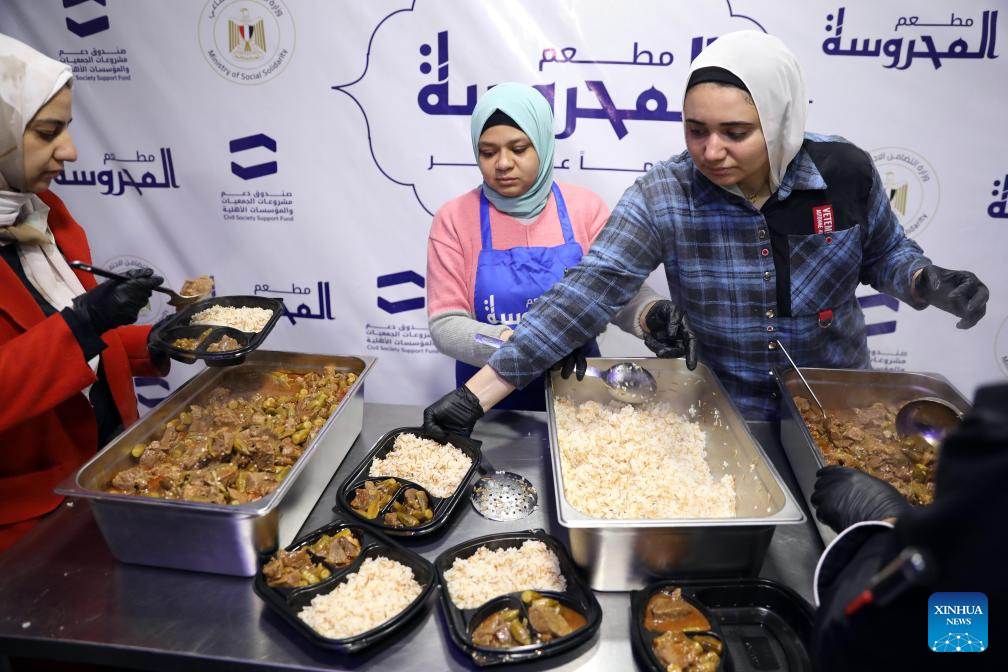
Staff members and volunteers prepare a free iftar (fast-breaking meal) at a government-sponsored public restaurant in Cairo, Egypt, March 13, 2026. (Xinhua/Ahmed Gomaa)
by Mahmoud Fouly
CAIRO, March 14 (Xinhua) -- As the sun edged closer to the horizon in Cairo, hundreds gathered at a government-sponsored public restaurant, sharing tables to enjoy a free iftar (fast-breaking meal) at sunset, after a whole day of fasting in the Muslim holy month of Ramadan.
Among them was Khaled Al-Masri, a young machinist who had just finished work at a nearby metal workshop. Running late on his way home, he and a colleague decided to stop by the restaurant after noticing the crowd gathering for iftar.
"We were worried we would miss iftar today," said Khaled. "Then we saw this place offering free iftar, and people were welcoming us in. It felt like a blessing at the end of a long day."
Scenes like this unfold daily at El-Mahrousa restaurant, one of more than 1,000 food distribution points participating in Egypt's "Abwab Al-Khair" (Doors of Goodness) initiative, which aims to support vulnerable families during Ramadan.
Launched under the patronage of Egyptian President Abdel-Fattah al-Sisi and implemented by the state's Tahya Misr (Long Live Egypt) Fund in cooperation with the Ministry of Social Solidarity, the initiative is one of several others that seek to provide more than 71 million hot meals and distribute over 5.5 million food boxes nationwide throughout Ramadan.
One of the initiative's key programs is the "Iftar for the Fasting" campaign.
At El-Mahrousa restaurant in Cairo, the kitchen produces around 4,000 meals daily, distributed between iftar and Suhoor (pre-dawn, pre-fasting meal), according to Eman Nasr, director of the feeding program at the Civil Society Support Fund, affiliated with the Ministry of Social Solidarity.
"We have no conditions for beneficiaries. Anyone who comes through the door is welcome, and we offer them a meal," Nasr told Xinhua.
She said that El-Mahrousa will continue its charitable activities even after Ramadan.
Inside the spacious kitchen of El-Mahrousa, preparations begin hours before sunset. Workers chop vegetables, cook large trays of rice, and grill chicken and beef in industrial-sized batches, while volunteers assemble meal boxes that will soon be distributed to hundreds of fasting visitors.
Head chef Ahmed Abdel-Rahman said the team starts working early in the morning to ensure everything is ready in time for iftar.
"We begin around seven in the morning because the quantities are large. Everyone here has a role -- some prepare rice, others vegetables, chicken, or meat -- so the work moves smoothly and the meals are ready before sunset," he said.
For volunteers, the experience means more than just preparing food.
Manar Nabil, one of the volunteers helping distribute meals, said she often feels a deep sense of joy watching people break their fast.
"When people come in tired and hungry and then leave smiling after their meal, it's a wonderful feeling," she said. "You feel like you are doing something meaningful for others."
As the sunset call to prayer echoed from loudspeakers across the neighborhood, giving the fast-breaking green light, the courtyard and rooftop dining areas of El-Mahrousa gradually filled with visitors sharing tables and plates of steaming food.
Among them was Mamdouh Rushdy, a security guard working at a nearby courthouse, who said he now visits the restaurant regularly during Ramadan.
"It's a lovely initiative. The food here is very good, and the people treat everyone kindly," he said while finishing his meal. "Just as the name of the initiative, Abwab Al-Khair, suggests, I can feel that the Doors of Goodness are open to everyone here." ■
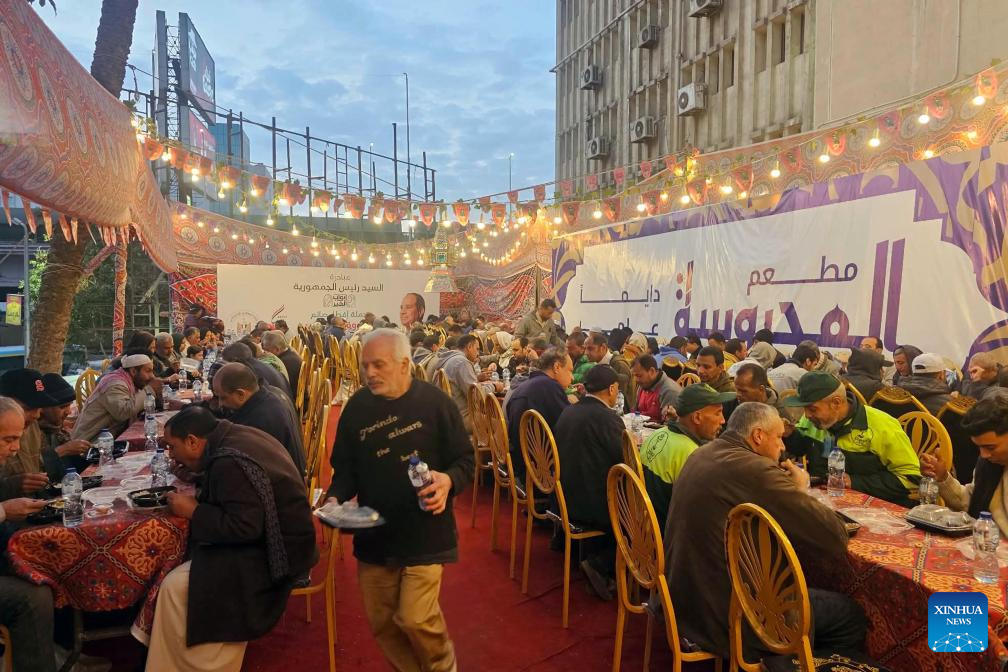
People enjoy a free iftar (fast-breaking meal) at a government-sponsored public restaurant in Cairo, Egypt, March 13, 2026. (Xinhua/Ahmed Gomaa)