
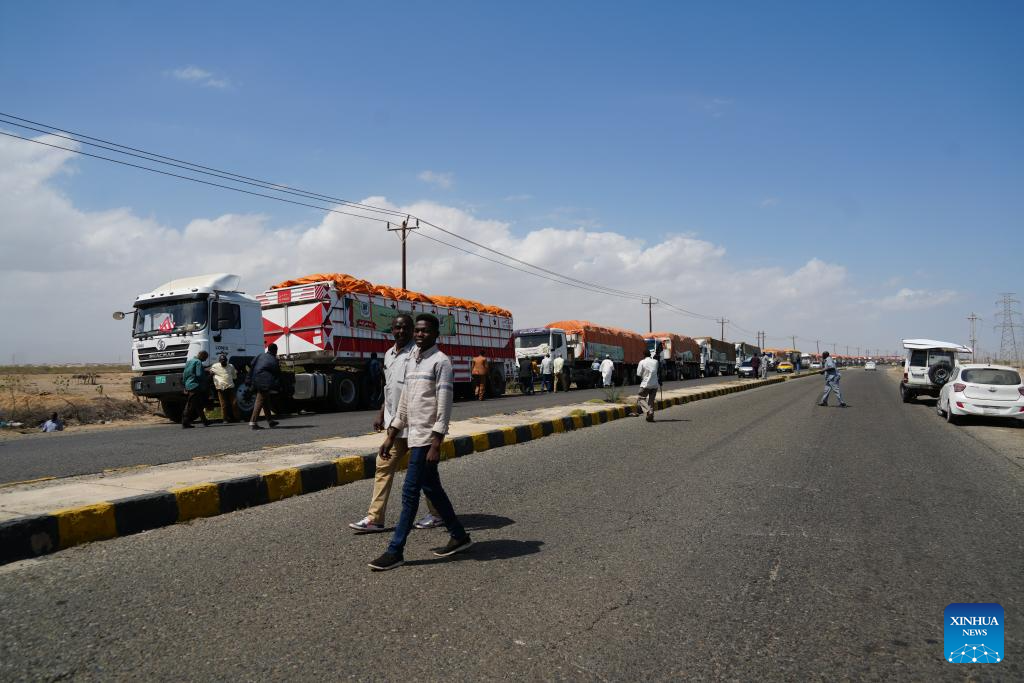
This photo taken on March 8, 2026 shows trucks loaded with humanitarian aid in Port Sudan, eastern Sudan. As Sudan's civil war approaches its third anniversary, the United Nations warns that humanitarian needs are rising, while the Sudanese government maintains that food supplies remain under control, raising concerns about the country's future food security. (Photo by Urqia Elzaki/Xinhua)
KHARTOUM, March 8 (Xinhua) -- As Sudan's civil war approaches its third anniversary, the United Nations warns that humanitarian needs are rising, while the Sudanese government maintains that food supplies remain under control, raising concerns about the country's future food security.
The UN's 2026 Humanitarian Response Plan estimates that 33.7 million people in Sudan will need aid this year, up 3.3 million from 2025. About 29 million people face severe food insecurity, and 23 areas are at risk of famine or already experiencing it. Some 9.1 million people remain internally displaced, while 3.6 million have returned home, mostly to Khartoum and Gezira states, often under harsh conditions with limited access to basic services.
The UN attributes rising needs to mass displacement, disrupted supply chains, rising prices, declining agricultural production in conflict-affected areas, and deteriorating health, water, and sanitation services. Humanitarian response is further constrained by funding shortages and access challenges, particularly in Darfur and Kordofan, where more than 80 percent of the population requires aid.
The UN estimates that 2.8 billion U.S. dollars is needed for humanitarian operations in Sudan in 2026 to reach 20.4 million of the most vulnerable. Aid groups warn that funding gaps could leave at least 14.2 million people without assistance.
In contrast, Sudanese authorities insist the food situation is stable.
Sudan's Humanitarian Aid Commissioner, Salwa Adam Benya, said Sunday that the government is working to maintain food supply stability through support for agriculture and coordination with international partners.
"The food situation in Sudan remains under control thanks to government interventions and the cooperation of international partners," she said, denying that famine exists despite international warnings of famine risks in some areas.
The latest UN-backed Integrated Food Security Phase Classification (IPC) report, released in November 2025, highlighted famine conditions in El Fasher, North Darfur, and Kadugli, South Kordofan. The report also warned that more than 21 million people faced high levels of severe food insecurity in September 2025.
At least one in five people suffers from acute malnutrition and is at risk of famine, while roughly 30 percent of children under five are malnourished.
Observers say discrepancies between UN estimates and the government's narrative stem from differing assessment methods and perspectives. International agencies focus on humanitarian indicators, while the government emphasizes its ability to manage the crisis.
"Sudan's food security crisis cannot be separated from the wider armed conflict and its impacts on the national economy," said political analyst Musab Mohsin.
"The war has affected agricultural production, transportation networks, distribution channels, and local markets, causing major imbalances in the movement of food between production and consumption areas," he said. Fighting and displacement in major agricultural states, including Gezira, Sinnar, and parts of Kordofan, have reduced production and limited farmers' access to inputs and markets, while rising transport costs and declining inter-state trade have pushed up food prices.
Food security expert Mohamed Abdul-Qadir told Xinhua that the crisis could worsen if the conflict continues.
"The war has disrupted entire agricultural seasons in some areas, especially in Darfur and Kordofan, where many farmers have abandoned their lands due to insecurity or displacement," he said.
He added that "the crisis is not only about food availability but also people's ability to access it. Rising inflation and declining household incomes make obtaining food more difficult."
On solutions, Abdul-Qadir said reviving agriculture requires broad support, including access to inputs, rehabilitation of rural infrastructure, and enabling farmers to reach finance and markets.
With international warnings and government reassurances in tension, Sudan's food security remains closely tied to the trajectory of the ongoing conflict and the effectiveness of humanitarian and development efforts in mitigating its growing humanitarian impact. ■
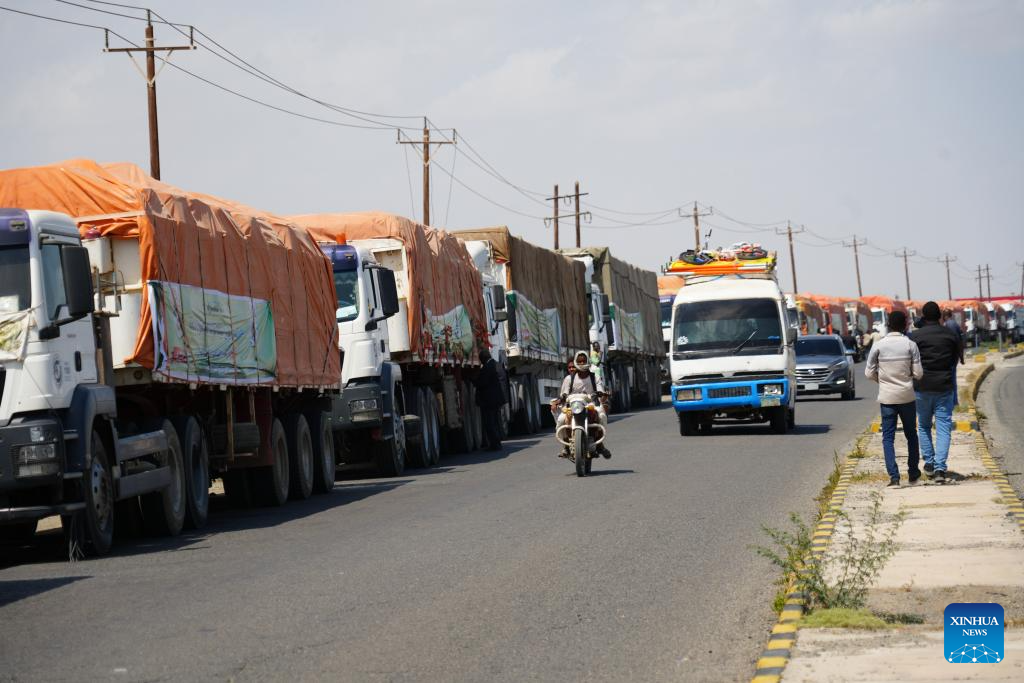
This photo taken on March 8, 2026 shows trucks loaded with humanitarian aid in Port Sudan, eastern Sudan. As Sudan's civil war approaches its third anniversary, the United Nations warns that humanitarian needs are rising, while the Sudanese government maintains that food supplies remain under control, raising concerns about the country's future food security. (Photo by Urqia Elzaki/Xinhua)
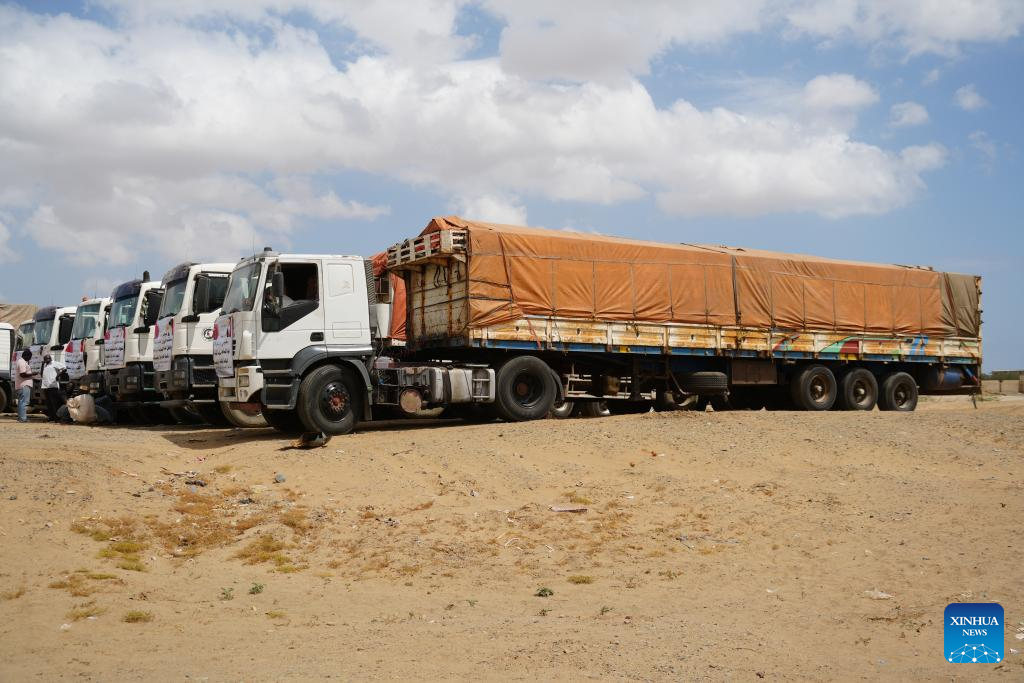
This photo taken on March 8, 2026 shows trucks loaded with humanitarian aid in Port Sudan, eastern Sudan. As Sudan's civil war approaches its third anniversary, the United Nations warns that humanitarian needs are rising, while the Sudanese government maintains that food supplies remain under control, raising concerns about the country's future food security. (Photo by Urqia Elzaki/Xinhua)