
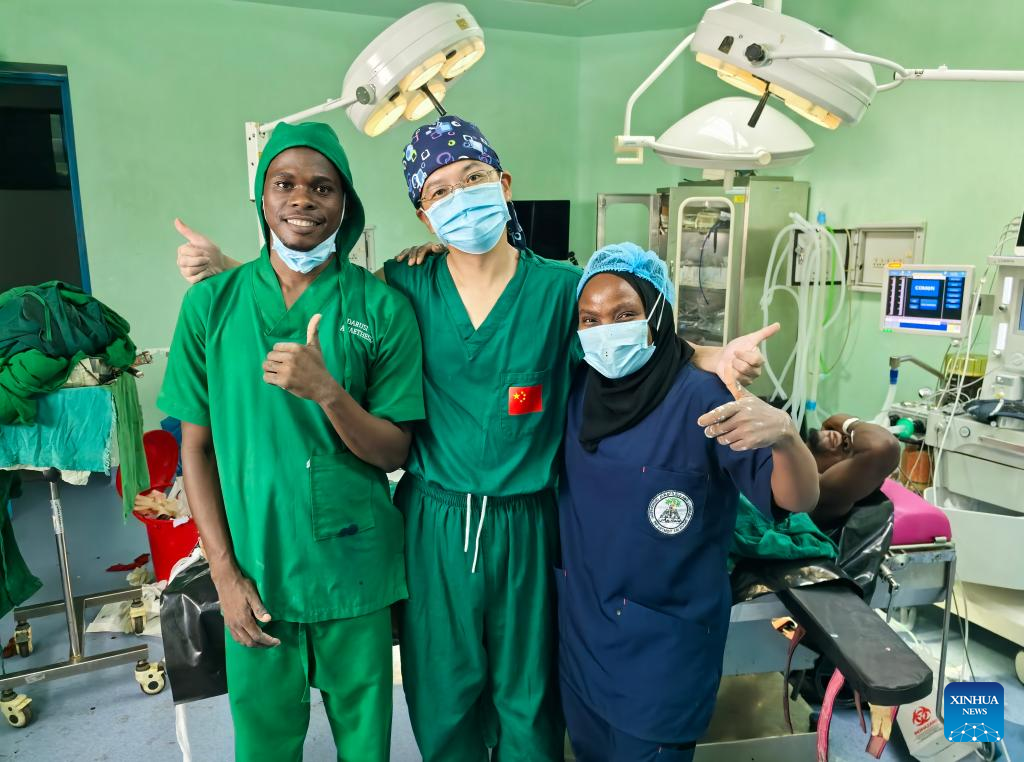
Hou Jianwen (C) and his local colleagues pose for a group photo after completing the surgery in Zanzibar, Tanzania, on Jan. 18, 2026. (The 35th Chinese medical team in Zanzibar/Handout via Xinhua)
DAR ES SALAAM, Feb. 24 (Xinhua) -- Three weeks ago, 31-year-old Ali Hamad Kombo believed his working life -- and his family's livelihood -- had come to an abrupt and painful end.
A commuter bus conductor in Chake Chake district on Tanzania's Zanzibar Pemba Island, Kombo, depends on daily wages to support his wife and three children. A road accident left him with a fractured right arm, forcing him to stop work and plunging his family into uncertainty.
"I thought everything was over," Kombo recalled in a recent interview with Xinhua. "Without my hand, I could not work. Without work, I could not take care of my children."
Today, Kombo's outlook has changed dramatically. Following a complex operation at Abdulla Mzee Hospital, he is recovering steadily and hopes to return to work in the coming weeks. His renewed optimism, he says, is thanks to the joint efforts of the 35th Chinese medical team in Zanzibar and local doctors.
"I have no proper words to thank the Chinese doctors," Kombo said, gently flexing his recovering arm. "They not only saved my hand after a very difficult surgery, but they also saved my family. I am looking forward to working again and earning an income."
A local doctor told Xinhua that Kombo's injury resulted from a traffic accident on Pemba Island, where narrow roads and a growing number of vehicles often lead to serious trauma cases, while medical resources remain limited.
After initial treatment, doctors confirmed that Kombo had suffered a severe fracture of the distal humerus near the elbow, an injury known for its complexity and high risk of long-term disability if not treated properly.
For Kombo, the diagnosis was devastating. "I could not even hold a cup," he said. "All I could think about was how my children would eat."
At Abdulla Mzee Hospital, local orthopedic surgeon Eveline Emmanuel Sikahanga reviewed Kombo's imaging and reached out to Hou Jianwen, deputy leader of the Chinese medical team in Zanzibar and chief orthopedic surgeon, stationed on Pemba Island as part of China's long-running medical aid program.
The imaging revealed a highly comminuted fracture, with the bone shattered into multiple fragments and the joint surface severely damaged. "This was not a simple fracture," Hou said. "It involved the joint, with many fragments that needed precise reconstruction."
Under the hospital's limited conditions, the challenge was immense, as there was no intraoperative C-arm fluoroscopy available for real-time X-ray guidance.
The first operation was scheduled for the evening of Jan. 17 and continued late into the night. Using an olecranon osteotomy approach to access the damaged joint, Hou worked closely with Sikahanga throughout the procedure.
Without fluoroscopy, every step relied on anatomical knowledge, tactile feedback and experience, what surgeons sometimes call a "blind operation." Each screw and wire placement was uncertain until postoperative X-rays confirmed the result.
"The fracture was even more complex than the images suggested," Hou said. "There were more than seven significant fragments, and one key piece was difficult to identify at first."
Together with Sikahanga, Hou carefully identified the anatomy, stabilized the bone fragments, and determined the correct angles for fixation.
As the surgery progressed, the need for additional assistance became clear. Hou called in Zhu Shuangjiu, head of general surgery with the Chinese medical team, to help maintain reduction and assist with fixation.
"With three people working together, everything became more efficient," Sikahanga said. The operation concluded around 1:00 a.m. local time the following day.
Hou's work did not end with the surgery. Unable to sleep, he sketched detailed diagrams of the fracture reduction and fixation technique, later sharing them with Sikahanga as a learning tool.
"This is how mentorship should be," Sikahanga said later. "Not just words, but standing with you during the hardest moments and helping you understand every decision."
Postoperative X-rays taken the next morning showed satisfactory reduction and fixation. Kombo's circulation and nerve sensation were intact, a crucial indicator of success.
For Kombo, the technical details matter less than the outcome. He can move his fingers. The pain is manageable. And for the first time since the accident, he can plan for the future.
"I will go back to work," he said with a smile.
For Hou and his colleagues, Kombo's recovery embodies the purpose of their mission. Chinese medical teams have worked in Zanzibar for decades, providing care, training and support in areas where resources are limited.
"True medical aid is not only about treating patients," Hou said. "It is about sharing knowledge, building confidence with local doctors, and taking responsibility together for every life." ■