
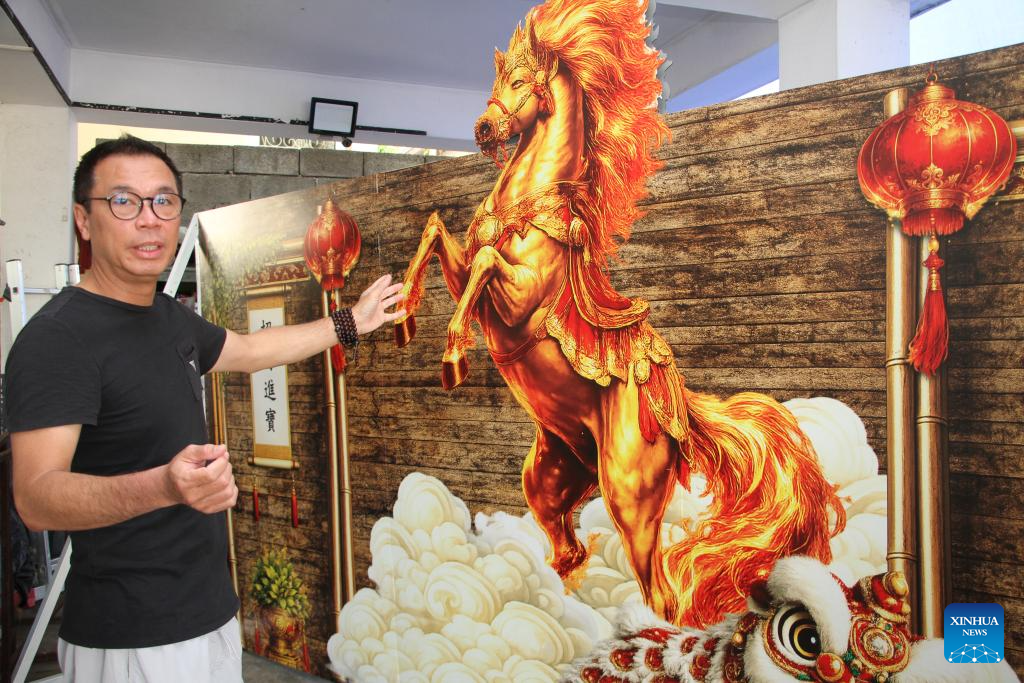
Jacques Li, head of a float workshop, introduces a display panel themed on the Year of the Horse in Port Louis, the capital of Mauritius, Feb. 11, 2026. (Photo by Ally Soobye/Xinhua)
PORT LOUIS, Feb. 20 (Xinhua) -- As a gentle summer sea breeze drifts through the streets of Port Louis, the capital of Mauritius, preparations for the annual Spring Festival float parade are underway inside a workshop.
Two large display panels dominate the space. One features a golden horse rearing high, framed by auspicious blessings that read "May everything go well" and "May money and treasure be plentiful." The other depicts a winter landscape from northern China -- snow-capped mountains and frost-coated trees -- offering a cool counterpoint to Mauritius's midsummer heat.
Design sketches lie in neat stacks on a long wooden table, their corners curled from repeated handling. Measuring tapes, red lanterns and rolls of canvas sit nearby. Around a dozen artisans work in close coordination: some weld metal frames, sparks flashing briefly; others secure panels inch by inch. One worker stands on an overturned drum to hang lanterns, while several others step back to assess the structure and make adjustments.
The festive atmosphere emerges gradually, through each welded joint, each lantern raised and each quiet exchange.
Jacques Li, head of the workshop and a third-generation Hakka Mauritian with ancestral roots in Meixian District in south China's Guangdong Province, said two floats are being prepared, as in previous years. One celebrates the Year of the Horse; the other showcases the snow and ice scenery of northern China, a contrast he believes will spark curiosity during the island's summer.
Li said he hopes the display will help Mauritians understand that China's Spring Festival falls in winter, a season of mountain vistas, ice sports and elaborate ice sculptures. "Winter in China is as good as, or even better than, winter anywhere else in the world," he said.
As a member of the Hakka community, whose history is shaped by migration, Li sees symbolism in the moving floats. "A float travels from one place to another. In some ways, that reflects the life journey of the Hakka people," he said.
Though the preparation is demanding, Li describes it as joyful and meaningful, both an expression of homesickness and a celebration shared with others. "Preparing the parade is like preparing a meal for the whole family," he said, adding that the floats belong not only to the Chinese community but to all Mauritians.
Months of discussions with the China Cultural Center in Mauritius and local Chinese associations went into refining the designs, balancing cultural authenticity with accessibility for diverse audiences.
Mauritius is the only African country that lists the Spring Festival as a statutory public holiday. Since the float parade was introduced in 2018 with support from local Chinese associations, it has become a platform for cross-cultural celebration.
Louise Chee Foong Tai Kie, vice president of the United Chinese Associations, said the parade has brought the festival beyond family tables and temple incense into the public square. For younger generations especially, she said, the floats serve as "living classrooms," turning cultural heritage into something visible and dynamic.
Among regular spectators is Vikramsing Gungah, a lecturer in intercultural dialogue at Middlesex University Mauritius and the son-in-law of a family from east China's Shandong Province.
For Gungah, the floats are more than decoration. They are "rolling chapters of a living history," showing how the Chinese community has preserved its traditions while taking root in Mauritian soil.
He recalls childhood Spring Festivals fondly: morning visits to the pagoda with his parents, evenings in brightly lit Chinatown, and the sweetness of rice cakes. The festival, he said, was his "first teacher in cross-cultural belonging," learned through taste, scent and shared smiles rather than textbooks.
At the parade, he does not see separate communities, but Hindu, Muslim, Creole and Tamil families standing side by side.
"The float parade is a conversation between civilizations," he said. "It requires no translation, only presence, openness and a willingness to be moved."
The floats are still under construction. On the 12th day of the first lunar month, they will roll through Port Louis as a highlight of the Spring Festival celebrations. Even before they set out, the connections they embody have already allowed the festive spirit to take root across the island.
This year, Gungah plans to attend with his daughters. As the floats pass, he said, he may hear his mother-in-law's words from Shandong: "When the Fire Horse gallops, blessings follow like flames." ■
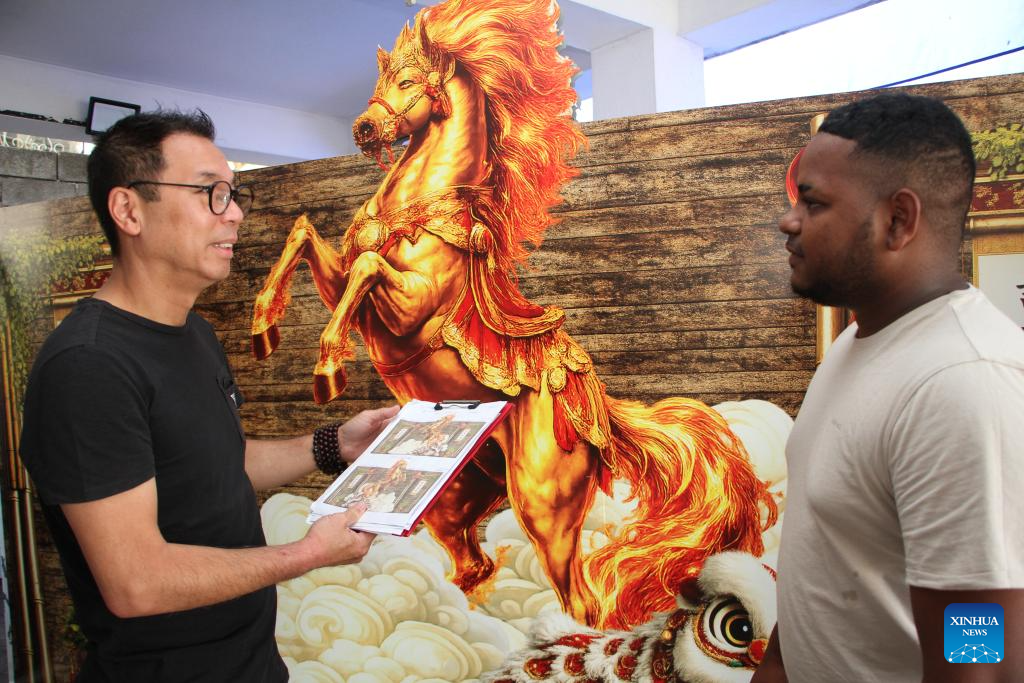
Jacques Li (L), head of a float workshop, discusses details of float production with an artisan at his float workshop in Port Louis, the capital of Mauritius, Feb. 11, 2026. (Photo by Ally Soobye/Xinhua)