
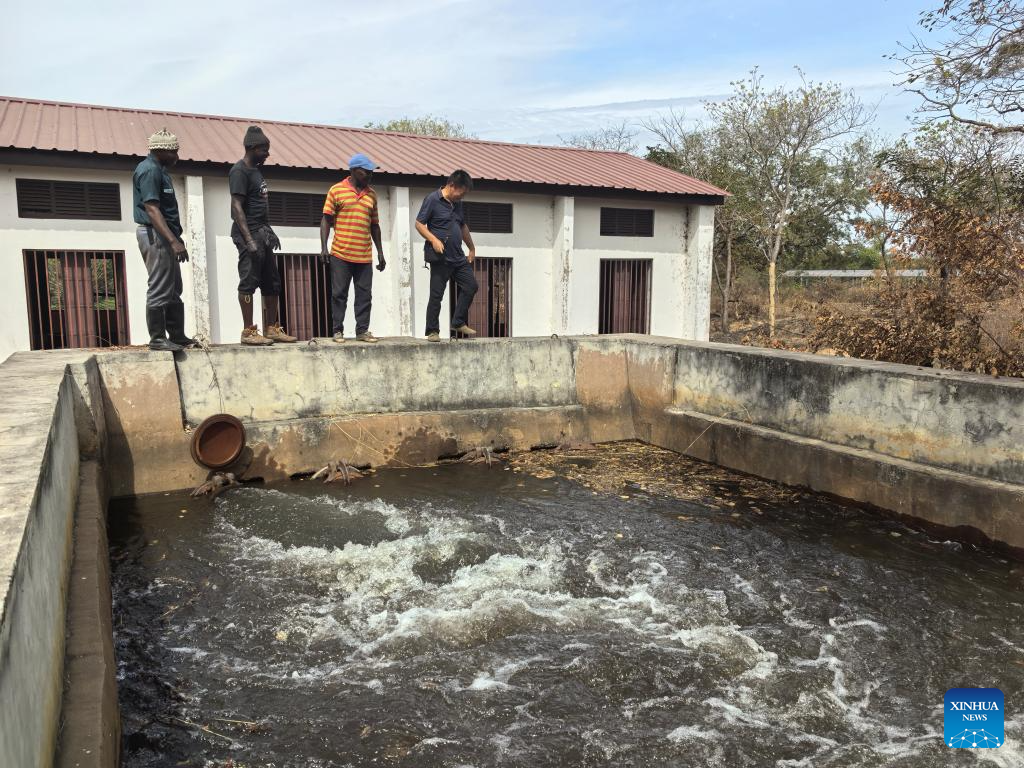
A Chinese agricultural expert and local staff members check the restored water flow at a pump station at Carantaba Farm in northeastern Guinea-Bissau, on Feb. 5, 2026. (The 12th Chinese Agricultural Technical Assistance Mission in Guinea-Bissau/Handout via Xinhua)
DAKAR, Feb. 14 (Xinhua) -- At Carantaba Farm in northeastern Guinea-Bissau, the flow of water in the irrigation canals abruptly stopped. Under the dry-season heat, rice paddies began to pale and the soil hardened.
The breakdown threatened more than a single harvest. Carantaba is also a key site for producing improved rice seeds in a country where rice is a staple food.
Planting at the farm is staggered. Seedlings were entering the critical stage, when water demand surges. Any prolonged interruption in irrigation could wither young plants and sharply reduce yields.
Farm technician Luis Fombe paced anxiously around the generator set. The diesel engine roared to life but vibrated violently. The alternator showed no output, the voltmeter needle stuck at zero, and the pumps remained idle.
"Finding original parts here is almost impossible," Fombe said. "Even if we order them, the seedlings cannot wait."
Out of options, he called the Chinese Agricultural Technical Assistance Mission based in Bafata, the second-largest city in the West African country. Two mechanics, Liu Qingguo and Deng Changchun, packed a welding machine and testing tools and drove straight to Carantaba.
Their diagnosis was immediate: multiple faults across power generation, transmission and the water pipeline. With no spare parts available, they dismantled the system, repaired it section by section, and reassembled it piece by piece.
Inside the machine room, an angle grinder shrieked as sparks flew. Crouching near the coupling between the generator and the pump, Deng measured again and again. A substitute part "didn't fit."
"At high speed, even a small deviation can cause strong vibration," Deng explained. "The pump will not lift water, and it could fail."
The team decided to machine the adjustment on site -- cutting, grinding, testing and trying again. When the connectors finally aligned, another problem emerged: the modification had shifted the pipeline out of position. Liu made a quick decision. "Cut it. We re-weld it." The pipe segment was removed, re-angled and welded back into place.
On the third day, Liu pressed the start button. The generator roared back to life. The transmission stabilized. Minutes later, water pressure opened the main canal valve, and irrigation water once again flowed toward the thirsty fields.
"We had no spare parts," farm manager Fonseca Saqui said, shaking hands with the two mechanics. "You worked with what was there, and it runs again. Thank you."
According to Zheng Junjie, head of the 12th Chinese Agricultural Technical Assistance Mission in Guinea-Bissau, China has been sending agricultural experts to the country since 1998. Twelve teams and more than 240 experts have worked across regions including Bafata, Gabu and Oio.
"The goal is not only to help produce more, but to pass on methods," Zheng said. Over the past two years, the mission has helped select 54 rice varieties suited to local conditions and produced more than 30,000 kilograms of improved seeds.
The repair at Carantaba exemplifies an "end-to-end" approach, from field demonstrations to training technicians who understand both agronomy and machinery. More than 26,000 people have received technical training, and agricultural equipment and inputs have been donated to local partners.
As China's Spring Festival approaches, all nine members of the current mission have chosen to remain on duty during the dry-season planting period.
"For people who work the land, nothing beats seeing the water come back, not even New Year dumplings," Zheng said. ■
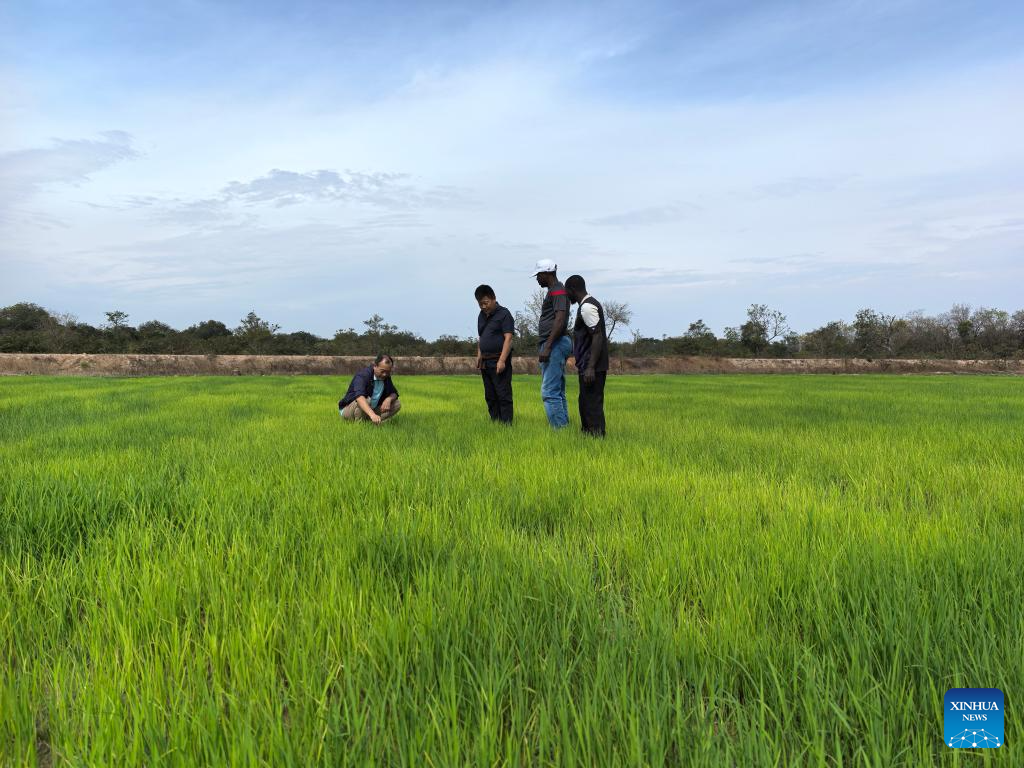
Chinese agricultural experts and local staff members check rice growth at Carantaba Farm in northeastern Guinea-Bissau, on Feb. 11, 2026. (The 12th Chinese Agricultural Technical Assistance Mission in Guinea-Bissau/Handout via Xinhua)