
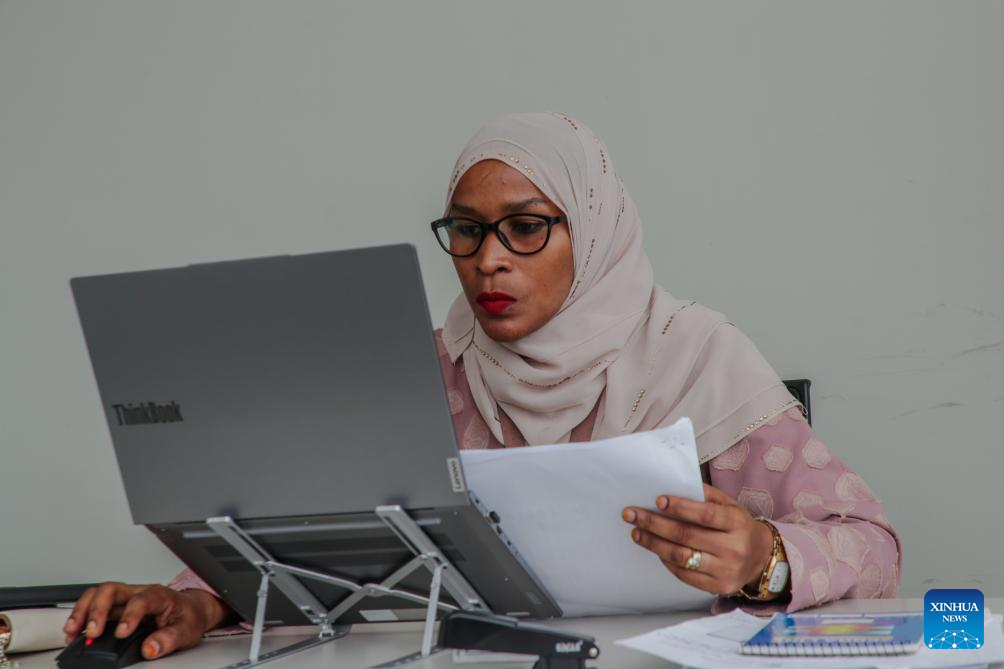
Amina works at her office in Dar es Salaam, Tanzania, Jan 15, 2026. (Xinhua/Emmanuel Herman)
DAR ES SALAAM, Jan. 20 (Xinhua) -- For three and a half years, Amina Ally Sauko has helped coordinate Tanzania Railways Corporation (TRC) train operations from its Operation Control Center (OCC) in the port city of Dar es Salaam, where precision and teamwork are essential.
Amina, a 35-year-old transport officer with the TRC, said this nerve center is more than a workplace -- it is where Tanzania's ambitions for connectivity, efficiency, and growth converge.
In 2025, her career took her far beyond Tanzania's borders. Selected for a special capacity-building program, she spent three months in China undergoing intensive railway training, an experience she describes as "a golden opportunity."
Amina was among 67 Tanzanian railway professionals, including 11 women, who completed the program commissioned by China Civil Engineering Construction Corporation (CCECC) and hosted by Beijing Jiaotong University and Zhengzhou Railway Vocational and Technical College.
The program was designed to address the urgent need for skilled personnel to operate Tanzania's rapidly expanding standard-gauge railway (SGR) network. Participants came from diverse roles, ranging from drivers, wagon inspectors, technicians, dispatchers, freight personnel, to safety officers.
At Beijing Jiaotong University, trainees were introduced to the fundamentals of modern railway systems. "It was intense, but it gave us a strong foundation," Amina told Xinhua.
After a week in the capital, Beijing, the group moved to Zhengzhou, a bustling railway hub in central China, where they spent nearly three months immersed in practical, hands-on learning.
At Zhengzhou Railway Vocational and Technical College, the curriculum focused on four core areas, namely mechanical and vehicle maintenance-ensuring locomotives and wagons meet international safety standards, passenger and freight safety management-learning protocols to safeguard both people and cargo, dispatch efficiency-mastering the art of coordinating trains across busy networks, and operational system management-integrating technology with human oversight for seamless control.
The approach blended classroom instruction with field practice. Trainees observed live dispatch operations, studied advanced signaling systems, and practiced simulations that mirrored real-world challenges.
"We combined what we already knew from Tanzania with what we learned in China. That combination made our skills much stronger," said the soft-spoken Amina.
The program was not only technical but also deeply personal. Living in China for three months meant adapting to new routines, languages, and cultures.
"At first, it was difficult. I missed my family a lot. But over time, I adapted, made new friends, and started to enjoy the experience," recalled Amina.
From navigating bustling Chinese cities to tasting regional dishes like noodles and dumplings, participants discovered a new world. "China's culture is rich and welcoming. We learned to appreciate diversity, and that understanding works both ways," she added.
China's railway system, widely regarded as one of the most advanced globally, left a lasting impression. High levels of automation, punctuality, and integration stood out.
"Technologically, China is far ahead. Their innovation and efficiency are impressive. It motivates us to think bigger about what is possible back home," said Amina.
Exposure to such systems helped Tanzanian professionals envision their own railway future, not as a distant dream, but as a practical roadmap. "Seeing how things work in China helps us understand how to improve safety, punctuality, and coordination in Tanzania," she explained.
The CCECC emphasized that the trainees would return as "seed instructors," tasked with sharing knowledge and training additional personnel within the TRC. This multiplier effect is expected to build a sustainable talent pipeline for Tanzania's railway sector.
"This program is not just about individual training," the CCECC noted in a statement. "It represents a shift from construction support to joint development of operational capabilities."
From the historic TAZARA railway, built in the 1970s with Chinese assistance, to today's modern SGR projects, cooperation between Tanzania and China has evolved from infrastructure construction to skills transfer and long-term sustainability.
Now back in Dar es Salaam, Amina applies her new skills daily. The screens and signals at the OCC feel familiar, but her perspective has changed. "I look at our operations differently now. I think more about efficiency, coordination, and safety. I also feel a stronger sense of teamwork," she said.
For her, the journey from Dar es Salaam to Beijing and Zhengzhou, and back again, is a reminder that behind every train schedule and control system are people who are learning, adapting, and working across borders to keep the rails moving forward.
"I am happy and proud to have been part of this program," she said with a smile. "It was challenging, rewarding, and unforgettable, and it has made me believe even more in the future of Tanzania's railway." ■
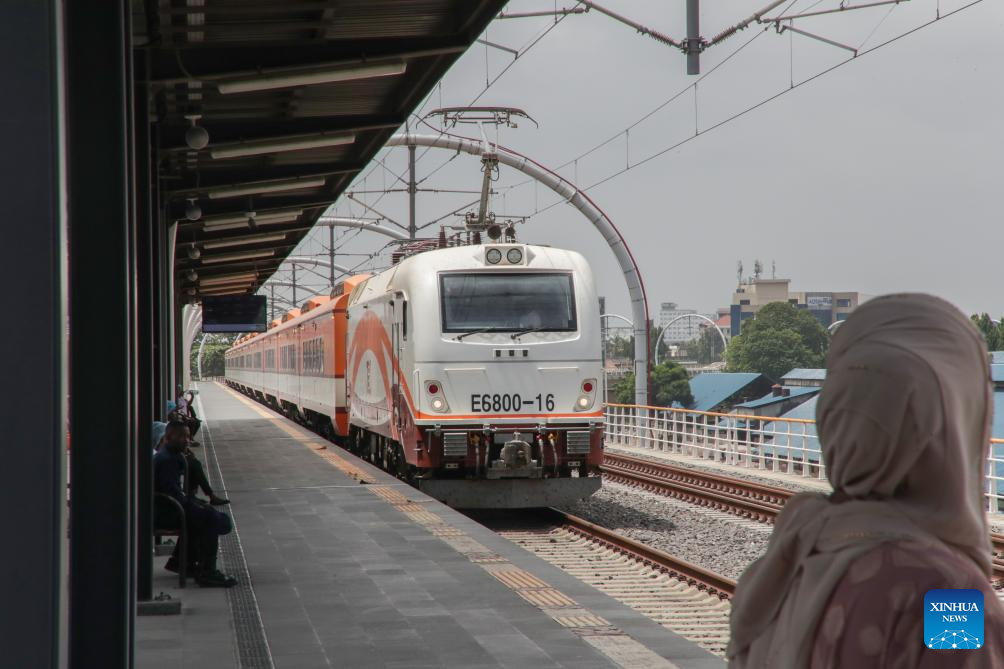
A standard-gauge railway (SGR) train pulls into Magufuli SGR Station in Dar es Salaam, Tanzania, Jan 15, 2026. (Xinhua/Emmanuel Herman)