
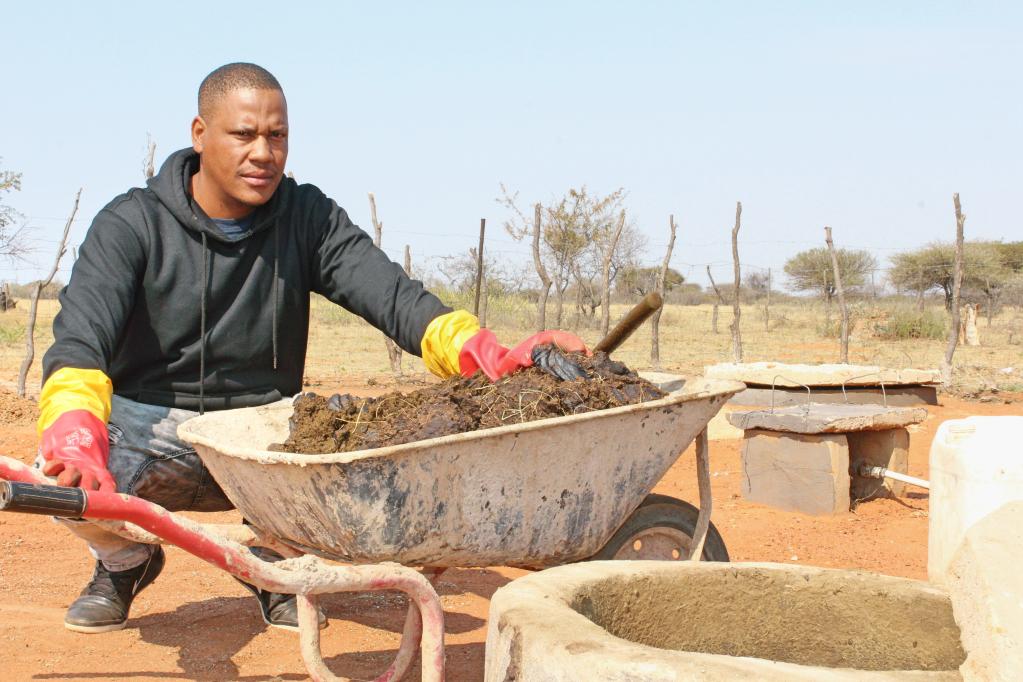
Goemeone Kagiso feeds cow dung into a biogas digester at a cattle post settlement called Gatuma located near Mmathethe village, Southern District, Botswana, Sept. 1, 2022. (Photo by Sharon Tshipa/Xinhua)
In the southern African country Botswana, biogas energy produced through agro-waste digesters is being promoted to farmers living in rural areas that are not connected to the national electricity grid.
GABORONE, Nov. 2 (Xinhua) -- At a cattle post settlement called Gatuma located near Mmathethe village in southern Botswana, Goemeone and Mpho Kagiso have over the past year embraced biogas energy and are enjoying more than just the financial relief it brings.
"Biogas has changed our lives a lot. When it is raining and it's windy, we can cook and don't go to bed hungry. We also warm up water for bathing," says Goemeone Kagiso, whose life is centered around livestock rearing and crop farming.
He and his wife own 15 cattle, five pigs and a wide range of poultry. From these, he collects between five to 40 liters of waste a day that he feeds into his 10-cubic meter biogas digester.
Kagiso is one of the 231 beneficiaries of the Botswana biogas project which was largely made possible by funding from the Global Environment Facility and the United Nations Development Programme (UNDP) with the objective of promoting the production and use of biogas as an environmentally friendly source of energy for farms, households and institutions that produce or have access to agro-waste.
The initial aim of the project, which was launched on Jan. 20, 2017 and completed in January 2022, was to construct 1,000 small-scale digesters but this target was reduced to at least 200 due to time constraints.
According to the project's final report, 110 small-scale digesters had been installed and the majority of them were operational by mid-2021.
To become a beneficiary, Goemeone Kagiso and his wife had to apply and invest P3,500 (271 U.S. dollars) towards buying construction materials for the digester. The implementing organizations covered labor expenses.
Kutlo Sedimo, 29, another beneficiary of the project said he spent P40,000 on materials needed for the installation of a 30-cubic meter digester that was completed in May last year in Matlagatse, a farming settlement near Molepolole village, about 50 km west of Gaborone.
"It's expensive but a good investment, having access to energy makes life easy and you invest once, it's better than buying electricity and gas every month," Sedimo noted.
What he feeds his digester is mainly cow dung from his family's 75 cattle. "The best time to collect cow dung is early morning before they leave for grazing," he explains, encouraging other citizens to use biogas as it also gives slurry, a fertilizer byproduct rich in nitrogen that would be good for their crops.
There were only 15 biogas digesters in the country when the biogas digester project was first rolled out. The increasing biogas digesters show that biogas is fast becoming popular in rural households that are not connected to the national electricity grid.
The UNDP final project report, on the other hand, suggests that the project implementers could have built more had it not been for the fact that some farmers were too poor to invest in the biogas digester construction materials.
"I encourage farmers to start using biogas, it will help them a lot and transform their lives," Kagiso said. ■