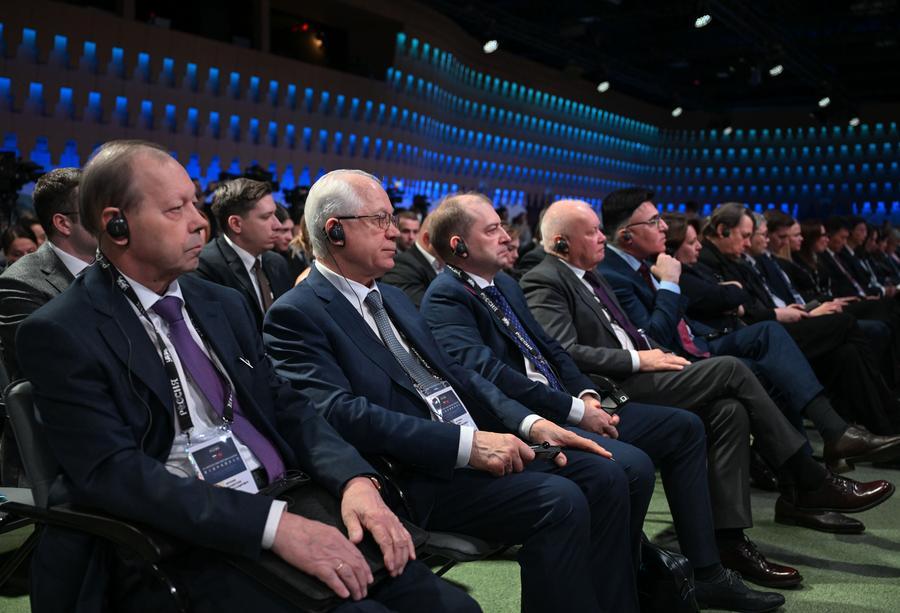
MOSCOW, Nov. 26 (Xinhua) -- The National Center "Russia" in Moscow has brought together media professionals from China and Russia this week for an exchange event.
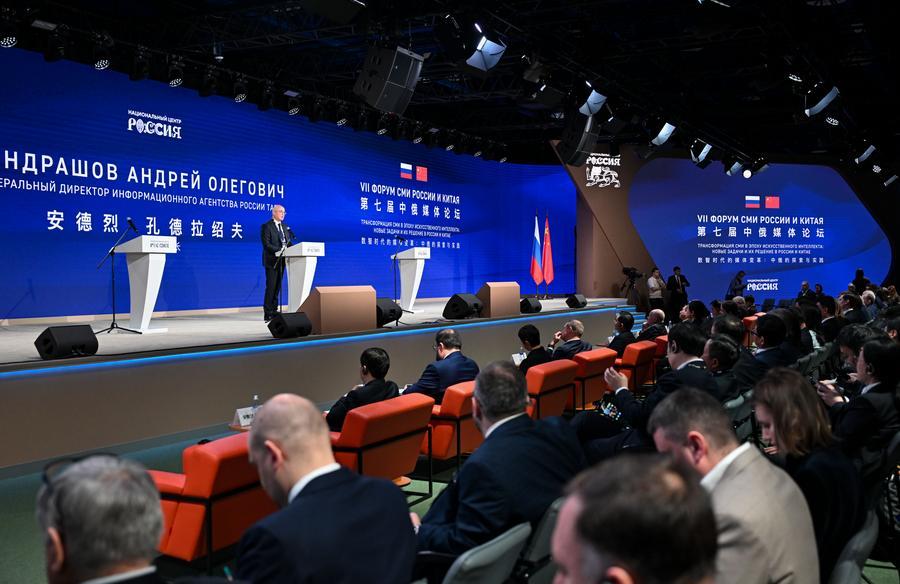
Hosted by the Publicity Department of the Communist Party of China Central Committee and the Russian Presidential Executive Office, and organized by China's Xinhua News Agency and Russia's TASS News Agency, the 7th China-Russia Media Forum was held on Wednesday with the theme of "Media Transformation in the Age of Artificial Intelligence: New Tasks and Responses in China and Russia."
A HISTORY OF DIALOGUE
Held alternately in Russia and China since 2015, the forum has become an important platform for bilateral media cooperation. Following last year's edition in Beijing, its return to Moscow highlighted the steady cooperation between the two countries. During this year's forum, 14 new cooperation documents were signed.
The collaboration has continued to deepen. In September 2025, Xinhua and TASS signed a 2026-2030 cooperation strategy covering news-feed exchanges in Chinese, Russian and English, as well as joint projects on artificial intelligence (AI) and economic information. In May 2026, the two agencies signed a memorandum marking the 70th anniversary of their partnership.
Participants said that under the strategic guidance of the two heads of state, media cooperation between China and Russia has grown steadily and yielded fruitful outcomes.
"We have traveled a long historical path, one marked by thousands of journalistic reports, hundreds of professional meetings and a rich legacy of mutual trust," TASS Director General Andrey Kondrashov said.
Pyotr Fedorov, head of the International Relations Directorate at the All-Russia State Television and Radio Broadcasting Company, said the relationship had evolved into a deep bond.

AI AND THE NEW FRONTIER
AI was the central focus of the forum. AI is transforming not only news production but also the ways news is consumed, distributed and verified.
For Chinese and Russian media, the task is to harness AI to boost communication capacity and influence while safeguarding journalistic credibility, and to develop models suited to their respective languages and cultural contexts. The issue also featured prominently at the 7th World Media Summit in Beijing earlier this month, where media leaders stressed the importance of accuracy, credibility and the responsible use of AI in journalism.
"AI opens up enormous opportunities, but also raises serious concerns," Kondrashov said.
Ignatiy Pavlov, general director of Russian business daily Vedomosti, said AI should be viewed as a tool rather than an adversary, while emphasizing that human editors should make the final decision before publication.
MEDIA AS A STRATEGIC DRIVER
The forum also examined how media cooperation could promote trade, tourism and people-to-people exchanges. Through accurate and compelling coverage, media organizations can foster mutual understanding and encourage grassroots exchanges.
Fedorov announced a cross-cultural project centered on the Yellow River and the Volga River. Chinese journalists will film along the Volga, while their Russian counterparts will cover the Yellow River, creating new opportunities for media cooperation and people-to-people exchanges.
Kondrashov also highlighted the role of regional media in strengthening mutual understanding. "Russia and China are vast nations. Citizens often know far more about each other's capitals than about life across one another's regions. Media can serve as genuine guides for this engagement," he said. ■