
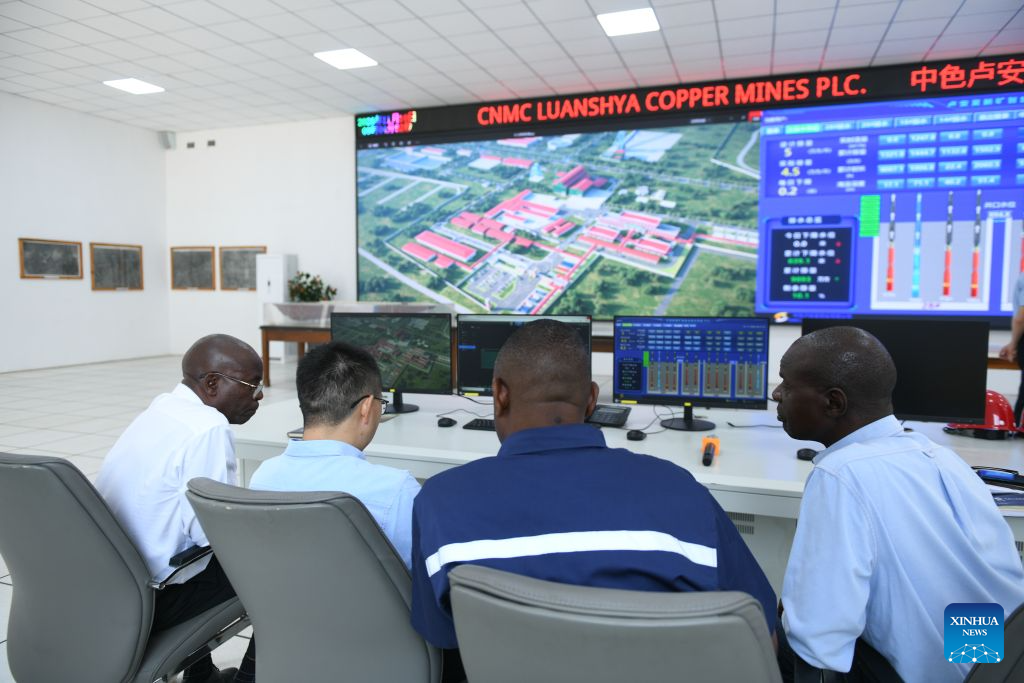
Staff members from CNMC Luanshya Copper Mines monitor work progress at the dewatering control center in Luanshya, Zambia, Nov. 10, 2026. (Xinhua/Liu Qiong)
by Xinhua writers Yang Dingdu, Liu Qiong, Bao Jiayi
LUANSHYA, Zambia, Nov. 26 (Xinhua) -- Beside a shaft in Luanshya town, Zambia's Copperbelt Province, clear water pours from a discharge pipe toward the Kafue River. It's being pumped up from more than a kilometer underground, draining a copper mine that sat flooded for 23 years after one owner after another gave up on it.
After years of decline as the mine lay flooded and idle, a Chinese operator has pumped out more than 100 million cubic meters of water to bring it back into production. The revival is breathing life into the town above, once written off as a "ghost town."
REVIVING AN ABANDONED MINE
Nicknamed the "garden town of the copper belt," Luanshya owes its origins to the copper discovered there in 1927. For decades, its fortunes would rise and fall with the mine.
After privatization in the 1990s, ownership changed hands repeatedly. In 2001, floodwaters surged underground, trapping the shafts and bringing mining to a halt. Seven years later, with copper prices in a slump, the last owner walked away, and the mine fell silent.
"They come, they close and they go back," said Michael Kasempi, an engineer who joined the mine in 1979. He recalled considering quitting in early 2009, when workers had gone months without pay and many were forced to sell their belongings just to put food on the table.
A few months later, China Nonferrous Metal Mining (Group) Co., Ltd. (CNMC) took over, with Zambia's state-owned ZCCM Investments Holdings keeping a 20 percent stake.
What the workers wanted most was an investor who would stick around, Kasempi said. Seventeen years on, the Chinese investor has not let that hope fade. "We haven't been disappointed," he noted.
"From my observation, the Chinese crack the hard nuts," said Robert Kamanga, Kasempi's colleague. Western investors saw little profit in a mine with limited reserves and low-grade ore, he said, but "the Chinese investors looked further ahead than everybody else."
With the high-grade ore largely depleted, the operator turned to leaching technology to recover copper from lower-grade material, including ore containing as little as 1 percent copper. "We used to throw out material at 0.35 percent copper. That was rubbish," Kamanga said. "But now we're going back to extracting copper from 0.35 percent."
In 17 years of operation, the mine has produced more than 700,000 tonnes of copper, with its copper cathodes reaching 99.99 percent purity and sold under a brand registered with the London Metal Exchange.
"What others gave up on, we have revived. What others could not do, we have done," said Jiang Lei, chairman of CNMC Luanshya Copper Mines.
REVITALIZING THE GHOST TOWN
"Way back, you could sit in this office and start counting the number of vehicles passing through the roads. But this time around there is even congestion here," said Charles Mulenga, mayor of Luanshya. "People are getting back to Luanshya, because they know that there is a future in Luanshya."
As the town's biggest taxpayer, the mine has helped fund the council's road resurfacing and new solar streetlights. Kasempi has also watched signs of revival spread through the neighborhood: neighbors renting out vacant houses, new homes going up, and a cinema, mall and supermarkets opening their doors.
The mine employs 1,485 people, 91.7 percent of them Zambian. "We are empowering 3,000 families to be able to keep their children in school," said Frederick Chola, the head of human resources.
At the mine hospital, each employee can bring six family members for free treatment. Christopher Simutowe, a surgeon past retirement age, has chosen to stay on. As the town grows, more of his work is in the maternity ward. "In the past two years we can see that there is more workload now at the hospital ... and more babies," he said.
The mine's return to operation is also opening doors for the next generation. At the mine-run Sino-Zam Vocational College of Science and Technology, 19-year-old Lubuto Chauluka, a miner's son, is training in heavy equipment on a Chinese company scholarship. When he was offered the scholarship, his parents urged him to seize the opportunity, "Go and represent us."
For Kasempi, the mine's revival has brought something more personal than a steady job. His daughter now works as a nurse at the mine hospital, and a grandchild goes to the mine-run school. "I find that there's a future for the family as well," he said. ■
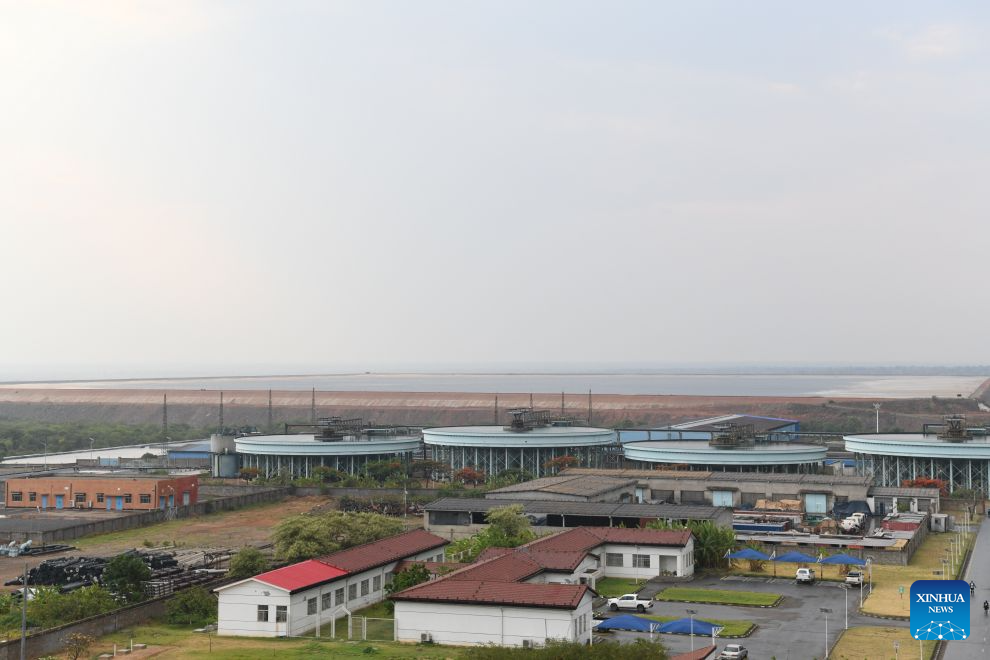
This photo taken on Nov. 10, 2026 shows the Mulyashi Hydrometallurgical Plant in Luanshya, Zambia. (Xinhua/Liu Qiong)
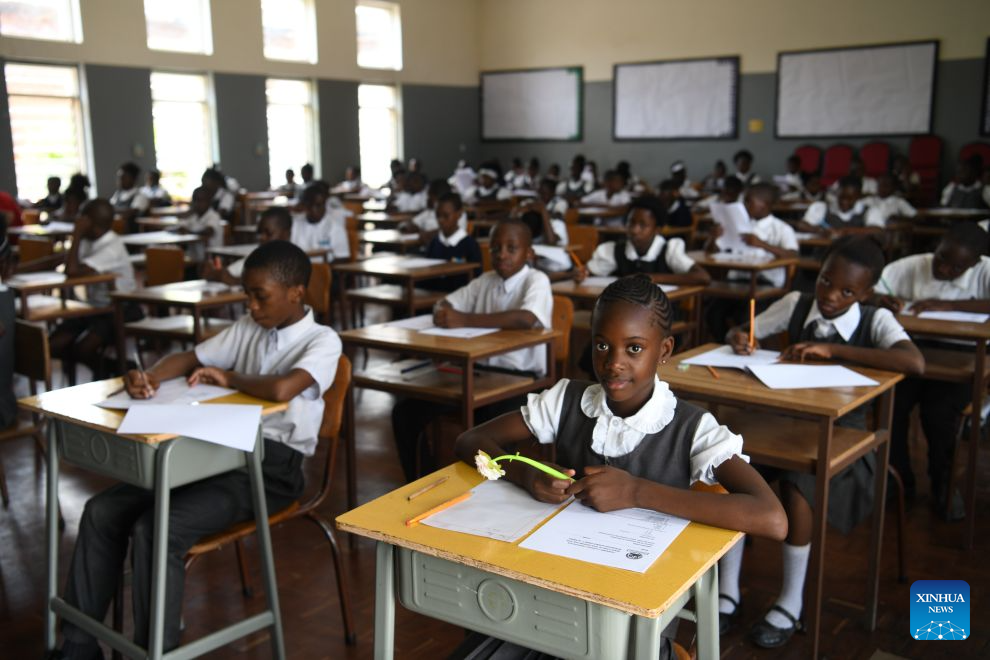
Children take their final examinations at a school in Luanshya, Zambia, Nov. 11, 2026. (Xinhua/Liu Qiong)


