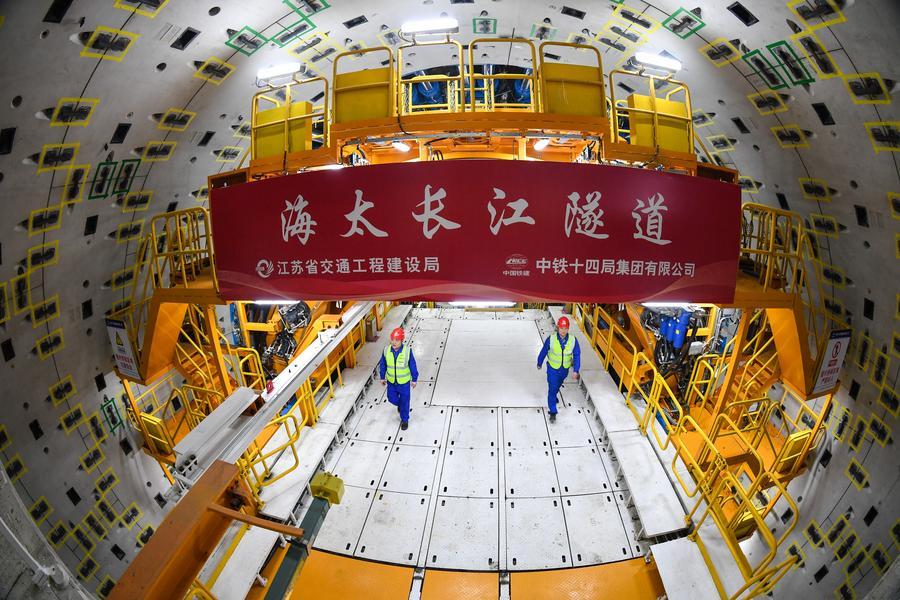
NANJING, Nov. 26 (Xinhua) -- The right-hand bore of the Haitai Yangtze River Tunnel, the world's longest underwater shield-built highway tunnel, crossed beneath the Yangtze River on Thursday, becoming the first of the tunnel's two bores to reach the south bank. The country's self-developed tunneling machine completed the 7.46-km under-river stretch.
The tunnel boring machine, named Jianghai, has a maximum excavation diameter of 16.64 meters. It began digging from the north bank in April 2025 and entered the under-river section that September.
The crossing took about 14 months, with the machine advancing an average of 20 meters a day, according to Meng Defeng, who oversees shield tunneling for China Railway 14th Bureau Group on the project.
The tunnel is a key step in building a major trans-river road link under China's longest river, connecting Haimen in Nantong with Taicang in Suzhou, both in east China's Jiangsu Province.
Stretching approximately 39.07 kilometers in total, the tunnel includes an 11.185-kilometer underwater section made up of two parallel bores.
Once open, the tunnel will shorten journeys from Nantong to southern Jiangsu and Shanghai, improving road connections across the Yangtze River Delta.
China issued a plan in July this year to comprehensively advance the high-quality development of integrated transport services during the 15th Five-Year Plan period (2026-2030), the Ministry of Transport announced. The plan aims to largely establish a modern integrated transport service system by 2030.
Under the plan, China will improve connections among different modes of transport, make passenger transfers more convenient and enhance freight logistics services. It will also promote the integration of transport and tourism, improve services at transport hubs, and strengthen rural passenger transport, freight and delivery services. ■