* Chinese astronauts Tang Hongbo, Wu Yi, and Pakistani astronaut Muhammad Zeeshan Ali will carry out the Shenzhou-24 crewed spaceflight mission, with Tang serving as commander.
* This mission marks the first joint flight of Chinese and foreign astronauts in the history of China's manned space program.
* A total of more than 90 scientific experiments and technology tests are planned for the Shenzhou-24 mission. These experiments and tests will cover space life sciences, space material science, microgravity fluid physics and combustion science, fundamental physics, space medicine and new space technologies.
JIUQUAN, Nov. 24 (Xinhua) -- Chinese astronauts Tang Hongbo, Wu Yi, and Pakistani astronaut Muhammad Zeeshan Ali will carry out the Shenzhou-24 crewed spaceflight mission, with Tang serving as commander, the China Manned Space Agency announced on Tuesday.
China's Shenzhou-24 crewed spaceship is scheduled to be launched at 8:18 a.m. (Beijing Time) Wednesday from the Jiuquan Satellite Launch Center in northwest China, Zhang Jingbo, spokesperson of the agency, said at a press conference.
The three astronauts are a spacecraft pilot, a flight engineer and a payload specialist, respectively. Tang has participated in the Shenzhou-12 and Shenzhou-17 crewed flight missions and is about to become the first astronaut to visit China's Tiangong space station three times. Wu comes from the country's third batch of astronauts and will embark on his first spaceflight mission. Ali will become the first foreign astronaut to visit Tiangong.
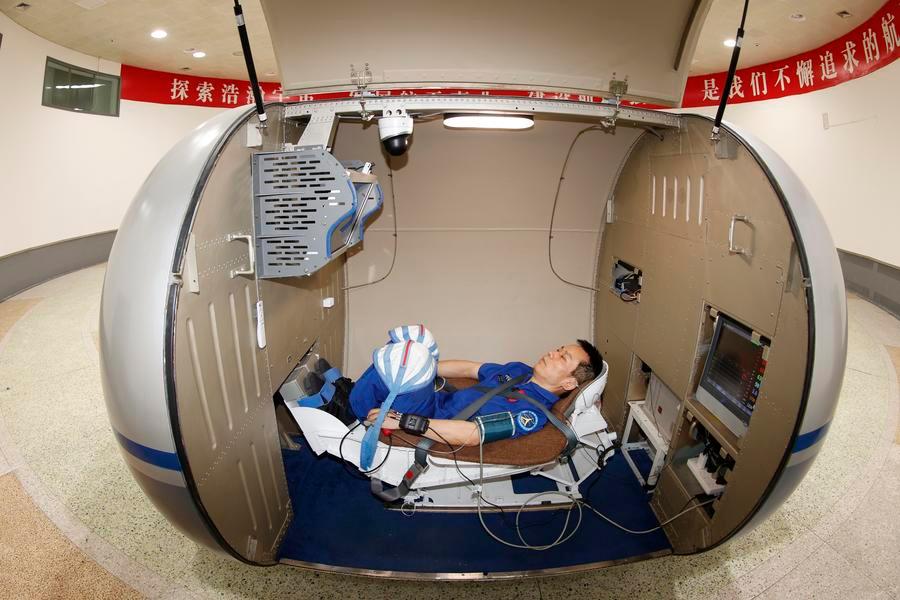
Tang later described himself at a media briefing as a witness to two historic moments -- the first Chinese crew's entry into China's own space station, Tiangong, and the upcoming first foreign astronaut's visit to the station.
"Five years ago, when we first opened the door of the space station, that excitement is something I still cannot forget," Tang said.
He added that, no matter how many times he flies, he will prepare with the mindset of a first-time flyer to ensure complete success.
Referring to his Pakistani crewmate, Tang said: "Although we come from different countries, our dreams of looking up at the stars are connected."
"Space belongs to all humanity, and exploring the universe is our shared dream." Tang expressed hope for more opportunities to work alongside international colleagues, contributing Chinese wisdom and strength to the peaceful use of space and a community with a shared future for mankind.
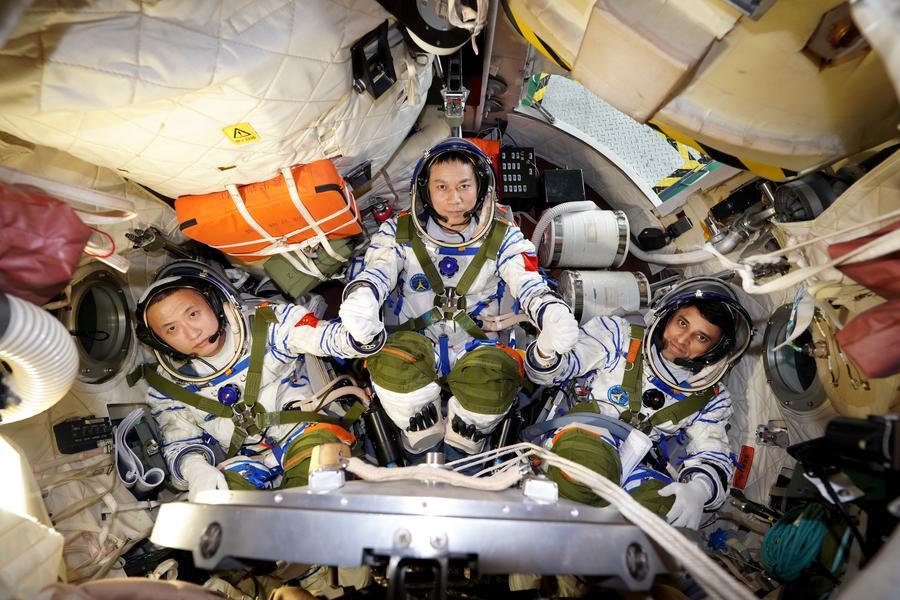
Wu said that an astronaut has only two states: flying and preparing to fly.
"Being selected is not the finish line of a dream, but the starting point of a mission," he said.
Wu said the crew made comprehensive preparations in theory, skills, physiology and psychology, and trained emergency responses into muscle memory. "Today I am fully ready. The stars are not far away, and my dream is in place."
Ali quoted ancient Chinese poems to express his feelings about his upcoming spaceflight. He called the joint flight a "historic collaboration" and said what comes after the flight matters more than the flight itself.
"This mission is not a finish line; it is a launchpad," Ali said.
Ali expressed his hope that the next chapter of China-Pakistan space cooperation would grow from one astronaut and one flight to multiple joint flights to the moon, Mars and beyond.
JOINT FLIGHT
In orbit, Ali will join in the crew's routine work and focus on joint China-Pakistan space science experiments, primarily installing experiment samples and units, and carrying out in-orbit experiments as scheduled, Zhang said at the press conference.
Four China-Pakistan cooperative projects in the fields of biotechnology and materials will be conducted during the Shenzhou-24 mission, and Ali will conduct an in-orbit experiment on photosynthetic cyanobacteria, the spokesperson noted.
Pakistan is China's all-weather strategic cooperative partner. This mission marks the first joint flight of Chinese and foreign astronauts in the history of China's manned space program. Zhang described it as a landmark achievement in bilateral cooperation as the two countries mark the 75th anniversary of diplomatic relations, and an important manifestation of their traditional friendship.
China's space station program offers abundant scientific application resources, stable in-orbit operation capabilities, a mature Earth-space transportation system, and a complete astronaut selection and training system, Zhang said, adding that China looks forward to working with more countries and regions to explore the vast universe, peacefully utilize outer space, and enhance the common well-being of humanity.
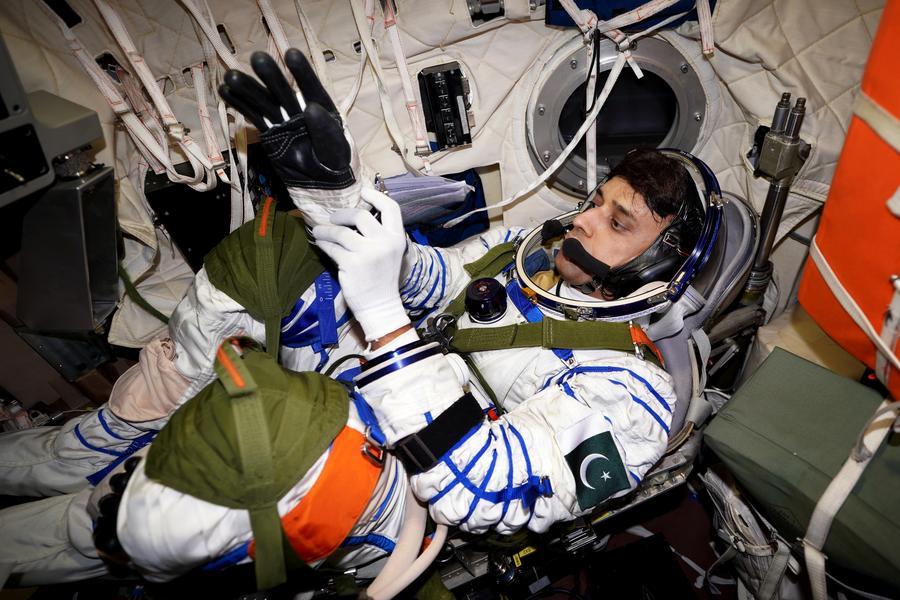
Ali said China and Pakistan had turned a pilot into an astronaut in a remarkably short span of time. "Now it is time to show this great achievement in orbit and send the world a message that we work hand in hand for the peaceful utilization of space," he said.
After a short-term joint flight, Ali will return to Earth together with two Shenzhou-23 astronauts, Zhang Zhiyuan and Li Jiaying, aboard the Shenzhou-23 spacecraft.
IN-ORBIT TASKS
The Shenzhou-24 mission's main objectives are to complete an in-orbit crew rotation with the Shenzhou-23 crew, maintain routine station operations, conduct space science and application work, and carry out maintenance, public outreach and payload tests, Zhang said at the press conference.
A total of more than 90 scientific experiments and technology tests are planned for the Shenzhou-24 mission. These experiments and tests will cover space life sciences, space material science, microgravity fluid physics and combustion science, fundamental physics, space medicine and new space technologies, the spokesperson noted.
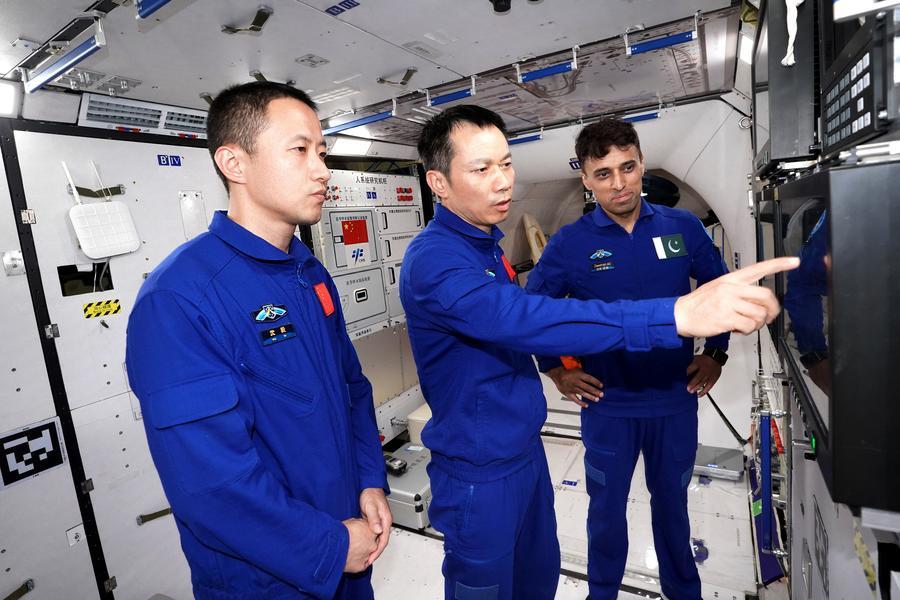
In space life sciences, researchers will build vascular chips and multi-type organ chips to explore how the space environment affects major physiological processes such as vascular aging, aiming to develop new strategies for preventing and treating age-related vascular diseases.
In the field of fundamental physics, the mission will explore new states of matter and new physical laws through optical-lattice quantum simulation and research on novel quantum states, as well as key technologies for inertial measurement based on the space cold-atom interferometer.
In space medicine, under the space human research program, the crew will advance multi-omics research and behavioral and brain-function studies in space, and further verify new health-maintenance technologies for astronauts and the public.
In aerospace technology, meanwhile, the mission will carry out key tests on a chem-electric hybrid propulsion system using new ionic liquid propellants, as part of efforts to develop new spacecraft propulsion technologies.
"China will continue to use the space station as a national space laboratory to steadily advance space science, space applications and space technology, better serving sci-tech progress and economic and social development," Zhang said.
(Video reporters: Li Guoli, Liu Yi, Da Rihan, Zhang Sheng, Fang Kuan, Wei Ying, Hong Liang and Sha Shiyuan; Video editors: Zheng Xin and Mu Xuyao) ■