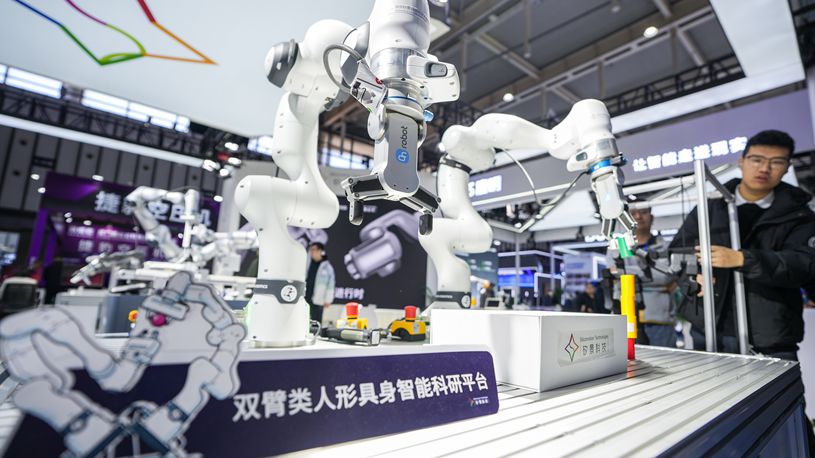

* China's push to unleash the potential of innovation and share technological dividends through open regional integration has resonated widely -- translating its innovation capacity into broader market opportunities and lending fresh momentum to economic growth and the building of an Asia-Pacific community.
* Across the Asia-Pacific, China's technological innovations are finding applications in a growing range of industries and aspects of everyday life.
* The release of the Shenzhen Initiative marked a milestone in the 30-year history of the APEC CEO Summit. It was a historic moment in Shenzhen, a city that has stood at the forefront of China's opening-up and has grown into a global innovation hub.
BEIJING, Nov. 22 (Xinhua) -- As host of the 33rd Asia-Pacific Economic Cooperation (APEC) Economic Leaders' Meeting in Shenzhen, China has placed openness, innovation and cooperation at the heart of its agenda as the three priority areas. Throughout this week's sessions, participants explored how the Asia-Pacific can navigate structural shifts and cultivate new engines of economic growth.
China's push to unleash the potential of innovation and share technological dividends through open regional integration has resonated widely -- translating its innovation capacity into broader market opportunities and lending fresh momentum to economic growth and the building of an Asia-Pacific community.
INNOVATION THAT BENEFITS ALL
At an experimental durian orchard at Chiang Mai University in Thailand, agricultural lecturer Supakorn Wongsuk prepares a drone for takeoff. Having studied in China, he now applies the technology to explore more efficient methods of cultivating tropical fruits.
Lifting smoothly into the air, the drone glides above rows of durian trees, releasing a fine mist of pesticide across their leaves and branches.
"Using drones to spray pesticides can improve operational efficiency, reduce farmers' direct exposure to chemicals, and protect their health and safety," said Supakorn.
He sees the Chinese innovations as offering benefits that extend well beyond farming efficiency. "For young people, drone operations can also create new job opportunities."
Across the Asia-Pacific, China's technological innovations are finding applications in a growing range of industries and aspects of everyday life.
The role of innovation also drew sharp focus at the APEC CEO Summit 2026 in Shenzhen.
"Innovation is very important, and innovation cannot be done overnight. It requires strong education support and accumulated experience. This is where we think China can play a role," said Indonesian Chamber of Commerce and Industry Chairman Anindya N. Bakrie.
"China has an important role to play," said Julien Leclair-Dionne, associate director at the University of Ottawa's Professional Development Institute. "Particularly given its technological capabilities, innovation ecosystem and experience in scaling emerging technologies."
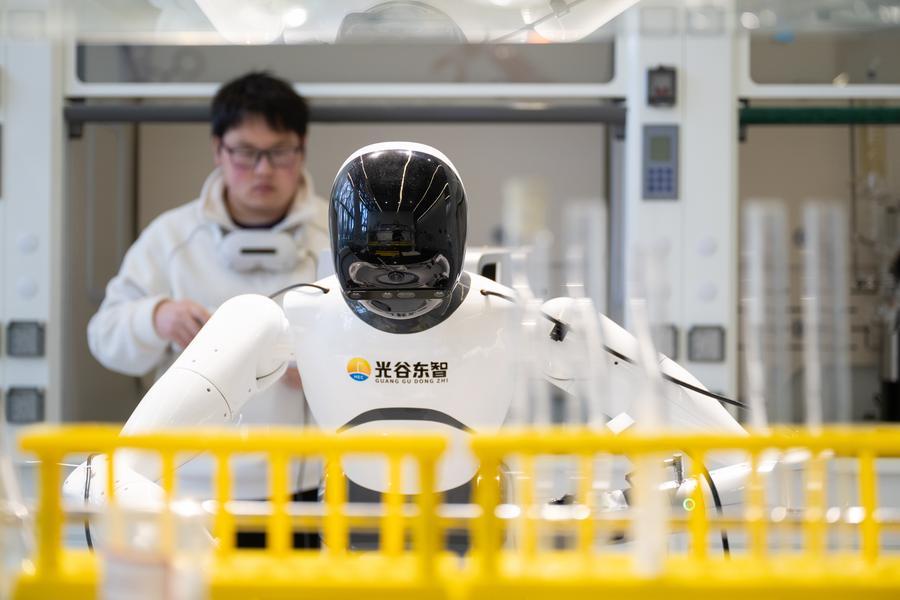
"Ultimately, what matters most is not simply how advanced the technologies become, but how effectively the innovations are translated into opportunities for people, organizations and communities across the region," he said.
OPENNESS CREATES OPPORTUNITIES
Released on Wednesday, the Shenzhen Initiative of the APEC CEO Summit 2026 highlighted the transformative potential of frontier technologies such as artificial intelligence, while recognizing the accompanying risks and regulatory challenges that require coordinated regional oversight.
At the heart of the document lies a clear, unified conviction among business leaders: no single economy can capture the promise of breakthrough technology -- or tame its disruptions -- alone; only deep regional cooperation can turn innovation into shared prosperity.
Auckland Business Chamber CEO Simon Bridges emphasized the need for cooperation amid global uncertainty. "I think cooperation is probably the byword of APEC. And we know in the world right now, it's more important than ever," he said.
China's approach to AI development provides "a very good example" that allows others to learn from its technological advances, he added.
The appeal of Chinese AI models has become increasingly evident across the region. In South Korea, nearly half of the AI models released by local developers on Hugging Face, a globally popular open-source platform, between January and August this year were based on Chinese foundation models.
"China has adopted AI with more open-weight, open-source, low-cost models that are going to be used by businesses around the world," said Jacob Cooke, CEO of WPIC Marketing + Technologies, a leading e-commerce and technology consultancy.
"These Chinese companies have done their best to get this technology out to help people," Cooke said at the summit.
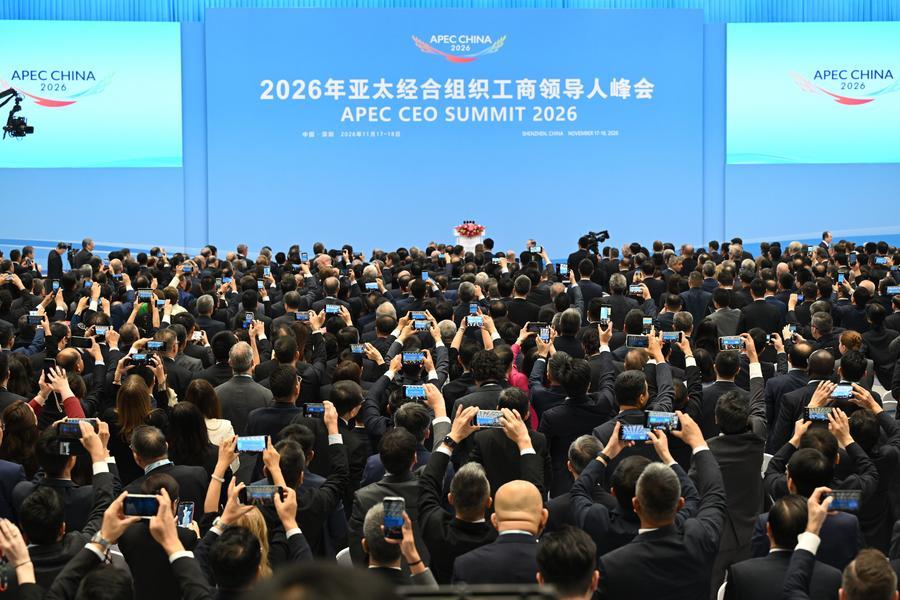
The release of the Shenzhen Initiative marked a milestone in the 30-year history of the APEC CEO Summit. It was a historic moment in Shenzhen, a city that has stood at the forefront of China's opening-up and has grown into a global innovation hub.
For Lee Ju-kwan, director of the National Center for APEC Studies at the Korea Institute for International Economic Policy of South Korea, Shenzhen's relentless innovation engine came vividly into focus during a visit to electric vehicle giant BYD's headquarters, offering a firsthand look at the homegrown tech muscle powering the city.
"I was deeply impressed by what I saw, particularly robots performing tasks that would traditionally be carried out by human workers on the production line," Lee said.
"This year, by hosting APEC, China has taken the opportunity to put forward and renew initiatives aimed at promoting openness and cooperation. I believe these efforts deserve attention and support," Lee said.
GREEN INNOVATION
"It's the most fantastic ride," said Jeffrey Sachs, a professor at Columbia University, looking back on an epic 15,000-km summer odyssey from Rome to China's Hong Kong, retracing Marco Polo's historic path behind the wheel of a BYD electric vehicle.

Sachs said the journey showed how far green technology had advanced. "The technology is already here. Most of it is in its most advanced stage in China," Sachs said during a high-level panel at the APEC CEO Summit 2026.
He also noted that China had significantly reduced the cost of green technologies, making the transition more affordable. "To go green is not to make an extra burden for the sake of the planet. It's just to have a low-cost, resilient, state-of-the-art energy system," he said.
The benefits of China's green innovation are also being felt by residents of Goulburn in New South Wales, Australia. With an integrated solar-and-storage solution supplied by a Chinese company, the local community has brought its own solar farm into operation.
The facility began supplying electricity to the grid in March, with part of its annual profits to be channeled into a community fund to help residents facing energy poverty.
"For a long time, it has been talk around the kitchen table. Suddenly here we are in amongst the panels, watching the sun send electrons to the people and my kids all own little parts of this with the community," said Goulburn resident Dave Suttle.
"Without China's involvement, we definitely wouldn't have solar cells as cheap as now," Martin Green, Scientia Professor of Photovoltaic and Renewable Energy Engineering at the University of New South Wales, told Xinhua.
Having worked with China's photovoltaic industry for more than four decades, Green is now collaborating with Chinese partners on the next generation of solar technology.
"Working with China, we feel we're in a position to improve the solar performance more quickly," he said. ■