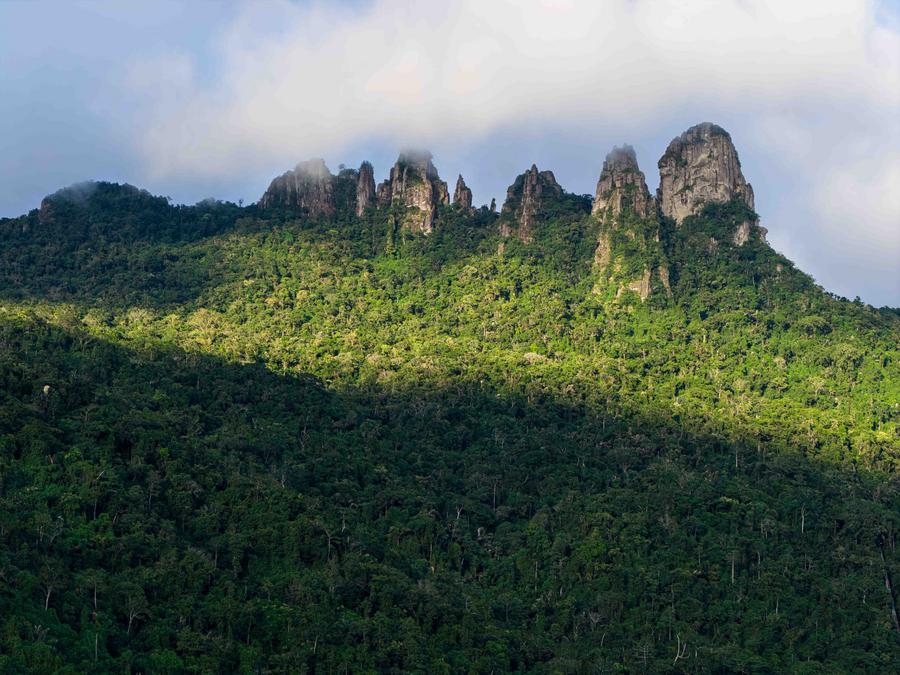
HAIKOU, Nov. 21 (Xinhua) -- For Alexandra Ogden, visiting Hainan's tropical rainforests was a sharp departure from the island's typical beach scenery, and a first-hand look at a conservation story she was especially glad to learn about.
"It was sobering to learn that only 10 Hainan gibbons remained 40 years ago, but heartening to see their population grow steadily to 44," said Ogden from Canada, who was in Haikou for a tropical rainforest conference.
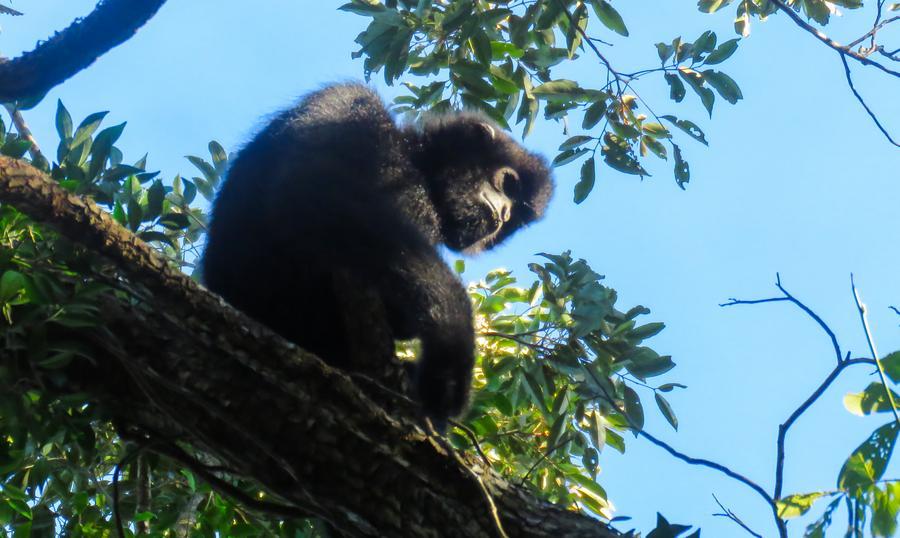
Once on the brink of extinction, the Hainan gibbon has made a remarkable comeback. By the early 1980s, only seven to nine individuals remained; in 2003, the population stood at 13 in two groups. By the end of 2025, it had grown to 44 across seven groups.
The recovery was highlighted at the 2026 Tropical Rainforest Ecosystem Partners Conference, themed "Global Treasures, Shared Future," held in Haikou, capital of south China's Hainan Province, from Nov. 18 to 22.
At the conference, a report released by the Xinhua Institute, a national high-level think tank affiliated with Xinhua News Agency, presented Hainan's gibbon conservation as a systematic answer to the question of how to save a species on the brink -- an answer the report traces through the species' recovery and the park's broader conservation efforts.
Found exclusively in the tropical rainforests of Hainan Island, the species is the only gibbon in the world whose population has continued to grow. Its recovery offers a glimpse into the progress of conservation efforts at the Hainan Tropical Rainforest National Park, which marked the fifth anniversary of its establishment on Oct. 12.
Of the world's 20 gibbon species, distributed across 11 Asian countries, most face population decline. The Hainan gibbon, classified as critically endangered by the International Union for Conservation of Nature (IUCN), was once widely distributed across Hainan Island, with its population exceeding 2,000 in the 1950s.
However, commercial logging, plantation expansion, and illegal poaching once led to a dramatic decline.
China established its first five national parks on Oct. 12, 2021, including the Hainan Tropical Rainforest National Park. Covering more than 4,269 square kilometers, the park plays a crucial role in protecting the island's tropical rainforest ecosystem.
Over the past five years, the park has relocated 459 households from its ecological core zone, decommissioned all 25 small hydropower stations in its core conservation zone, and phased out 248,300 mu (about 16,553 hectares) of plantations. It has also allocated 265 million yuan (about 39.5 million U.S. dollars) for ecological buyouts, according to Zhu Shirong, deputy director of the Hainan Tropical Rainforest National Park Administration.
These efforts have helped protect more than 95 percent of Hainan Island's primary forests and over 55 percent of its natural forests. Forest coverage in the park has remained stable at 95.9 percent, while researchers have discovered 91 previously unrecorded species of wild plants and animals in the area.
In Bawangling, conservation workers have built 38 canopy bridges across gaps in the gibbons' habitat, allowing them to move safely over ravines in search of food and places to rest. More than 300,000 native trees and shrubs have been planted, and more than 5,000 mu of habitat has been restored.
Conservation efforts have also become increasingly science-based. The park has established an integrated ecological monitoring system that combines satellite remote sensing, park-wide patrols, and ground-based observation to track changes across the rainforest at different scales.
Researchers have used acoustic data to identify important developments in the gibbon population, including the arrival of male individuals and the formation of new family groups, events that were difficult to capture through conventional field monitoring. Infrared cameras installed in trees and drones are also being used to record the animals and track their daily movements.
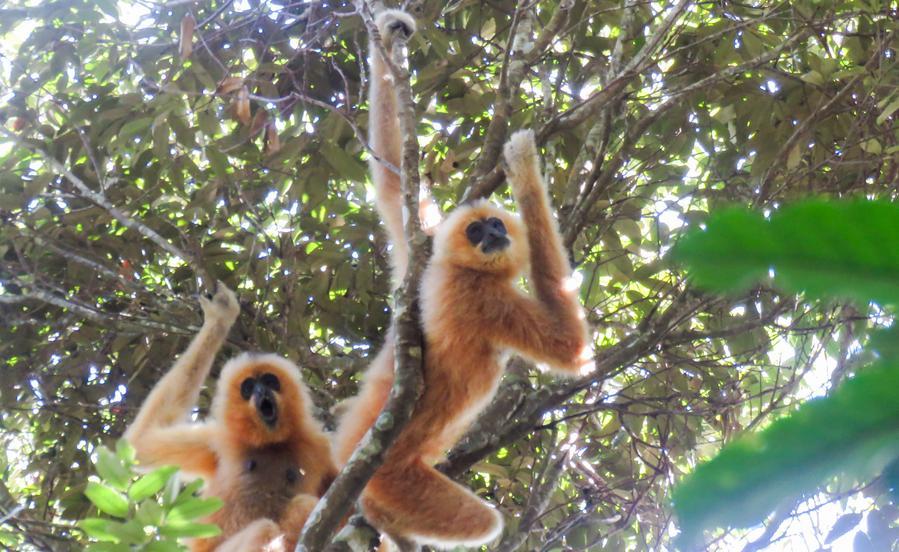
Hainan has established a national gibbon conservation research center and an academic committee to strengthen scientific research and protection. "Conservation today is about more than simply counting gibbons. It is a systematic undertaking that combines protection with active population management," said Zhou Zhaoli, deputy head of the Hainan gibbon monitoring team.
The report put that idea in a broader context. As a flagship species, the Hainan gibbon offers an important window for observing the effectiveness of ecological conservation, and its recovery reflects a process of continuous improvement in the forest ecosystem. This practice shows that conserving wildlife with extremely small populations cannot be limited to the species itself, but must also focus on the entire habitat, the report said.
The model has since traveled beyond Hainan. The IUCN has introduced the experience to the international community as an example of "Chinese wisdom, Hainan experience and the Bawangling Model." Hainan has also led the establishment of the Global Gibbon Network, with its secretariat located at the Hainan Institute of National Park, bringing together 36 conservation institutions from 11 countries to jointly carry out gibbon conservation research.
Rainforest protection has also benefited surrounding communities. Over the past five years, the park has prioritized hiring 1,593 local residents as ecological rangers, while another 231 community rangers have been recruited through service contracts.
In Maona Village in Shuiman Township, Wuzhishan City of Hainan Province, residents have developed a large-leaf tea industry and ecotourism by drawing on local rainforest resources. In October 2026, the Wuzhishan Tropical Rainforest Large-Leaf Tea Cultural System was included in China's list of Important Agricultural Cultural Heritage sites.
For six consecutive years, the park has conducted gross ecosystem product (GEP) accounting as an independent spatial unit. Its GEP value increased from 204.513 billion yuan in 2019 to 208.966 billion yuan in 2024. ■