BEIJING, Nov. 20 (Xinhua) -- As artificial intelligence (AI) continues to reshape education, research and the workplace, universities and technology firms across China are exploring ways to better equip students and professionals with the knowledge, skills and judgment needed to keep pace with rapid technological change.
These questions and discussions took center stage at a recent talent forum hosted by the University of Hong Kong (HKU) in Beijing. The event brought together scholars, industry leaders and other participants to discuss talent development and innovation amid the AI revolution.
Employment pressure remains high across China, with 12.7 million college graduates set to enter the workforce this year, according to official figures. Meanwhile, fast-moving advances in technology and the digital economy are reshaping labor demand: some traditional roles are shrinking, while new occupations calling for advanced skill sets are emerging in growing numbers.
Against this backdrop, Wang Yang, HKU vice-president and a mathematician with more than three decades of work experience in the United States, stressed that foundational knowledge will remain essential to preparing students for an AI-driven era.
"China actually has an advantage here," Wang said, referring to the country's long-standing emphasis on subjects including mathematics, physics and languages. He argues that stronger critical thinking and judgment can turn this educational strength into a tangible edge in the age of AI.
Looking more broadly at China's scientific progress, Wang noted that the country's research capacity has improved markedly over recent decades. He voiced optimism about continued advances in the next 10 years, while flagging challenges to international academic exchanges stemming from geopolitical tensions.
Tan Jianrong, an academician of the Chinese Academy of Engineering and professor at Zhejiang University, said employers are increasingly seeking interdisciplinary talent.
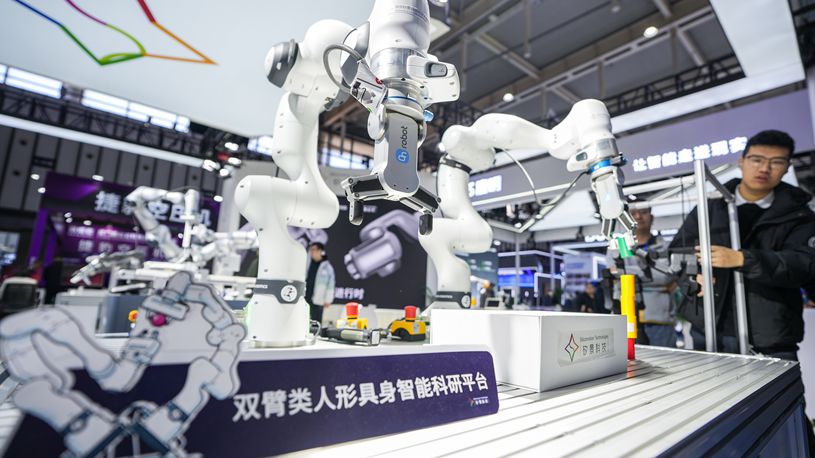
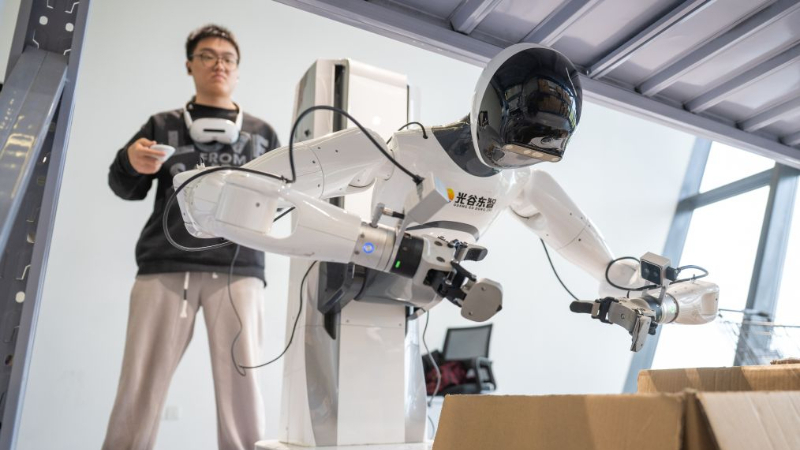
Fields such as robotics and embodied AI demand integrated expertise spanning mechanical engineering, information technology and other disciplines, rendering traditional disciplinary boundaries less suited to modern talent development, he explained.
Tan, however, warned that universities cannot simply pile new courses onto already heavy curricula. Institutions must also streamline existing content and shift focus from knowledge transmission to nurturing students' ability and motivation to learn independently.
This push for educational transformation aligns with China's outline plan for education development under the 15th Five-Year Plan (2026-2030). The document calls for deeper coordination among education, science and technology, and talent development, alongside reforms to education evaluation systems and the digital transformation of schooling.
Li Hongyang, an HKU assistant professor and co-founder of a Shanghai-based robotics startup, described how AI is already upending conventional teaching practice. Large language models can summarize lengthy lecture materials in minutes and help students finish some assignments far faster than before, he said.
Drawing on his experience supervising doctoral students, Li added that rigorous thinking, sustained inquiry and the ability to spot flaws in existing research are key qualities that conventional assessment metrics -- including academic grades -- often fail to capture fully.
From an industry perspective, Duan Nan, vice-president of e-commerce giant JD Group and deputy director of JD Explore Academy, highlighted three qualities growing in importance for professionals working alongside AI: the capacity to deliver practical outcomes, sound judgment, and the skill to frame the right questions.
While AI can generate a wide range of potential solutions, humans still need to steer the technology and assess whether its outputs meet real user needs, Duan said. ■