BEIJING, Nov. 20 (Xinhua) -- From personalized entrance music welcoming guests from APEC economies to red and blue silk scarves adding a splash of color to their family photo, the just-concluded APEC gathering in Shenzhen, south China's Guangdong Province, turned cultural diversity into a vivid expression of the Asia-Pacific's shared sense of community.
What melodies greeted the leaders and representatives as they arrived for a gala dinner? What cultural elements were woven into the scarves' designs? Here are some interesting details behind these memorable moments.
FAMILIAR TUNES, WARM GREETINGS
On Wednesday evening, visiting leaders and representatives arrived in succession at the International Communication Center of Shenzhen for a banquet, where an orchestra awaited them as a thoughtful and pleasant surprise.
As they walked down the red carpet, each was accompanied by a live rendition of a familiar melody from their home country or region.
U.S. President Donald Trump, for instance, was welcomed with "America the Beautiful." He paused to take in the performance, smiling before applauding the musicians.
Dating back more than a century, the classic song is rooted in a poem extolling America's national identity and the beauty of its vast and diverse landscapes.
Over the years, it has become a familiar musical expression of American patriotism at ceremonial occasions, including presidential and diplomatic events. During then U.S. President Richard Nixon's historic visit to China in 1972, the song was specially selected by then Chinese Premier Zhou Enlai to welcome him at the Great Hall of the People in Beijing.
Mexican President Claudia Sheinbaum was welcomed with "Cielito Lindo," one of Mexico's best-loved folk songs.
Conveying warmth and tenderness, the title can be loosely translated as "lovely sweet one." Written in 1882, the song has accompanied generations of Mexicans and become a familiar soundtrack to festivals, sporting events, weddings and family gatherings.
As Australian Prime Minister Anthony Albanese entered, the orchestra played a traditional Australian folk song, "Click Go the Shears."
Depicting a shearer's day at work in the days before mechanical shearing became widespread, the song evoked an iconic scene from the country's rich agricultural heritage.
Similarly, South Korean President Lee Jae Myung and his wife were welcomed with the Korean folk song "Arirang," while Russian President Vladimir Putin was greeted with an exuberant piece from "The Nutcracker," a ballet composed by Russian maestro Pyotr Tchaikovsky.
At Wednesday's APEC welcome banquet, organizers arranged 22 welcome songs, starting with "Jasmine Flower," arguably the most recognizable Chinese folk melody in the West. Mexican President Sheinbaum played the song on a stringless smart guitar while waiting for the banquet to begin.
THREADS OF HARMONY
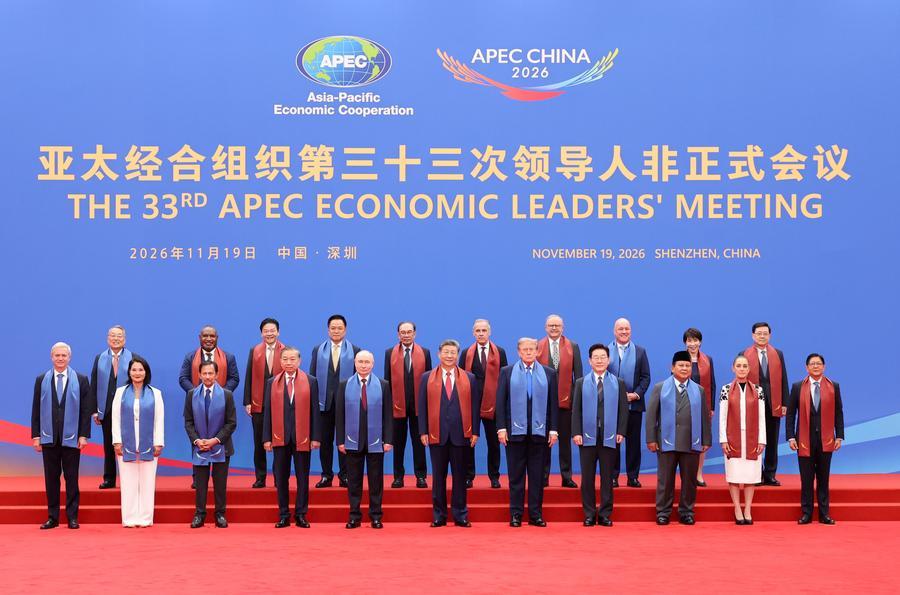
When the leaders and representatives gathered for their iconic group photo the following day ahead of the APEC economic leaders' meeting, the scarves they wore, featuring traditional Chinese designs, immediately became a focal point.
Over the years, a cultural highlight has emerged alongside the forum's formal economic agenda, with participating leaders and representatives donning traditional attire provided by the host economy for their group photo. In 2004, Chile dressed APEC leaders and representatives in handwoven, reversible chamantos. In 2007, Australia went with its iconic Driza-Bone coats, originally designed to keep outback workers dry in wet weather.
In recent years, the tradition has taken a lighter turn, with shawls and scarves replacing full outfits.
The scarves provided by China came in deep red and blue. The red ones were crafted primarily from Xiangyunsha silk, also known as gambiered Canton gauze, a traditional fabric once traded along the ancient Maritime Silk Road.
Dubbed the "soft gold" of textiles for its value and intricate craftsmanship, this naturally dyed fabric originating from Guangdong Province embodies the enduring artistry of China's intangible cultural heritage.
The blue version, meanwhile, was made using Song brocade, a representative of traditional Chinese silk weaving dating back to the Song Dynasty (960-1279).
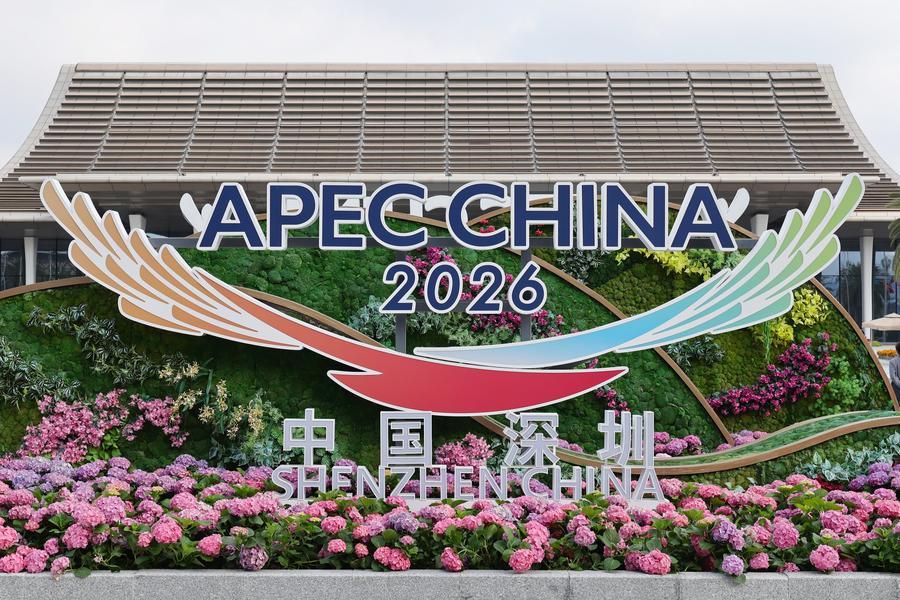
The hem of each scarf is embroidered with the APEC 2026 logo, which features 21 interwoven feathers forming the shape of a soaring Peng -- a legendary giant bird associated with Shenzhen, nicknamed the "City of Peng."
This design represents the diversity and connectivity of the 21 APEC economies, as they rise together toward shared prosperity and work to build an Asia-Pacific community.
On the reverse side of the embroidered logo are auspicious cloud and wave motifs, traditional Chinese symbols representing aspirations for peace and prosperity.
In a relaxed moment before the group photo, participating leaders and representatives helped one another adjust their scarves, adding a warm and personal touch to the occasion.
Wu Jianhua, representing the scarf's chief designer, said the design symbolizes the 21 APEC economies joining hands to chart a shared path toward prosperity.
"We hope these scarves convey not only the richness of Chinese culture, but also a shared sense of belonging to the Asia-Pacific community," Wu said. ■