
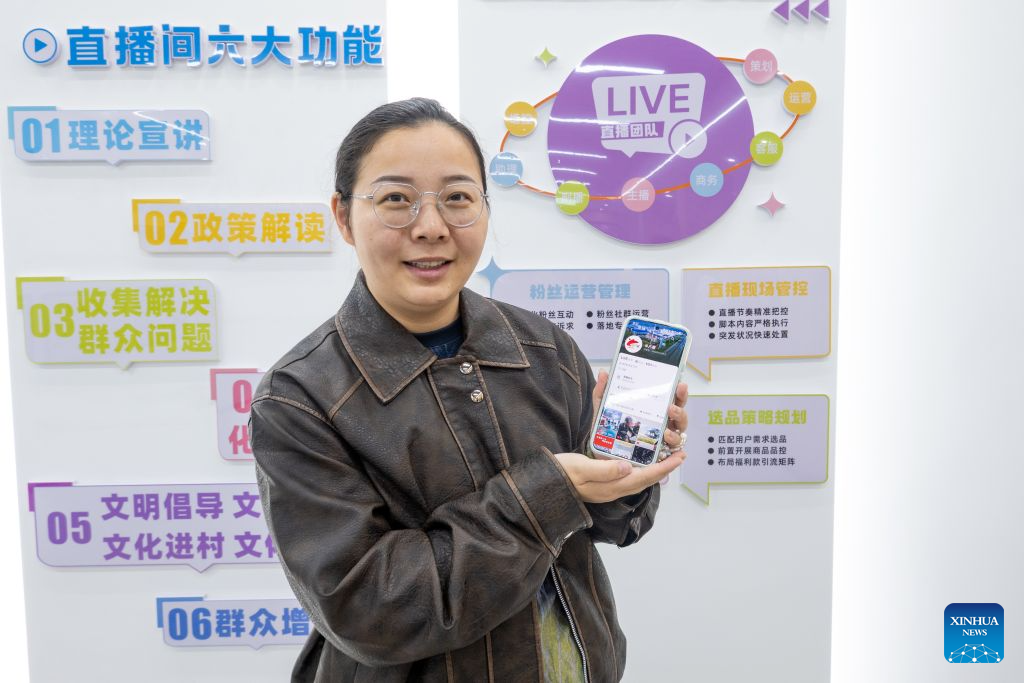
Shan Xin, a publicity official of Zhangbaling Township, displays an interface of her Douyin account for short video clips at the township in Mingguang City, east China's Anhui Province, Nov. 8, 2026. (Xinhua/Zhao Jinzheng)
HEFEI, Nov. 19 (Xinhua) -- What began as a casual market livestream last year has evolved into a heartfelt public service bridge, connecting migrant workers with their hometown in an eastern China village.
Shortly before the Chinese New Year in 2025, Li Yang, head of the general Party branch committee of Baimishan Community in Mingguang, a county-level city in Anhui Province, went live at a local market. The broadcast, however, soon took on an unexpected new mission as viewers started asking Li to look after their aging parents left behind in the village.
Among those he checked on was 84-year-old Zhang Peiquan, whose children, working far away, often worry about his well-being. Li dropped by the elderly man's home and arranged with neighbors to alert community workers in case of emergencies.
"We feel reassured, and his children can rest easier too," said Li, one of the first batch of college-graduate village cadres in his township.
This practice of "taking requests online, making visits offline" has since become a routine part of the community's work.
"Livestreaming makes communication more direct, and problems get solved with warmth," said Shan Xin, a local township publicity official.
Among the 400-odd clips published by Shan on Douyin, China's major short-video platform, some focus on residents' everyday troubles -- a broken basketball hoop, faulty streetlights and the like -- while others document how the issues get fixed.
"The more problems we help resolve, online or offline, the better we grasp what local people truly need," she noted.
Across China, livestreaming has woven itself into many corners of daily life, opening fresh avenues for work, business and communication. For village cadres used to face-to-face talks with villagers, it is a new, sometimes challenging way to respond to public questions and concerns.
"I need to be prepared for any question the audience raises," said Ding Jun, deputy head of the general Party branch committee of Hehua Village in Mingguang. To give precise replies, he keeps studying the latest policy documents and official interpretations. "Now I'm something of a walking encyclopedia of rural policies."
As dusk settles, Ding gets ready for his evening livestream. "Thanks for tuning in. Drop your questions in the comments. If typing is inconvenient, hit the mic button and we can chat live," Ding greets his online audience, part of a routine he has kept up for three years.
Within minutes, nearly 100 viewers join, with comments flooding in on medical insurance, elderly care and farmland contracts. Ding answers each query carefully and in full.
"These are the matters people care most about, especially migrant workers with elderly parents back in the village," Ding said. Whenever new government policies are released, he makes every effort to share the updates with his online followers promptly.
He still remembers how awkward he felt on camera three years ago. "I was nervous and tripped over my words," he recalled. Drawing on 13 years of grassroots work in the village, he knows local families' worries well, explaining policies in plain language and delivering tangible help.
Mingguang ranks among Anhui's first 20 pilot counties rolling out livestream-enabled rural public services. Official data show the scheme has handled over 7,000 policy consultations and settled more than 1,100 neighborhood disputes locally.
"Offline, we need to engage with villagers and build friendships. The same goes online. That is how we can serve them better," said Shan. ■
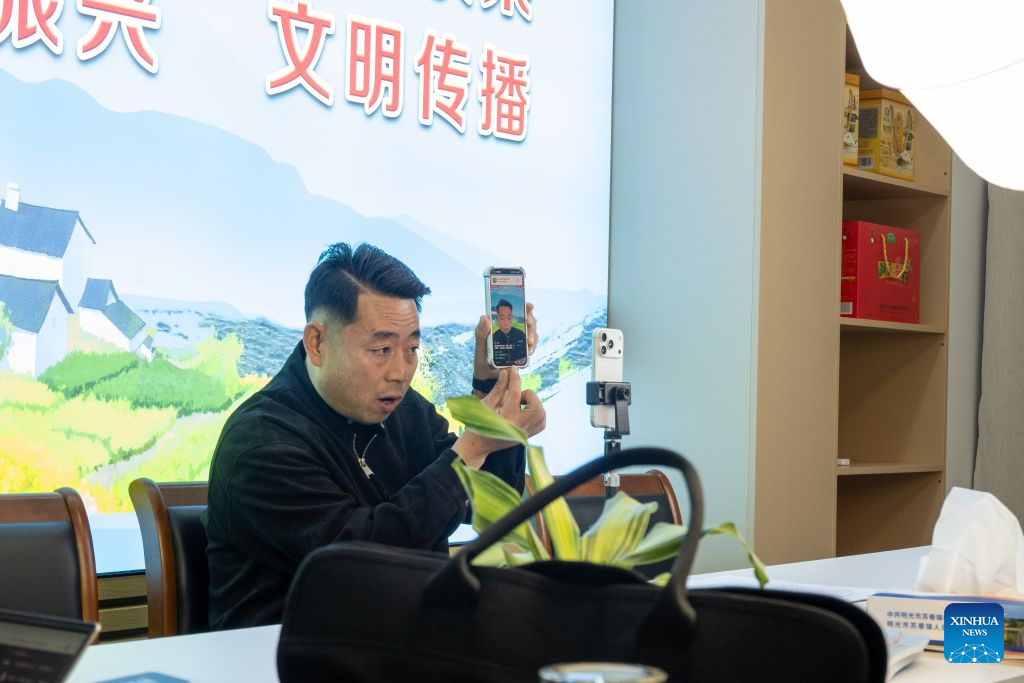
Ding Jun, deputy head of the general Party branch committee of Hehua Village, promotes products via livestreaming at the village in Mingguang City, east China's Anhui Province, Nov. 8, 2026. (Xinhua/Zhao Jinzheng)


