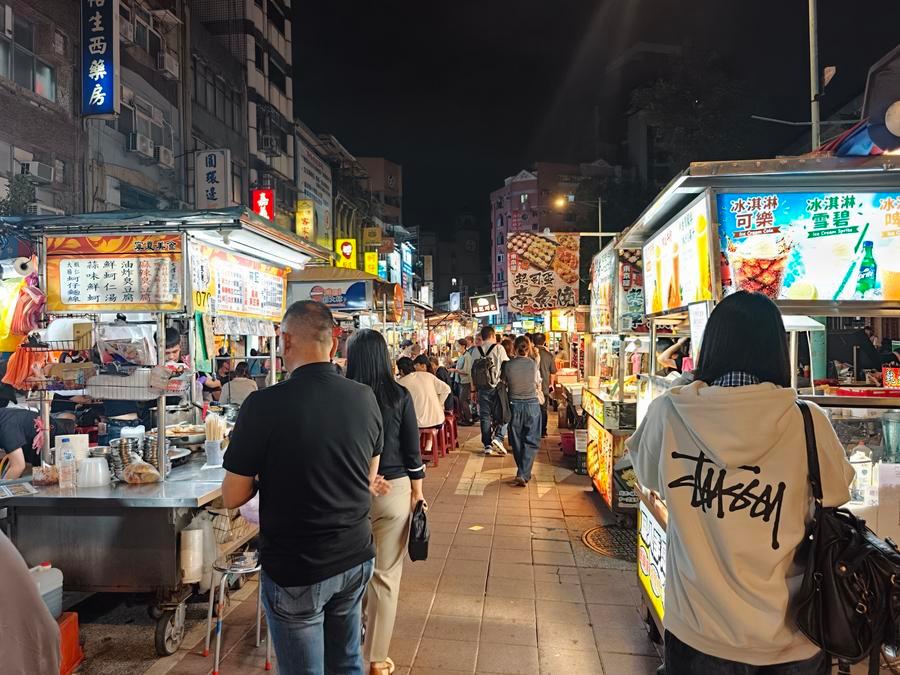
TAIPEI, Nov. 18 (Xinhua) -- By 4 p.m., traffic was still weaving along Ningxia Road in Taipei. Half an hour later, the street was closed to vehicles, barriers were put up, and food carts began rolling in. Before long, around 180 stalls and shops lined both sides of the road, transforming the thoroughfare into a bustling food street.
The air soon filled with the aromas of local favorites, from braised pork rice bowls and pig liver soup to sausages seasoned with local spices. Drawn by the enticing smells, diners began arriving in search of affordable delicacies.
Ningxia Night Market is among Taipei's best-known food markets. It ranked first on this year's list of the 10 most popular night markets in Taipei and New Taipei City, and was once a favorite destination for tourists from the Chinese mainland.
"We are now in our third generation of running this business," said a woman surnamed Tsai, who was busy stir-frying beef at her family's stall. She recalled that mainland visitors once queued up for dishes such as stir-fried beef, oyster omelettes and vermicelli soup.
"These days, we hardly see mainland tourists anymore. Of course, we hope they will come back," she said.
Across from the market's landmark sign, a vendor surnamed Chen, who sells braised snacks, said mainland visitors accounted for more than 30 percent of her customers seven or eight years ago. Many would eat at her stall before buying food to take away.
Chen moved to Taipei after marrying and relocating from Kinmen, an island just off the mainland coast near Xiamen. She said she still travels frequently to the mainland.
"Kinmen and Xiamen are separated by just a stretch of water. I often visit the mainland. We share close ties because our people and cultures are connected," she said.
Mainland tourists once accounted for about 20 percent of Ningxia Night Market's customers, said Lin Ding-guo, head of a Taiwan-wide trade association representing night market businesses.
With a shared language and similar food cultures, mainland visitors were particularly valuable customers, Lin said, noting that many returned to the same markets on successive trips.
Often described in Taiwan as a "penny economy" because of its affordable food, the night market sector is more than a popular dining attraction. It is also a vital source of income for hundreds of thousands of vendors and their families.
According to the association's latest figures, Taiwan has more than 150,000 night-market food stalls run by over 300,000 vendors.
The decline in mainland visitors has dealt a blow to the sector, as Taiwan's tourism industry has lost access to a major source of visitors amid growing obstacles to cross-Strait exchanges since the secessionist-minded Democratic Progressive Party (DPP) came to power in 2016.
A larger customer base would not only boost vendors' revenue but also allow them to spread fixed costs, including wages, stall rents and utility bills, across higher sales volumes, Lin said.
Increased purchasing volumes could also help lower ingredient costs, while suppliers of meat, seafood, soy sauce and other products would benefit from more orders, he added.
Several stalls at Ningxia Night Market were closed during the visit. Lin explained that some vendors who had accompanied him to the Ningxia Hui Autonomous Region in northwestern China for a food and cultural exchange had yet to return, with some extending their stays to explore the region.
The connection between the two places goes beyond their shared name. Ningxia Night Market takes its name from Ningxia Road, a roughly 300-meter street in central Taipei that was itself named after the region more than 3,000 km away.
Lin, a former head of the Ningxia Night Market Tourism Association, has spent years promoting exchanges between the two. Since 2013, he has helped organize joint marketing initiatives under the slogan "Taste Ningxia, Visit Ningxia," linking tourism attractions and food cultures in both places.
Having visited the mainland region six times, Lin speaks enthusiastically about its landscapes and local produce.
Goji berries and red dates from Ningxia are familiar to consumers in Taiwan's traditional Chinese medicine and food industries. Ingredients from the region are also used in medicinal soups sold at night markets, he said.
Ningxia's lamb is another specialty Lin particularly appreciates, although cross-Strait transportation challenges mean it is rarely available at Taipei's night markets.
Reflecting on cross-Strait exchanges, Lin said face-to-face contact was essential to building personal connections.
"Meeting in person makes a difference," he said.
With exchanges having dwindled in recent years, visits to Ningxia have increasingly become what he described as a "one-way journey" for him and some other Taiwan residents.
Lin said Taiwan's night markets had accumulated considerable experience in food services and business operations, while the mainland offered a vast consumer market and a wide variety of local products.
There was considerable room for cooperation in agricultural trade, catering and tourism promotion, he said.
For vendors at Ningxia Night Market, the hope that mainland tourists will return is about more than busier stalls and higher revenues. It also means steadier incomes and better prospects for the families whose livelihoods depend on the nightly trade.
Meanwhile, on mainland social media platforms, many users continue to reminisce about the food at Ningxia Night Market, expressing hopes of visiting Taiwan again and rediscovering the familiar flavors they remember. ■